It is time to keep your appointment with Unearthing Forgotten Horrors.
This week’s show falls on the May bank holiday so we will celebrate with a Beltaine special featuring music from Iron Maiden, Paul Giovanni, Jethro Tull, Inkubus Sukkubus, Dead Can Dance, English Heretic, Sharron Kraus and The Hare and the Moon among others. As usual it all goes down on a1radio.co.uk at 7pm UK time.
Unearthing Forgotten Horrors’ is an hour-long delve into the darker recesses of the musical underworld. A chance to immerse yourself in obscure horror soundtracks, dark drones, weird electronica, freaky folk, crazed kosmiche and some of the most abhorrent and twisted psychedelia ever committed to vinyl, CD or cassette.
This week’s Unearthing Forgotten Horrors features new music from Joseph Curwen, alongside classics from Power of Zeus, Bulbous Creation, Forest, Fabio Frizzi, Tudor Lodge and David Hess to name just a few. It all kicks off Monday evening at 7pm UK time on (A1Radio – Online, Anytime)
A1Radio – Online, AnytimeA1Radio is an Internet Radio station broadcasting from Peterborough in the UK. We broadcast 24/7 with live shows throughout the week, and you can interact with us o…
Unearthing Forgotten Horrors’ is an hour-long delve into the darker recesses of the musical underworld. A chance to immerse yourself in obscure horror soundtracks, dark drones, weird electronica, freaky folk, crazed kosmiche and some of the most abhorrent and twisted psychedelia ever committed to vinyl, CD or cassette.
Enter code APRSHIP50 at checkout and get free mail shipping (weight restrictions apply) or 50% off Ground shipping. Offer expires Friday, April 22nd at 11:59 PM. Don’t forget, coupon codes are CASE-SENSITIVE.
This offer is valid for all Folk Horror Revival related books, including the Cumbrian Cthulhu series.
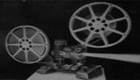
In the early 1970’s, so the story goes a group of young up and coming Portuguese script writers recruited from adverts in trade magazines and on university noticeboards were locked in a room together with a projector, an endless supply of coffee and cigarettes and a pile of books. The books were mainly short story collections of the weird and esoteric fiction variety whilst the projector showed episodes of American sci-fi/supernatural TV show The Twilight Zone in continuous rotation.
This inexperienced collective were charged with producing the first six episodes of what was hoped to be Portugal’s response to a current trend for surreal storytelling and macabre tales. Given the work that Spanish filmmaker Amando de Ossorio and Italians Jess Franco and Dario Argento were currently involved with it is easy to see why television executives thought there was an opening in the market for Portugal’s take on the genre. The dream was to create a weekly TV show much like The Twilight Zone but with European art house sensibilities that showed leanings towards the current trend for the more grisly macabre work of those three directors.
This claustrophobic setting and the darkly intense atmosphere of the continuously flickering projector led this band of writers to emerge almost two days later with the now fabled ‘O Campo Bazar’.
datauri file
datauri file1
datauri file2
datauri file3
datauri file4
Full of hope for this exciting project, filming began with alarming speed – but with scripts still being finished on set and the technical equipment in the hands of an equally inexperienced and amateurish crew the project seemed to be dying before it had even been fully born. The resulting pilot episode was critically panned and although it is cited to be Alfred Molina’s screen debut he now strongly refutes the fact claiming no involvement whatsoever in the doomed project
Critics were relentless in their damning of everything to do with this project from the sets and stories to the acting and directing. There was however one factor that caused such embarrassment that it is often cited as the last nail in the not very convincing coffin.
To affiliate this fledgling series to an already established genre and gain credibility, Vince Price had been employed to provide the voiceover introduction. It transpired that a staggeringly significant percentage of the overall budget had been spent on securing Price’s services – money that everyone agreed should have been spent on the program itself. What made this so embarrassing however was the fact that Vince Price’s pronunciation and overall delivery of the Portuguese introduction was so cringingly bad as to sound like a mocking stereotype. With no money left to find another actor of Price’s stature to rerecord the part, and with newspapers and radio programs daily mocking this particular aspect of the show, the station programmers decided to cut their losses and pull the plug.
datauri file5
datauri file6
datauri file7
datauri file8
datauri file9
‘O Campo Bazar’ would have disappeared without a trace – as was the TV Company’s wishes – had it not been for the release of the` (episodios de) O Campo Bazar’ e.p. Indeed there are no known surviving prints of the six episodes – of which only four ever saw the light of day – but the existence of this e.p. has ensured that the legacy of this doomed project is not forgotten. ` (episodios de) O Campo Bazar’ was a promotional gimmick marketed as `a sampler of instrumental works created especially for the programme’ and has since become an ultra-rare curio hiding out with the national collection of Hen’s Teeth.
Cover of the 1973 release `O Campo Bazar’
The original press release states that `the stunning full colour sleeve features O Campo Bazar in horrifically realistic costumes’. This is the only reference ever given to the performers who were – and still are – a mystery. Released in Portugal in 1973 on the Gravacoes Freeworld label this collection of sinister synth led soundscapes is long overdue a rerelease.
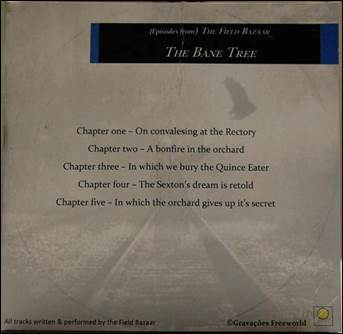
Several years later the cult status and mythos of the group/artist brought about the release of `The Bane Tree’– again on the Gravacoes Freeworld label. This vinyl version of `The Bane Tree’ is the only UK release for `O Campo Bazar’ there has been the. The artist(s) name had been translated into English – The Field Bazaar – and the` (episodes from)’, which was a clear indication of its TV series roots, had also been translated and kept. The name itself – `The Field Bazaar’ – comes from a short story by Sir Arthur Conan Doyle and was seemingly chosen to represent the writers own take on `The Twilight Zone’…..a mysterious place where the weird and wonderful coexist with the horrifying and the macabre.
The Bane Tree has the feel of being demos and unused tracks from the original recordings although the music is more acoustic and pastoral sounding with greater use having been made of sound effects. The performers remained unknown.
Front cover of the UK release `The Bane Tree’
Back cover. Note the full name translation for the title whereas credits list the group as just `the Field Bazaar’
Recently artwork for a previously unreleased and assumed lost (episodes from) The Field Bazaar album `A Tale of Witches, Woodland and half-remember melodies…’ was discovered in a box of old picture frames at a church jumble sale in Long Crendon, Buckinghamshire. In 2012 a ¼ inch tape also surfaced at a bankruptcy sale for a small recording studio in Bloomsbury which had been known for soundtrack and sound effect recordings. This acetate contained what is now believed to be tracks from the recording sessions for this lost album. So far a tweaked and updated `The Musgrave Ritual’ is the only track to have materialized from this lost album. The title again references Sir Arthur Conan Doyle and includes a reading of the ancient ritual from the Sherlock Holmes story of the same name.
Artwork for the recently discovered `lost’ album
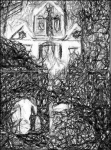
Also found alongside what is assumed to be the final approved artwork for the lost `A tale of Witches, Woodland and half-remembered melodies….’ was a scribbled early sketch for the album cover – possibly drawn up by one of the unknown, almost mythical members of the band/collective/composer who made up (episodes from) The Field Bazaar. A more recognizable sketch of the final composition shows the removal of the witch’s young companion for the image –possibly considered too sinister in its implications – and also the crucifix from the front of the building.
datauri file14
datauri file15
The Long Crendon sketches – Note the inclusion of the child and crucifix in the first sketch which has been omitted in the second more familiar image.
Unfortunately there are no signatures or notes on the reverse of either piece to hint at who the artist may have been or even who was operating in the studio under The Field Bazaar moniker at the time.
Several tracks recorded by (episodes from) The Field Bazaar have been rereleased in recent years thanks to the work of a small group of geekish fans who hunt down the original studio versions, strip them down, clean them up and remix them to form even the briefest of tunes into a coherent track. Their curation and conservation of the (episodes from) The Field Bazaar’s music is not only helping to save a forgotten gem but also to bring it to a wider audience.
(https://soundcloud.com/thefieldbazaar-1)
“Bury the dead deeply, water its grave with streaming eyes, and in spring-tide pluck a withered violet or some other sweet-scented blossom from the green sod” – ‘The Writings of Althea Swarthmore’ (Collected in ‘A Night On The Moor, and other tales of Dread‘), by R Murray Gilchrist.
I was inspired to write this post by Gilchrist’s line, which made me think how a symbolic knowledge adds depth and nuance to even simple statements. Gilchrist can be almost as dense in his writing as the fogs that settle on the Peak District settings of his horror fiction but a little knowledge of the symbols and thoughts he employs will help us navigate both his work and the work of many other artists.
“I would give you some violets, but they withered all when my father died”
(Hamlet: IV.v.181-183)
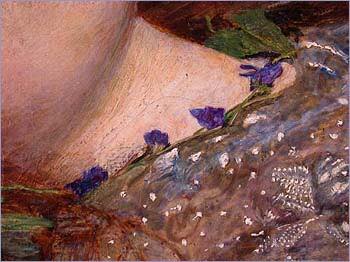
Violets are a symbol of constancy and faithfulness, but equally of untimely death in the young and melancholy. This leads the flower to be identified not only as a reminder of the natural cycle of life, death and rebirth but as a catalyst to transition; from maiden to wife, innocence to knowledge, life to death…
‘At The First Touch Of Winter, Summer Fades Away’, by Valentine Cameron Prinsep (1897).
Persephone was gathering violets when Pluto rose from the underworld, enamoured with the maiden, and drew her down into his shadowy domain. Her abduction caused great despair in her mother, Demeter, who neglected her duties as harvest goddess while searching vainly for her daughter (using, interestingly, the twin torches of Hecate to cast light into dark places). This neglect led to fruits withering on the branch, crops rotting in the field and starvation in the people of the Earth. Zeus, petitioned by the starving, commanded Pluto to release Persephone to her mother for two-thirds of the year, the summer-time of sowing and harvest. She would then return to assist her husband in judging the dead for the remaining third of the year, the winter-time of sorrow.
Many of the Persephone myths show her as an unwilling victim, abducted and forced into a relationship that takes on something of the Stockholm Syndrome. A handful, however, show Persephone as willingly taking on her role as arbiter of both Life and Death; she tempers her husband’s stern views but is also fully aware that the hope she gives the living is ultimately doomed.
“Violet! Sweet violet! Thine eyes are full of tears; Are they wet, even yet, with the thought of other years?” James Russell Lowell
(The title of this post is taken from ‘The Waves’, by Virginia Woolf, almost herself a modern Ophelia. Valentine Cameron Prinsep was Virginia Woolf’s maternal great-uncle).
The Corpse Roads draw closer …
Could the poets / photographers whom have had work accepted in the book and wish to have their biography and web-links included but have not already sent, please email the details to folkhorrorrevival@gmail.com no later than 5th April 2016 pleas. After this date it will no longer be possible to include in the book Thanks smile emoticon
Unearthing Forgotten Horrors’ is an hour-long delve into the darker recesses of the musical underworld. A chance to immerse yourself in obscure horror soundtracks, dark drones, weird electronica, freaky folk, crazed kosmiche and some of the most abhorrent and twisted psychedelia ever committed to vinyl, CD or cassette.
This week’s Unearthing Forgotten Horrors Radio Show goes out at 7pm UK time this evening Monday 21st March on (a1radio.co.uk) and features music from Belladonna and Bouquet, The Heartwood Institute, Gonga, Moss, Mark Koven, Black Mountain Transmitter, Broadcast and the Focus Group and The Rattles.














 Folk Horror Revival & Urban Wyrd Project ⨘