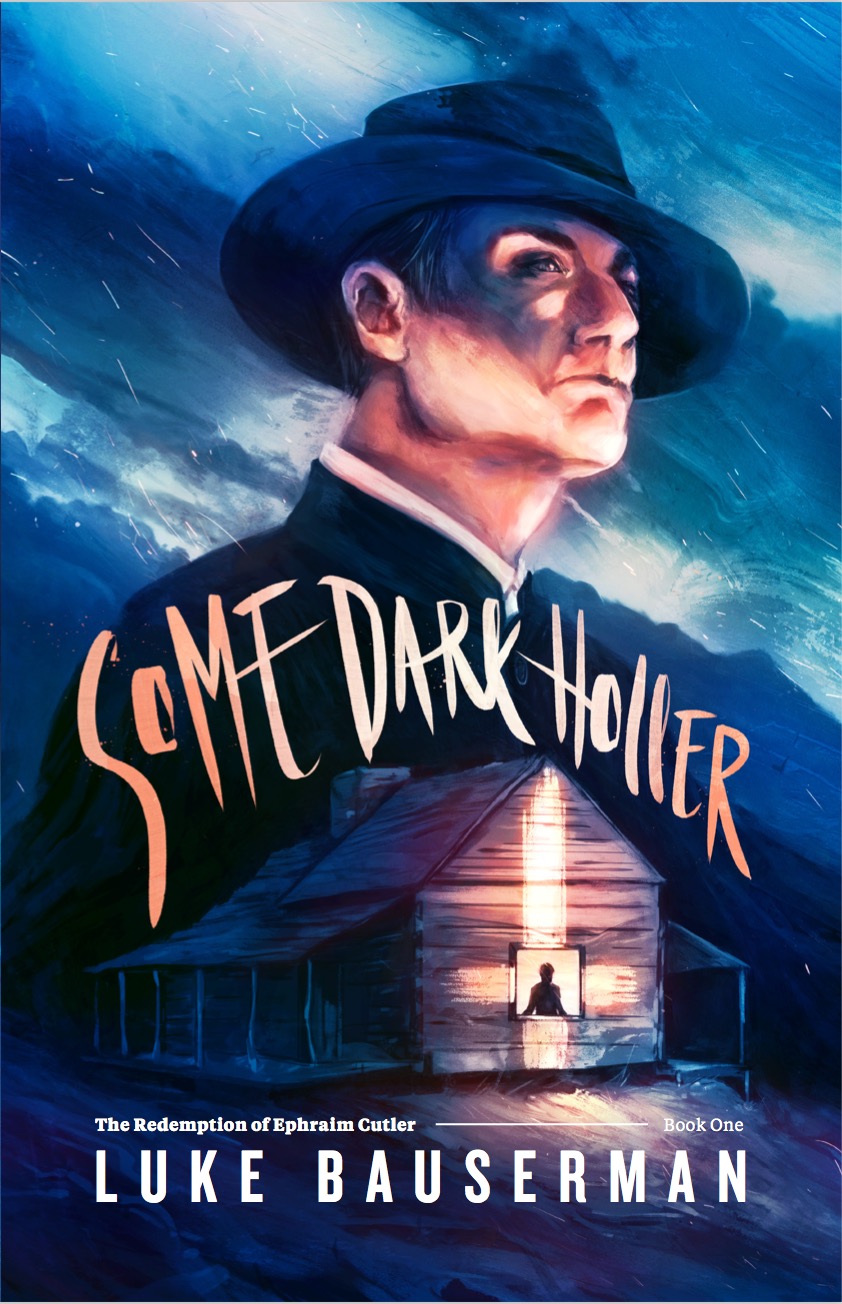
Book review: Some Dark Holler by Luke Bauserman

Ephraim Cutler is a 16 year boy, living in the backwoods of Appalachia in the aftermath of the American Civil War. His mother hasn’t been right since his father was killed in the war, killed by a Union bullet. She blackmails him into taking revenge by killing an innocent Yankee, so Ephraim, forced to choose between killing an innocent man or the death of his mother, commits murder. To try and redeem himself, he flees into the forest, but unknown to him, there’s more powerful and sinister forces than the local townsfolk after him, and soon he has a hellhound on his tail.

Some Dark Holler is richly evocative of it’s setting, drawing heavily on Appalachian folklore. I found this to be one of the most interesting aspects of the book, seeing how traditional European beliefs had changed when transplanted to America; the hellhound is a real dog reanimated by a black magic ritual rather than the spectral hound you may be more familiar with, there’s also a granny doctor, an old woman wise in the ways of healing, similar to the wise women of old. It certainly made me want to find out more about the folk tales the author drew on. Luckily, he’s produced a book on this very subject, which is available free from his website, which I’m looking forward to reading.

The plot itself moves along at a fair old gallop, with a fair few twists and turns. Although it’s the first book in a series, it’s satisfying as a stand alone book. I’ll certainly be picking up the sequel when it comes out this year.

More info at www.lukebauserman.com, where as well as his previously mentioned ebook, the author also blogs about local folklore, so well worth checking out.

Review by Scott Lyall

When Will The Wolves Howl ?” / ” Kiedy Wilki Zawyja ?” by Mzylkypop

This is an album which throbs, pulsates and yes, howls, with imaginative intensity.

When Will The Wolves Howl? provides the soundtrack of a chilling imagined future. England is surrounded by the Republics of Scotland and Wales. Albion is now ruled by a far right government that has come to power on a manifesto of forced repatriation. There is panic in the streets. Resistance is scattered as bands of immigrants, environmentalists and activists flee to the ‘wild space’ north of the border. Here they bind together as they hide away from the UKops who deploy witch drones to trap, imprison and deport them.

So far, so dystopian. However, while this album undoubtedly warps the dark currents of the present into the future in disturbing ways, this is a recording that delights the listener with the most vibrant musicianship. The soundscape is ever-changing, twisting and turning with dexterity in ways which bewitch and surprise. Analogue instrumentation, mostly drawn from Somerset’s collection of 1960s keyboards, effects and woodwind, is used throughout to provide distinctive and innovative instrumentation.

Three years in the making, When Will the Wolves Howl? is an album fermented to perfection. It is the brainchild of Michael Somerset, formerly of industrial funksters Clock DVA and Was (Not Was). Those Revivalists who were lucky enough to attend the FHR events at the British Museum in 2016 and the Hepworth Gallery, Wakefield in 2017, will most likely recall the striking performances delivered by Michael alongside The Consumptives and Mother Crow.

The album brings together a variety of other talented musicians on the Sheffield music scene, including I Monster, Simon Lewinski and several highly skilled drummers and bassists. Of particular note is the singer Sylwia Anna Drwal, whose vocal performance animates the whole recording with flair and sonic seduction. Given the subject of the album it is interesting to note that Sylvia is Polish and one might assume that the band’s name Mzylkypop is also of Eastern European derivation. However, this is not so as it is in fact a word which Somerset made up as a child to describe the ‘mischief maker’ in the Superman of DC Comics whose name was just a bunch of letters and symbols. As the strange uncertainties of 2018 begin to unfold, it is time that we allowed Mr Somerset and his fellow Mzylkypop mischief makers to entertain and protect us.

The howling has begun.

John Pilgrim

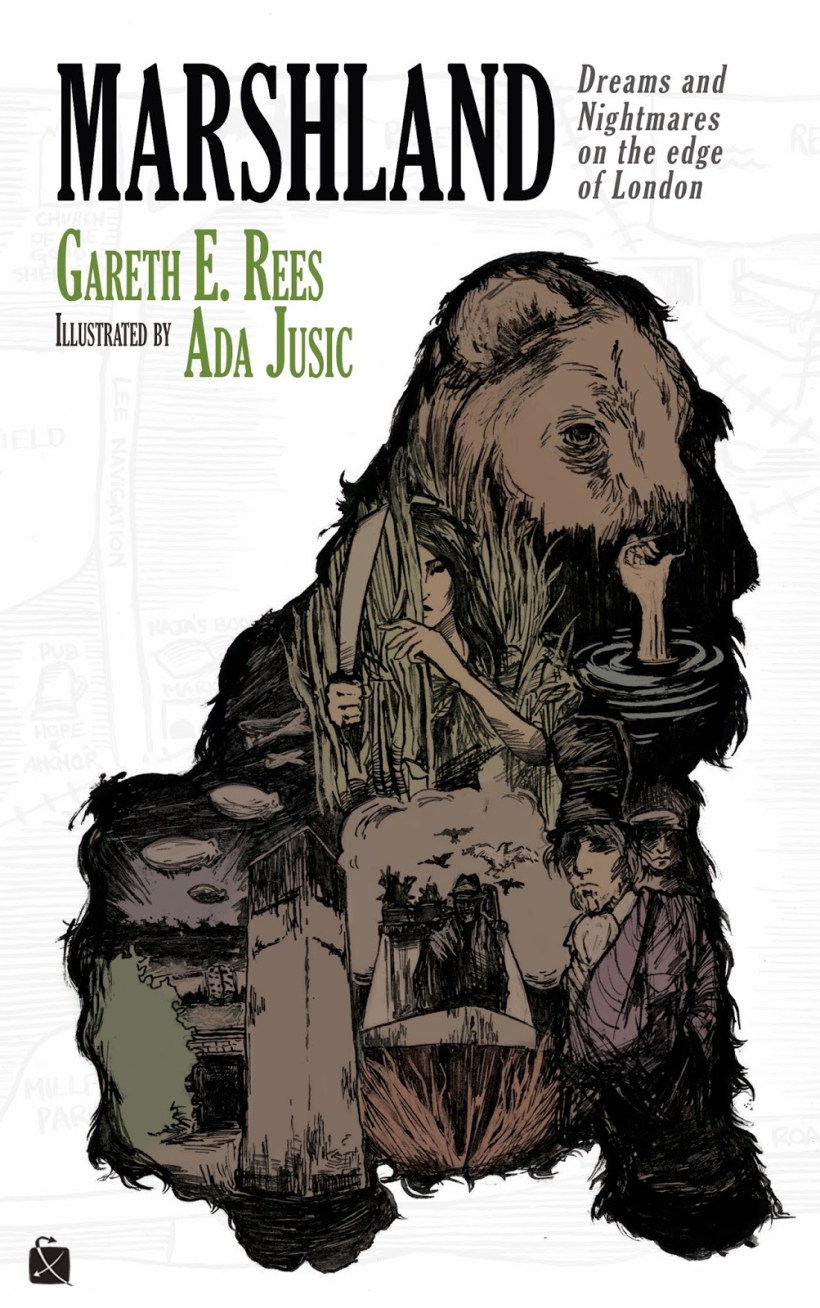
Review – Marshland – Nightmares and Dreams on the Edge of London Gareth E. Rees

Marshland_cvrv23_HiRes.jpg

A waking dream on the margin between two universes

Marshland – Nightmares and Dreams on the Edge of London

Gareth E. Rees

Illustrated by Ada Jusic

INFLUX press

“Cocker spaniel by his side, Rees wanders the marshes of Hackney, Leyton and Walthamstow, avoiding his family and the pressures of life. He discovers a lost world of Victorian filter plants, ancient grazing lands, dead toy factories and tidal rivers on the edgelands of a rapidly changing city. Ghosts are his friends. As strange tales of bears, crocodiles, magic narrowboats and apocalyptic tribes begin to manifest themselves, Rees embarks on a psychedelic journey across time and into the dark heart of London. It soon becomes clear that the very existence of this unique landscape is at threat. For on all sides of the marshland, the developers are closing in… Marshland is a deep map of the East London marshes, a blend of local history, folklore and weird fiction, where nothing is quite as it seems.” (Taken from the blurb.)

It is hard to write a considered review of a book that has affected one emotionally. This book is inspiring, emotive and eye-opening.

I have never been to Hackney. I fear London. There is a side of me that despises it. This is the seat of our utterly disappointing government, the home of evil bankers, vacuous celebrities and relentless musical theatre. London decides what to watch, what to visit, what is best and fashionable to wear, what to listen to, to read, to eat. It is faceless and monstrous, the twisted soul of our country.

I initially approached this book with some trepidation, did I want to spend days trawling through a text that explored an area of this city? After exploring the blurb and the fantastic quote pulled from its recesses:

“I had become a bit part in the dengue-fevered fantasy of a sick city.”

I figured that the writer could be singing from the same hymn-sheet. In many ways his book reveals an attitude far more complex than that. Whilst he despairs at the encroaching development of London into the edges of the Marshland in Hackney it is also clear that were it not for earlier developments such as the railway it would not exist. Significantly it is the meeting of these two worlds – this island of nature and the bizarre mix of architecture and industry – that creates a synergy. A little universe in which the strange will occur. A world in which the mundane and the surreal collide. This little world sticks its middle finger up at the city with such defiance that it crackles with an other-worldly energy.

“Wherever you’ve got a margin between two types of culture and two types of landscape you often get a deeper awareness of the supernatural and the spiritual.” – Revd. Tony Redman – (taken from M.R.James: Ghost Writer – BBC)

It is this margin that Gareth Rees explores. Like a 21st Century Kay Harker, he explores a world in which the lines between imagination and reality are continually blurred. In Masefield’s “The Midnight Folk” we constantly question whether Kay is dreaming or awake and the sensation is similar here. By placing the real; the architecture, news reports and stringent historical research, alongside the unreal, we are plunged into a vortex of monsters, bears, time-slips, shamen and hallucination.

The book explores the geographic reality of the Hackney Marshes, but overlaying this in soft swirls of mystical graffiti are utterly compelling tales inspired by or pulled from Mr Rees’ study of the area. It appears that his study is a mix of hard graft and rambling through the Marshes with his dog Hendrix.

Rees introduces us to a man who transforms into a bear, two unfortunate time-travellers and an unhappy couple who find themselves possessed and changing into the occupants of a demolished factory. We meet the occupants of a barge from London’s netherworld, explore the legacy of the Olympic Village whilst visiting a mystical peddler in contraband antique books. This scratches the surface and I would urge you to seek out this book to discover more.

What strikes me about this book is how it has opened my eyes to my own town. I live in Reading which like many urban sprawls contains a weird mix of old and new. It was on finishing the final chapter that I took my children out for a walk. We have been to the nature reserve in Reading but on our way there we decided to try a different route and found ourselves on an old railway line. This ran high above the water meadows. On one side the beauty of the floods were framed by pink-grey tower blocks, while on the other streams and rivers snaked through swathes of green before the drab majesty of the town dump in the distance. We discovered:

dumped mattresses, ceiling fans and wheelbarrows vomited out of the backs of broken garden fences

the remnants of an old fire on the old railway bridge, made from its tumbling bricks

a lake of glass (my son’s words)

two rusted metal fences that framed the path creating “a gate to Narnia” (my daughter’s words)

It was into this margin that a deer ran across our path.

We were in the town yet not in the town.

We were in the country yet not in the country.

I had discovered the margin between worlds.

I hadn’t looked for it before.

Chris Lambert
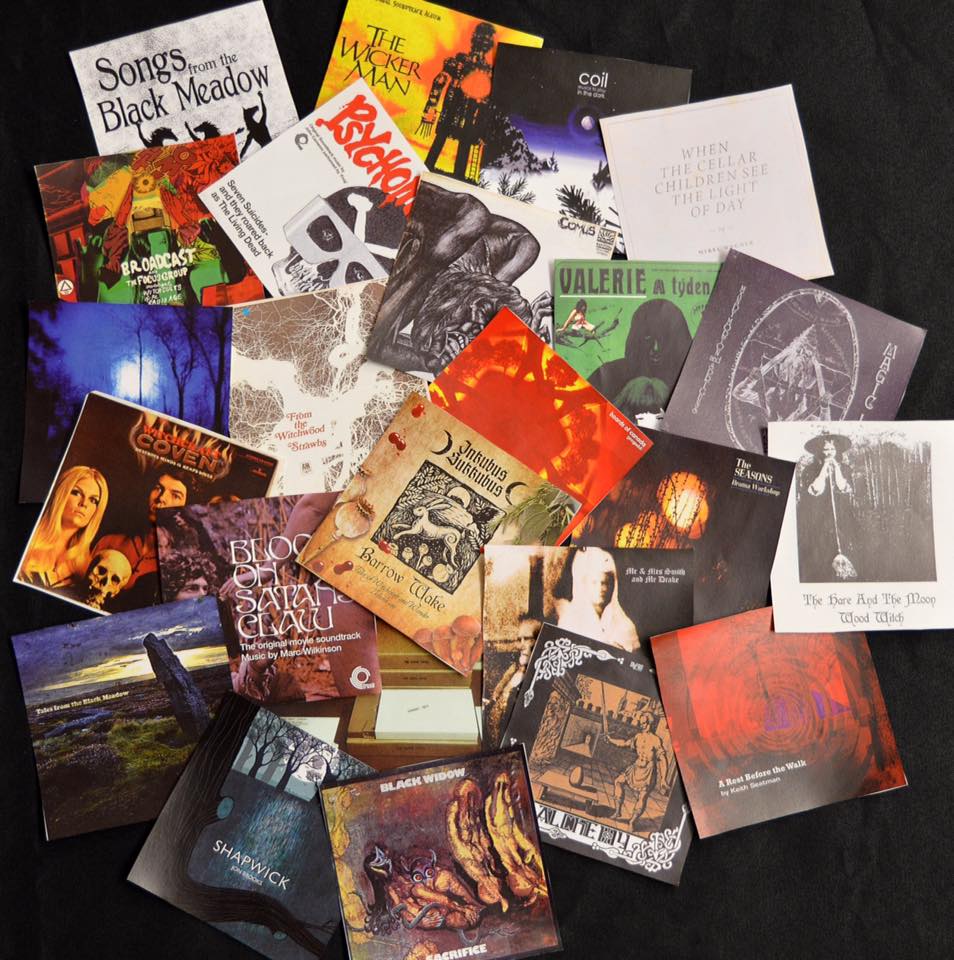
Folk Horror Revival Young Artist of The Month

The Folk Horror Revival Young Artist of The Month is an award for children under 12 years old. Many of our group members come from an arts background and so we’d like to encourage and inspire the next generation too.
We don’t mind if the work is based on other artists work as we understand that all artists learn from copying, plus its great to see the inspiration behind the work. Drawings, paintings or any other medium are welcome. The drawings must be inspired by either folk horror, folk tales (including fairy tales), folk traditions, ghost stories, magic, myth, legend or even the seasons.

Every month we will be giving away a copy of Sharron Krauss’ book Hares in The Moonlight(published by Wyrd Harvest Press) to our favourite artist. For more information about this great book, please follow the following link:

http://www.lulu.com/shop/sharron-kraus/hares-in-the-moonlight/paperback/product-23432343.html

The winner will be announced during the last week of every month and will be judged by Folk Horror Revival administrators John Chadwick and Chris Lambert.

Please don’t worry if the entry is submitted on the last few days of the month as all entries will roll into the following month if they arrive after our decision making.

Submit all entries digitally, as a .jpg file preferably, to fhryoungartistawards.

Best of luck!

Book Review: American Ghost by Paul Guernsey

American Ghost by Paul Guernsey

Thumb Rivera is a small time drug dealer who makes the mistake of trying to get in league with the local biker gang, which ends badly for him. American Ghost follows his efforts to solve his own murder from the afterlife. Paul Guernsey’s third novel is basically a supernatural detective story with a heavy dose of dark Americana, featuring backwoods biker club houses, trailer meth labs and abandoned murder houses.

The story is structured in an interesting fashion, with Thumb’s spirit travelling through time and space, with no knowledge of how the afterlife works, this being revealed slowly to him via other trapped spirits he meets on the way, including the ghost of a man who died in a road accident, who now lingers in the spot he died. By and large Thumb has to observe how life moves on without him, but learns to communicate with two living people, a hapless ghost hunter and a pig farmer who is also a frustrated novelist, who provide a conduit to the land of the living.

The story is well constructed and keeps you engaged as the plot unfolds, as Thumb comes closer to discovering who killed him and why. The afterlife Guernsey constructs is fascinating, with it’s own internal logical and laws.

I’m not usually much of a fan of crime fiction, but this supernatural twist on the murder mystery made it much more enjoyable. If you fancy a haunting (in both senses of the word) mystery novel, then this is for you.

Paul Guernsey also edits The Ghost Story, which has much of interest to revivalists.

review by Scott Lyall

Review – The Stone Tapes – Avebury

Was this sent to me in the post or did I discover it in a cavity between the two damp granite walls of a forgotten stately home? Did I, driven by the impulse of a voice within me, frantically tear it from the mud and sod of a field deep in the heart of the West Country? Was I surrounded by ancient stones that seemed to sing out to me when touched or gently caressed? I am uncertain. Is this a genuine recording created using up to date digital technology or are they the sounds captured in the lusum magnetite of the dank walls, playing back when the atmospheric conditions are just right? There is an uncertainty here. This uncertainty is frightening and this fear is rich and sublime.

I listen again to ensure that it is not simply my own imagination or a half forgotten dream, but there it is; the voice in the static, the seemingly innocuous information about Avebury, the snatches of phone conversation with one voice strangely distorted. Is it deliberate? I don’t know. But I am unsettled, I am frightened and this fear is alive and immediate. But I welcome this and I stroll towards it all, arms wide.

In West Kennet the ritual has begun and my head spins, half formed voices dance out at me from within the ether, the whirling electronic dervish excites, inviting me to join the dance but I must not. I must resist. I take shelter in the lychgate, the rain pummelling down all around me and for a moment all is calm.

The rain stops and I venture towards the Owl and Druid Stone. I know I should not touch it but my hand is pulled forwards. The voices and tones thrust into me like lightning into bark. I am among the petrosomatoglyphs, the damp and the drip, the indistinct. The sound grows, it ululates through me as I spin, the light between the stones scratching at my retinas with every pass. My feet leave the ground, stray ends of grass tickling at my bare feet as I rise a narrow herepath before me, made of silver and granite. On closer inspection the path is festooned with tiny carvings, myriads of spirals, symbols, laughing mouths. The mouths move and speak and sing and question and grin. I am lost. I fall.

Reality seeps in. A voice clear and distinct on the end of a crackling line gives thanks. But, it flits away and deeper voices and drifting tones chant around me.

A cry. Someone is lost. But how can you be lost if you stand in one place? How can you be lost if you have not moved from the centre of a field? The sound builds, a low hum, growing. Reassuring dots and bleeps try to break through, but something is crawling in the dark. Something is in the way. I cannot move.

I am overtaken. I should not have listened to the Stone Tapes for madness seeps through. Sometimes we look to deep into the dark, sometimes we travel too far.

I have removed the headphones but Avebury is still within me. The sounds among the stones are sounds among the synapses. The stones are seen when I shut my eyes, when I blink, when the sunlight scrapes across the iris, the stones creep through into the dark.

Do not listen.

Do not listen.

Do not lis

Do not

Do

Sink. Tread. Spin.

Let it in. Let the stones in. Let them all in.

Chris Lambert – January 2018

REVIEW – Rowan Amber Mill `Harvest The Ears’

The Rowan Amber Mill
Harvest The Ears
(https://rowanambermill.bandcamp.com/album/harvest-the-ears)

The Rowan Amber Mill have been quietly but steadily pursuing their own eerie ruralism and arcane take on psychedelia since 2008’s ‘Folk Devils and Moral Panics’, notably releasing the ‘Book of the Lost’ project with fellow traveller of these roads, Emily Jones, in 2014. This latter recording was an homage to such films as The Wicker Man, Witchfinder General, Blood On Satan’s Claw and Psychomania and ably constructed a soundtrack for an imaginary composite movie, replete with accompanying lobby cards and a suitable mythos. Aficionados of both modern day acid folk troubadours such as Sproatly Smith and Sharron Kraus as well as the haunted electronics of the Ghost Box label are strongly encouraged to wander not only the dark woods of ‘Harvest The Ears’, but also those of the Amber Mill’s back catalogue (a twisted folk version of Gary Numan’s ‘Are Friends Electric’ is one suggested highlight).

The Rowan Amber Mill’s most recent offering is a summing up and compilation of sorts, gathering new, unreleased and remastered songs together under the appropriate banner ‘Cuts From The Folk Horror Archive Vol 1’.

The extended title track of the afore mentioned ‘Book Of The Lost’ opens the album, a Vincent Price styled narrator and a shimmering wash of harpsichord and vintage synth immediately creating an effective atmosphere somewhere between John Barry and Paul Ferris’ s essential score for Witchfinder General. The full length ‘The Book of The Lost’ is a master work and this lengthier version of a track cut from its parent album is no less essential. The melancholic beauty of ‘Separations’ follows, part electronic madrigal and part woodwind imbued lament; this is truly a folk song of the forest. Next, ‘The Witch Twists The Pins’ is a sinister nursery rhyme, echoed vocals framed by the darkest of psych folk to conjure an evocative and magical musical incantation. A highlight of an album filled with many such strong points, this would be worth the cost of admission alone but there is much, much more. ‘Face Of Flowers (Woodcut)’, from the genius ‘Heartwood’ album, utilises harmonised vocals, insistent acoustic guitar and spectral strings in manner that surely has Paul Giovanni nodding his agreement from above. ‘A Hunting’ glistens into being from a few stately harp notes, growing and layering with both analogue synths and waves of choral voices, creating a welcome sense of unease and beguiling nostalgia. This then segues into ‘Pit Of Horror’, a swirling and dramatic instrumental that surely would have been gracing the soundtrack to a 1970’s children’s TV show of a more pagan bent, such as ‘Children Of The Stones’ or ‘The Owl Service’, had it been of that age. ‘The Witch Twists The Pins’ agreeably returns in instrumental form, revealing hitherto hidden detail, until it leads into the final track ‘The Call Of The Black Meadow 1, 2 and 3 (Backing and FX)’. A track previously used on The Rowan Amber Mill’s promotional video for the ‘Songs From The Black Meadow’ album (inspired by Chris Lambert’s book ‘Tales From The Black Meadow’), this is a haunted house of a song, stripped back to effects and sounds redolent of Daphne Oram or The BBC Radiophonic Workshop with solar winds and ghostly electronics whispering in and out of focus to powerful and disturbing effect. And then it is over and the listener is left with an enduring and pleasant feeling of disquiet, appropriate given the folk horror nature of these compositions.

This is an album then that belies its compilation or assorted collection status; it genuinely works as a piece in its own right and sits comfortably and confidently alongside the other Rowan Amber Mill recordings. Highly recommended to those who are keen on investigating the musical side of the folk horror revival, this is indeed a rich harvest for the ears. Time to gather the corn.

Grey Malkin January 2018.

Folk Horror Revival in Shindig! magazine 74

Check out the current issue 74 of Shindig! magazine for a feature by Adam Scovell on the music of the classic folk horror films Witchfinder General and The Blood on Satan’s Claw. The article is an abriged extract from an essay to be published in the next upcoming book from FHR/ Wyrd Harvest Press, Harvest Hymns covering the music of folk horror.

The book will be a mixture of articles, album reviews and interviews from the likes of Maddy Prior, John Cameron, Jim Jupp, Jonny Trunk, Sharon Kraus, Jim Moon, Rennie Sparks, Drew Mullholland and many more, and we hope to have it available early in the New Year. As a teaser here’s all the albums reviewed in the book:

Shindig! magazine, devoted to "the most far-out ’60s sounds through country-rock and folk to soul and electronic experimentation", has long championed folk horror worthy music and related films and TV. You’ll have to hurry to pick up a copy of this issue in the shops though, the next issue is going to be available on the 4th of January.

Shindig! subscriptions and back issues if you miss this one are available here:

http://www.silverbackpublishing.rocks/shop/


Adam Scovell is author of the book ‘Folk Horror: Hours Dreadful and Things Strange’, and his blog Celluloid Wicker Man can be read here:

https://celluloidwickerman.com/


The Wyrd Kalendar – The December Mix

It is December.

The bells are ringing and the Old Father is coming. Find out what happens to those who displease the Old Father in extracts from the final tale of the Wyrd Kalendar entitled "Santa Claus and the Witch".

You can buy the book at – http://www.lulu.com/shop/http://www.lulu.com/shop/chris-lambert/wyrd-kalendar/paperback/product-23371751.html – All profits go to Wildlife Trusts.

As you wander through the snow and ice of the Kalendar Heath you will hear Simon and Garfunkel, Sufjan Stevens, Marc Almond, Iron and the Wine, Broadcast, Bjork, Bert Jansch, Anne Briggs, Ryuichi Sakamoto, Zen, The Divine Comedy, CAN, Kate Bush, The Ukulele Orchestra of Great Britain, Sea of Bees, Sean Wesche, Lindisfarne, Jethro Tull, Mazzy Star, The Rolling Stones, Spinal Tap, Jimmy Smith, The Free Design, David Cain, Neal Casan, Vashti Bunyan, The Who, The Fall, Scott Walker, Nick Cave and the Bad Seeds, The Grateful Dead, David Gray and Victor Hely-Hutchinson as well as extracts from Winter Landscape by Laurie Lee.

This is the last Wyrd Kalendar mix of the year. You can hear all the others for every month of the year by visiting – https://www.mixcloud.com/Wyrd_Kalendar

There will be four seasonal mixes next year. Look out for the Spring mix on March 21st.

Happy Christmas!

“A Persistence of Geraniums” by John Linwood Grant.

Please do not be fooled by the slimness of this volume, these are tales to charm, chill, intrigue and entertain.

The collection opens two differing ghost stories. Firstly the eponymous "A Persistence of Geraniums". A wonderfully humorous ghost story with a twist. Full of witty one line descriptions which capture the nature of the characters with a cutting perfection. Following this comes "His Heart Shall Speak No More" a darker, more serious tale in the vein of traditional ghost stories. Exploring the well loved theme that some things which are found would be much better not found at all and having all of the required shivers one would expect of a tale of this kind.

It then moves on to a series of stories concerning Edwin Dry, The Deptford Assassin. No ordinary assassin in any way, shape or form. By turns he shows a social conscience, a chilling coldness and lack of emotion and a humour entirely his own. From impersonating an asylum inmate, to shrugging off a demonic possession, nothing it seems can shake his steady nerve and calm demeanor. An extremely intriguing character that I would be more than happy to read more of.

The closing story is an alternative view of Thomas Carnacki, which I will say little about, other than it shows the great Occult Detective in a very different light. Definite food for thought.

A thoroughly enjoyable read, I would be hard pushed to chose a favourite from these entertaining tales. What stands out throughout is John Linwood Grant’s skill of description and humour. With a minimum of words he makes these characters alive. A passing mention of one item of clothing or a small but telling personality trait and somehow their essence is captured. Tales with dark edges and at times a dark humour to match.

I only have two complaints concerning this book,

1. There was a distinct lack of geraniums.
2. It really wasn’t long enough.

Reading it has left me with the desire to read more of the back catalogue of short stories available and to hope that more will be forthcoming!

To say a little about the author, John Linwood Grant frequently entertains the members of the Folk Horror Revival group with his excellently funny St Botolph’s Parish Newsletters. Those of us lucky enough to be on his Facebook friends list get extra snippets from St Botolphs which are often some of the funniest things I find in my newfeed. John is also part of the editorial team behind the Occult Detective Quarterly magazine and his short stories have appeared in numerous publications. More from John can be found on his Greydogtales blog. He also likes lurchers, a lot.

(http://greydogtales.com/blog/)