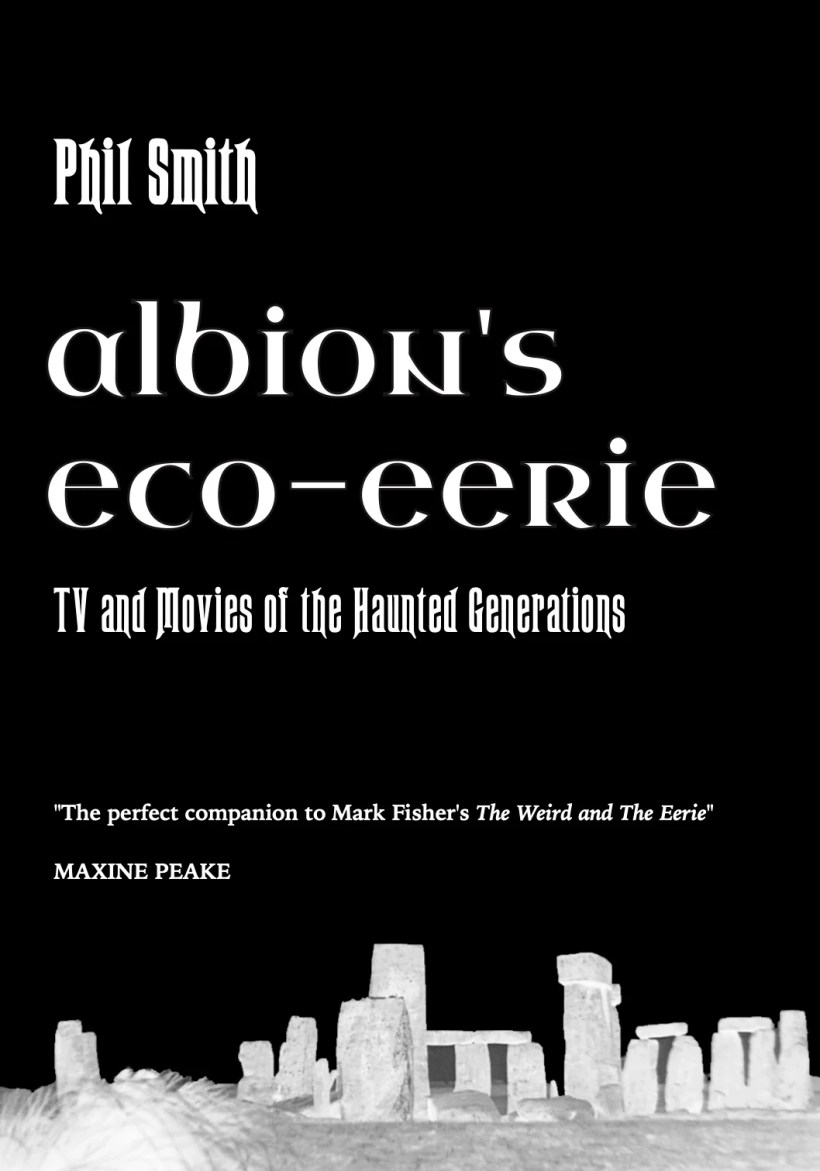

In Albion’s Eco-Eerie, author and professor, Phil Smith seeks an alternative reading of TV and Movies of the Haunted Generations suggesting looking at the media in terms of ‘unhuman characters, the materials and the edgeland spaces’. He suggests the term ‘hobgoblinology’ as a name for his contemplation of the subject matter, but I question whether that is necessary as the ‘Eco-eerie’ term he uses in the book title does a much better job of specifically conveying the centre of attention. If the use of a term helps the writer unlock what they want to say in the book, then it’s a useful tool, but going forward I don’t know if there is a need for any further terminology within the gamut of topics. I enjoyed reading Smith just talk about his selected subjects more than about the terminology and application of it, which I felt disrupted the flow a little. I have personally discovered with labels that they have a limited purpose – they only need to point in a direction rather than map a territory down to the millimetre. Sometimes too much definition risks stifling and suffocating further creativity in the crib, whilst a net cast too widely can serve no real purpose. Further labelling may be best served to supermarket shelves and the toes of mortuary corpses. I fully understand that as wider interest in the sub-genres/modes have grown that the terms ‘Folk Horror’ and ‘Hauntology’ may carry some baggage or alternatively are limiting but I don’t feel like the remedy for that is more terminology. That said, for the purpose of this book the term ‘Eco-eerie’ alone is ideal.
Smith’s lens upon the estrangement between humankind and nature when looking at specific examples is an intriguing vantage point to take. Smith adds an s to the end of Bob Fischer’s term ‘Haunted Generation’ to take us back before Generation X’s particularly spectre-ridden childhoods (a demographic that also seems particularly attuned to Burns’ predilection for a nostalgia that is part warm and fuzzy and part traumatised by monsters).
Smith’s book, as the name suggests, mainly concentrates its attention on British examples (some creations from other countries are discussed at times in comparison) and again there’s a nice range of choices including The Company of Wolves, Oh Lucky Man!, Whistle and I’ll Come to You and the work of the late Nigel Kneale (whom is currently enjoying a long renaissance of interest) is covered well particularly regarding one of his lesser-discussed creations The Quatermass Xperiment. One of the strongest sections in the book for me talks about the strange 1975 children’s television series The Changes. This curious show is possibly the epitome of Albion’s Eco-eerie, though I must admit that whilst I enjoyed watching that programme I was never as much a fan of its conclusion and its explanation as I was of what came before in earlier episodes.
Albion’s Eco-eerie is a slim book but there is a lot packed within its covers and I would recommend it as a book for those with an existing interest in the fields who want to look at the subject matter from a different and intriguing vantage point, and as a reference book for students and film-TV critics/writers rather than a first-stop introduction to the subjects covered.
Films and TV shows discussed:
Night of the Demon
The Maze
The Company of Wolves
The Quatermass Xperiment
Quatermass 2
The Strange World of Planet X
Fireball XL5: ‘Plant Man from Space’
Quatermass and the Pit
O Lucky Man!
The Changes
Children of the Stones
Whistle and I’ll Come to You
A Warning to the Curious
The Lovecraft Investigations (podcast)
Hellraiser and Hellbound: Hellraiser II
The Girl with All the Gifts
To purchase visit HERE
 Folk Horror Revival & Urban Wyrd Project ⨘