Phil and Layla from Hawthonn have just released a critically acclaimed album ‘Red Goddess: Of this Men Shall Know Nothing’ on Ba Da Bing records. They will also be appearing at our Folk Horror Revival event, Swansongs which takes place in York on May 12th at the Black Swan. John Pilgrim caught up with Phil and Layla for a chat about the new album, their influences and what we can expect from the upcoming gig.
Your new album is Red Goddess: Of this Men Shall Know Nothing. Who is the Red Goddess and what is it that men shall know nothing of? What clues does the album provide in these respects?
Phil: For a long time the new album didn’t really have a title. We had a lot of themes that we touched on: mugwort (‘In Mighty Revelation’), menstruation (‘Lady of the Flood’), hysteria (‘Eden’), the post-mortem exploitation of women’s bodies (‘Misandrist’), and dream… all things which I suppose could be considered as relating to the feminine experience. Originally I’d given the album the working title Flood, but I don’t think either of us were 100% happy with that…
Layla: We had been reading several books around the time we were working on the album, particularly Penelope Shuttle and Peter Redgrove’s The Wise Wound, which had a lot of invaluable knowledge on the sacred feminine and many jumping off points for inspiration, and also Peter Grey’s The Red Goddess, which explores his vision of Babalon: the Scarlet Woman, or Mother of Abominations – a goddess found in Thelemic mysticism. The idea that she represents earth and sexual impulse made her a fitting matron deity for this set of recordings.
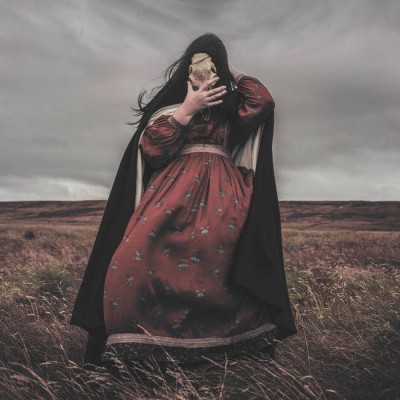
Phil had also found a painting by Max Ernst called Of This Men Shall Know Nothing, which in the early stages of designing the album cover he had wanted to recreate in tableaux. The final cover photo by Narikka contained some coincidental resonances to the Ernst image, and the title of the painting seemed to echo concepts within the album of feminine wildness, and the perceived unknowableness of the female nature.
Phil: The Ernst picture has also been interpreted as depicting sexual alchemy, which also ties in with much of Peter Grey’s writing on Babalon and the goddess’ connection to sexual magic and the three ‘Fs’: f(e)asting, flagellation and fucking!
Red Goddess has already been critically acclaimed. Ben Chasny, of Six Organs of Admittance, had this to say:
“Hawthonn is the real deal. Equally adept at transcribing crow calls into musical scales as they are at creating horizon melting atmospheres, Red Goddess raises the bar for musicians interested in composing straight from the creative imagination. For fans of Jocelyn Godwin, John Dee and Folk Horror as much as the darker spectrum of British music, this is a record of staggering breadth.”
Following on from this, here, can you say something on how you went about composing Red Goddess and the role of the creative imagination in this project? How did the experience develop your theory and practise of the creative process more generally?
Phil: I think imagination and creativity are inextricably linked. Many of our favourite artists and poets place great emphasis on imagination, reverie and sudden illumination. Of course, that doesn’t mean there’s not a lot of hard work to do in bringing these visions to fruition, but it is the imaginative aspects that dominate their experience and make the whole enterprise worthwhile. There are often equal amounts of technique and imaginative work going on in a piece – and, as in poetry, we often try to bring disparate symbols together into a whole. Layla’s work on ‘In Mighty Revelation’ really worked well in this respect: she brought together sounds recorded at an abandoned cooling tower with a recording of Rin’dzin Pamo’s thighbone trumpet blasts (- using an instrument anointed with her menstrual blood -), which evokes a very interesting sonic atmosphere and attendant mental imagery: a decaying post-industrial temple, open to the stars (- as we recently discovered were the ancient Indian temples of the cult of the Yoginis, female tantric deities -), and the sort of space where edgeland herbs blossom: in particular mugwort, which rather became our ‘vegetable ally’ for this album (our previous collaborations having explored hawthorn and yew!). Conjuring mental spaces to accompany the sound – and continuing to explore them through the ongoing process of producing the music – is a very important part of our practice, but only one amongst a whole other lot of imaginative and creative techniques we use!
Layla: Dreams, for example, have been integral to the creative process for Hawthonn from the start and continue to be so. The latest track we’ve been working on is conceived around a dream I had recently that I was reading a grimoire of Andrew Chumbley’s, whilst a portrait of him next to me began to shapeshift into a demon. The dream sound/landscape was incredibly vivid and evoking those sounds, feelings and thoughts again has made it a compelling project on both a creative and imaginative level.
The cover image for the album is powerfully striking. How did this come about? What was the location and what was its significance to you?
Layla: The cover image came about due to a set of lucky coincidences/syncronicities, I had followed a photographer, Aki Pitkänen, alias Narikka, on Tumblr after a friend of mine posted a pagan/magic themed set of his. I thought his work was exceptional, so showed it to Phil.
Phil looked him up on Facebook and that same day Aki had posted to say he was looking for collaborators/models to work with in our home town of Leeds the following month. We got in touch and found we had a lot of shared interests, and agreed to take him up on Ilkley moor as apparently they have no moors in his home country of Finland and he’d always wanted to shoot on one!
A friend very kindly drove us all up to Whetstone Gate, and as I still didn’t really know what Aki wanted as a backdrop I had planned a walking route to take him to various antiquities that held personal significance to us… but ultimately Aki just wanted “bleak” as the backdrop so most of the photos he took of us are from a particularly desolate spot near the Badger stone, overlooking a huge barrow that most people don’t even know is there.
We had a few hours of larking around with skulls before the proper Yorkshire weather hit us, and then I was extremely glad to be wearing a thick wool cloak! He sent us that shot almost immediately when we got home and we knew right away that one of them was the cover, which we had been stuck on for a couple of months.
Both of us have a long love and personal connection with Ilkley moor so it seems doubly fitting that the cover was shot there – Phil recorded some of his earlier music as Xenis Emputae Travelling Band on the moor and we have spent many hours wandering there together. It’s especially wonderful in the mist, when the edges of the real world are completely erased and all you can see are the soft curves of land in front of you. It’s a beautiful, liminal landscape that can become quite frightening after dark!
As a duo of ‘Mugwort-smoking surburban witches’ in what ways do you seek to connect with the ‘old ways’ and the hidden currents of Old Albion ?
Layla: I think we both have quite vivid, mystic connections with landscape. Our relationship with the world we inhabit both on a physical and imaginal level is essential to both our personal practices and our music. We don’t try and claim any tradition. Although Traditional Witchcraft has been a source of inspiration at times, we are more interested in the poetic relevance of the landscape and it’s past inhabitants: a palimpsest of activity and meaning, which we unearth and interpret in our own way. The place where we live is rich in Romano-Celtic history so we have made dedication to, and drawn inspiration from, an Iron age shrine in the woods and a sacred river that flows nearby. The two deities associated with them – Cocidius and Verbeia – have formed a god/goddess duality in our personal mythos, which has become a particular backdrop to our more recent music.
Phil: Cocidius and Verbeia are very much deities embedded in our northern landscape, and they derive their names from the meetings of two cultures: Roman and Celtic. In some ways, thinking deeply about this – and the political climate of our time – has forced us to revise our thoughts on religious syncretism and the bugbear of cultural appropriation. We want to distance ourselves from the idea of pantheons being nationalistic and tied up with rigid ideas of cultural identity, which have become increasingly toxic. We emphasise the highly syncretic nature of religion in the ancient world as a potential alternative, and one that does not dilute the power and individuality of deities by reducing them simply to interchangeable masks of pop-Jungian archetypes. On our track ‘Lady of the Flood’, we borrowed from the Graeco-Egyptian magical papyri, which are masterpieces of heady magical lore and symbolism, incorporating fragments of ancient Egyptian ceremonialism, Greek mythology and Gnostic cosmology into something that more visceral and powerful than its component parts. In some ways, it is the Roman presence in England that also connects us to Egypt, and I find it fascinating that the English witch Andrew Chumbley incorporated so much Egyptian lore into his ‘Sabbatic Craft’, which at first glance seems very much rooted in the British landscape, but again yields work that is highly eclectic, but utterly spellbinding and aesthetically ravishing in its execution.
You are clearly fascinated by occult thinkers and writers from previous centuries such as Heinrich Cornelius Agrippa and Dr John Dee. Do you see a contemporary relevance to such figures?
Phil: I think Dee is most relevant to my solo work, such as Hesperian Garden, which features compositions drawn from his Hieroglyphic Monad: a glyph which he believed had profound implications for all arts and sciences. I do find it quite funny how such an establishment figure – a courtier and member of England’s elite – has become such a countercultural hero, although there is no denying that he was a deep and eccentric genius. Agrippa, similarly, is a rather profound inspiration personally, but in Hawthonn we often concentrate on the works of more contemporary occultists and artists: John Balance, Andrew Chumbley, Peter Grey & Alkistis Dimech, Penelope Shuttle & Peter Redgrove, and so on. I think my own work can be quite cerebral and uncompromising sometimes, often with quite dense swathes of sleeve-notes or accompanying texts, but with Hawthonn we strive toward something more direct and relevant to the present.
You will be playing at ‘Swansongs’ at the Black Swan in York on 12 May. What can people expect from your performance?
Phil: The three Fs! Haha, only joking…
Layla: I was so nervous but dead-set that we’d play live this year, the first gig was an absolute joy to do, so I’m hoping the York gig will be equally transcendentally fun! Ritual elements, death whistle, singing bowl, synths and bone rattles… I hope it’s a little bit spooky and we can coax the resident ghost out for a duet.
Phil: Hah, in that case, we definitely have to re-use the Spiricom frequencies that we used in our first album. After that particular recording session, our infant son woke up sat on our bed babbling excitedly to thin air! We managed to record that and include on our track ‘Thanatopsis’! I hope that whatever happens, it will be a mesmerising and sonically engaging experience even for those who don’t buy into the occult side of things!
Lastly, can you tell us something amusing that has happened while working together recently as Hawthonn?
Phil: Well, we’re often quite serious when it comes to Hawthonn and how we go about working on these pieces. They are often entwined in our interests, obsessions, dreams etc, and we have quite critical listening sessions while each piece develops. Sparks often fly, but that process definitely enhances the quality of our output tenfold. Our friend Gretchen (of the noise rock band Guttersnipe) said she imagined us working together in perfect hippyish harmony – but our ‘studio’ is definitely an infernal forge, and what we create there is far more robust for it!
However, one amusing thing that did happen was when we decided to make a kangling, or thighbone trumpet, which is an important tool in chöd rituals of Tibetan Buddhism, which involve the use of fear to cut through the ego. Being made of a human thighbone, the kangling has a unique, utterly unnerving and haunting sound. We were very interested in making our own, and a friend of ours told us that he had some human bones from a medical skeleton that had been given to him by someone else who felt uneasy keeping them around. So, we gathered all the material, including dust masks, hacksaws, knitting needle (for poking through the marrow), and so on. I took the bone outside to cut it, and sat with it for a while, sombrely meditating on death and thanking the original donor from which it came.
As I began to saw the top end off, however, it became apparent something wasn’t right. The bone was too hard… and solid. It turned out to be a very convincing plastic cast! At that point, it seemed like the universe was having a cosmic joke at my expense, and the solemnity of the occasion was undermined somewhat! It was even more amusing to think of our friends respectfully transporting these bones from flat to flat as they moved around Leeds, completely oblivious to the fact that they had never been part of a living thing!
Wow… we probably sound like a right pair of ghouls!
You can listen/buy Red Goddess: Of this Men Shall Know Nothing here.
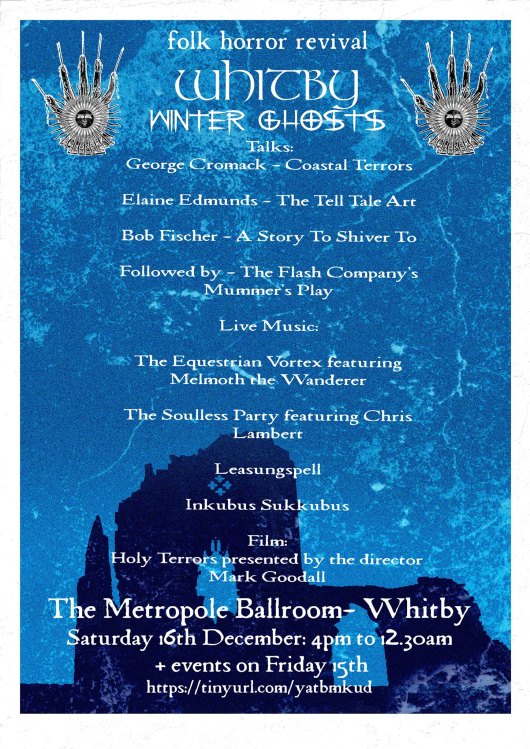
Swansongs takes place on May 12th at the Black Swan, York featuring live performances from Sharron Kraus, the aforementioned Hawthonn and Sarah Dean. Tickets are available from the following link.
https://www.eventbrite.co.uk/e/swansongs-tickets-44059576379



 Folk Horror Revival & Urban Wyrd Project ⨘