The following review is for Charles Doran’s fascinating new short film Soirée.
Soirée tells the story of Bill, a young academic who we learn lives in the beautiful house at the top of the hill with the Bougainvillea – a thorny ornamental plant that grows in his garden. Bill is incredibly proud of his garden and loves nothing more than spending time sitting outside and enjoying the peace and tranquillity it provides. When we are first introduced to him this is where he is. His girlfriend Soledad (Surely a reference to Jess Franco muse Soledad Miranda) joins him, she hands him a gift to celebrate their one month anniversary. Bill looks unimpressed by the cufflinks and admits that he has not bought a gift for Soledad. Bill comes across as being very self-centred, claiming that his very presence is present enough for Soledad, who then mentions that they have been invited to a party by a Professor friend of hers that evening. Bill doesn’t seem too keen to attend but he begrudgingly accepts the invitation to the party.
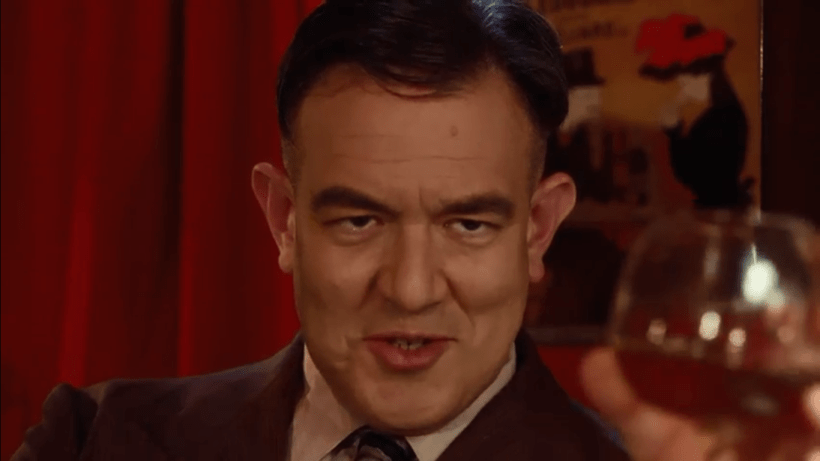
The soirée, which is being held at the Institute for the Scientific Study of Human and Non-Human Phenomena is hosted by a gentleman named Wilhelm, played by Doran’s brother and co-writer Timothy. As he and Bill become acquainted over a few drinks, we are treated first hand, to what a scene stealer Doran is. His role as the Aleister Crowley type occult leader figure of Wilhelm is a perfect bit of casting, he exudes a genial menace of the sort made famous by Charles Grey’s Mocata in The Devil Rides Out or Niall MacGinnis as Julian Karswell in Night of the Demon. He is also attired most appropriately in a 1930s style suit, and even his home décor seems appropriate for an occult leader. As the two drink and become further acquainted we begin to see just how thoroughly unpleasant Bill really is. He tells Wilhelm and Soledad of the despicable way in which he was able to cheat the former owner of the house out of her home, and when they are joined by Wilhelm’s friend Jason, he is dismissive and rude about the occult figurine that Jason has brought to the party for the ritual that is due to take place. A very drunk Bill then agrees to be silent during the upcoming ritual in order that he may stay and watch.
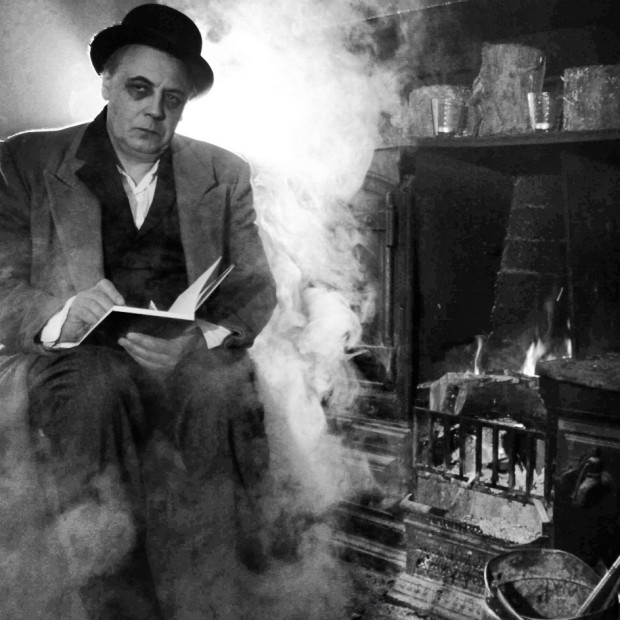
Timothy Doran as Wilhelm
Warning! The following two paragraphs may contain some slight spoilers. The camerawork and direction are spot on, particularly during the ritual scenes, which are just oddball enough to be truly menacing. The use of drums and a ritual dance performed seductively by a female cast member help to create a suitable atmosphere, whilst the use of animal masks draw influence from Robin Hardy’s classic The Wicker Man. Wilhelm’s mask, on the other hand, harks back to something very Lovecraftian in nature, but even more terrifying.
As an interesting side note I would like to draw attention to the film’s use of the ancient Roman religion of Mithraism, which was practiced throughout the Roman Empire in the early centuries of the common era. This is particularly of interest to me as I live in the North East of England, near to the site of the Temple of Mithras at Carrawburgh, on Hadrian’s Wall, which was built around 200 CE. Legend would have us believe that the God Mithras captured and killed the primeval bull in a cave. This apparently led to Mithraic temples being small, gloomy places as they try to replicate the atmosphere of the cave.
Overall, this is a beautifully made short film with a straight forward but well executed plot. The production values are great, and the main cast are all excellent, Matthew Nelson as Bill, Catie Smith as Soledad, Timothy Doran as Wilhelm, and Patrick Peterson as Jason. All ably buoyed by a fine supporting cast. In fact, the whole film looks and feels a lot more expensive than it is, which is real credit to the director who has created something that looks good on a budget. All credit to him for his hard work because it really does pay off here. I look forward to seeing where Charles and his brother go from here…
Charles Doran is an Administrative Professional for a major university in Southern California. His previous short films, Westsider, and Ennui, played at film festivals all over the world. Soirée is his first attempt at an “urban wyrd “ type of film. Soirée was co-written by his brother Timothy, an Assistant Professor of History at Cal State Los Angeles, who runs the very real Institute for the Study of Human and Non-Human Phenomena, the primary setting for the film.
The Sermon opens with some beautifully shot images of the English countryside haunting, magical and pictureseque they set the scene perfectly. These are followed by an opening credit sequence that recalls the heyday of Hammer and Amicus films, a lone crow flies into shot and lands in a lonesome tree. A close up of the crow sits behind the films titles, in homage to Piers Haggard’s folk horror classic The Blood on Satan’s Claw. Already this feels like familiar territory.
The story concerns the events of a small rural village somewhere in England. We are presented with images of a young woman and her father, the local preacher preparing for the sermon of the title. She is filling a glass decanter with wine, whilst the father shaves in preparation of the coming events.
The vast majority of the film’s eleven minutes takes places in the church hall, as the preacher well spoken and charismatic takes centre stage. The sermon itself is unsettlingly homophobic in nature and makes for incredibly uncomfortable viewing. What it does is, it sheds a little light on the attitudes of the community, its people and its prejudices. The preacher’s hateful attack on homosexuality is strikingly outmoded to us in today’s world, and yet the congregation is supprtive of his principles. It highlights perfectly for me the positive changes that we as a people have undergone over the last 50 or 60 years in our attitudes to sexuality. I am reminded somewhat of The Wicker Man, in that we are presented with a rural community isolated not only geographically but also from modern liberal thought. One imagines how Sgt Howie must have felt upon finding out that certain archaic practices were still being practiced many years after popular belief in them had faded away.
The final twist in the tail is a satisying turn, it is harsh and unpleasant in its execution, however it makes for a great ending. The film is not yet out on general release so I am unable to discuss the storyline any further at present, other than to say it is an excellent film and well worth checking out if you get the chance.
Overall, The Sermon is a very well made, beautifully scripted short film. The music by Benjamin Hudson and Cape Khoboi fits perfectly, and it features some genuinely lovely cinematography, that really captures the essence of the English countryside. I am not entirely sure if it was intentional, but several external shots were taken from a low angle. This was very reminiscent of Dick Bush’s amazing cinematography for Blood on Satan’s Claw, where it was used to great effect to hint at how everything rises up from the earth. This may or may not be the case, however I felt compelled to raise it in passing.
Director Dean Puckett cut his teeth making documentary films, the most recent of which was released in 2013, Grasp the Nettle highlights the exploits of a group of land rights activists who battle to set up alternative communities in Britain. The Sermon is his second fiction short to have been supported by Creative England and the BFI after the comedy, horror, sci-fi short Circles in 2015. Circles, which was also set in Devon involved paranormal investigators taking their revenge on a group of crop circle hoaxers. I will certainly be looking forward to seeing more from Dean on the evidence of The Sermon.
The Sermon will receive its premiere at the BFI Flare London LGBTQ+ Film Festival this coming weekend, Saturday March 24th. I have included more information for those interested in checking out this excellent folk horror gem.
In August 2017 via the pages of Fortean Times Magazine I first heard of the film Holy Terrors created by Mark Goodall and Julian Butler much to my delight and anxiety. Not only was it a movie featuring 6 weird tales of Arthur Machen but it was made in Whitby! Machen and Whitby – two things I cherish very dearly so I was very eager to see this film but also worried that it might be awful. (Those worries were happily unnecessary.)
Also at the time we at Folk Horror Revival were organising the Winter Ghosts event for the following December in Whitby. I mentioned to our Events Manager, Darren Charles how the film could’ve been a good addition to our bill if it were not already fully booked. Then much to my surprise and delight, I received an email from the film director Mark Goodall, who had heard about our event and was wondering if we would like to screen Holy Terrors there. Would we?? Is a bear Catholic? Does the pope … Yes! We were interested!
Some jiggling around of schedule and the film was added to the bill and was indeed an atmospheric and beautiful end-piece to the event.
Before discussing the film further, just a short resume of Arthur Machen, for although his light is belatedly beginning to shine brighter, outside of certain horror fiction circles, he is still something of an unknown quantity to many folk.
Born in Wales in 1863, Machen’s career in weird fiction blossomed out of the Symbolist and Aesthetic fin de siècle of the 1890’s. Like a number of other artists and writers of the era, Machen’s work was a curious brew of spirituality and decadence. Blending paganism and Christianity both in his work and in his own personal mysticism, born the son of an Anglican minister he was a member of the Hermetic Order of the Golden Dawn, but did not renounce his Christian faith. He therefore, in a sense, has an air of the notion of Celtic or Insular Christianity, whereby it has been suggested that some of the earliest priests of the Celtic Church were possibly former druids some of whom preferred to preach in the outside cathedral of nature than within a church; and that numerous acolytes of which were ascetic hermits that lived in remote quiet places. Oddly enough it is often claimed that the Synod of Whitby marked the official end of the Celtic Church. (The Synod of Whitby (664 A.D.) was a Northumbrian synod where King Oswiu of Northumbria ruled that his kingdom would calculate Easter and observe the monastic tonsure according to the customs of Rome, rather than the customs practised by Irish monks at Iona and its satellite institutions. The synod was summoned at Hilda’s double monastery of Streonshalh (Streanæshalch), later called Whitby Abbey.)
Machen was one of the early masters of weird fiction, particularly a faction of which, with his own use of folklore (notably the use of fairies not in their tiny twee Disneyfied forms but as the strange human sized people of old lore) and spirit of place, may now frequently be referred to as Folk Horror.
Those who cite Machen as an inspiration or to express enthusiasm for his work include figures as diverse as the writers H.P. Lovecraft, Jorge Luis Borges, Stephen King, Ramsay Campbell, Alan Moore, Iain Sinclair and Sir John Betjeman through to musicians such as Mark E. Smith, Belbury Poly and Current 93. Notorious occultist Aleister Crowley was a fan of Machen’s work but reputedly it was far from being reciprocated, with Machen having a personal dislike for the man.
So how would Machen’s subtle strange tales translate to screen?
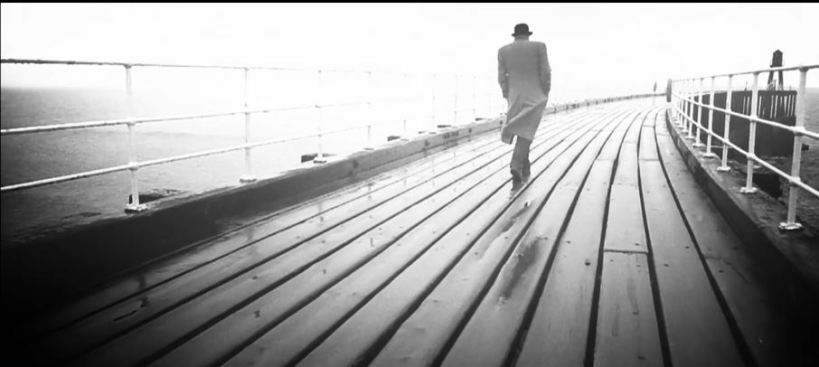
Holy Terrors slowly fades in to scenes of an empty shore and a desolate man. The hauntological soundscape of composer David Chatton Barker (Folklore Tapes) leads us to the body of a man beneath a bridge. Thus opens ‘A Cosy Room’ the first of the 6-weird tales of Arthur Machen. (Indeed, I can vouch it is a cosy room and one not devoid of otherly presence either as I recognised it straight away as a room that I myself have spent several nights in. In fact, after viewing Holy Terrors for the first time at Winter Ghosts, it was the room that I would return to sleep in that very night. The filming location for this segment was The Stoker Room of the cool and quirky hotel La Rosa in Whitby’s East Terrace. Overlooking a great view of Whitby Abbey and the harbour, the wonderful building-sized cabinet of curiosities that is La Rosa hotel has a plaque outside marking it as a place that author Charles Dodgson, aka Lewis Carroll of Wonderland fame amongst other things, stayed at several times. The Angel Hotel in New Quay Road is also suitably plaque-bearing as a residence where Machen stayed.)
The opening wordless narrative shot in atmospheric black and white marked in me the feeling that I was really going to like this film, but also mark it as a film that would not appeal to viewers who only like their horror visceral, fast and with a simple plot and conclusion. Like the tales of Machen, this film adaptation is steady, subtle, atmospheric and most often strange rather than horrific. Some of the tales do not build up to a definite explanation and conclusion but remain more as captures of a strange moment or sequence, rather like many reported real life anomalous experiences.
So, it is safe to say from the outset I could see that Holy Terrors will not be to all tastes but is deliciously to mine.
We are then invited to taste The White Powder of the second tale. This is one of the Machen stories to have a more typical sense of narrative in that it follows an event to a solid culmination. It is a tale of both dread and decadence and has both the air of M.R. James ‘The Ash Tree and Kafka’s Metamorphosis but still remains essentially a Machen tale.
(an amusing synchronicity with the screening at Winter Ghosts was that the imbiber of the said White Powder of the film develops an odd black spot on his hand as an early symptom that something is amiss. The black spot very much resembled the black spot on the audience members’ hands that bore the blurred remains of the mark of the Folk Horror Revival sun symbol hand-stamp.)
The White Powder is a solidly told tale and it really brings forth the power of Goodall’s film-making. Relying strongly on an audio narration that bonds Machen completely with these new dreaming of his creations, the character that is etched within the faces, particularly the eyes of the actors in this film is a strong motif, that in its use becomes somewhat hypnotic. Another film-making skill that Goodall employs to great effect is making Whitby timeless; the use of soft focus, careful framing and light bleached backgrounds removes any trappings of modern life such as shopfront banners and so forth.
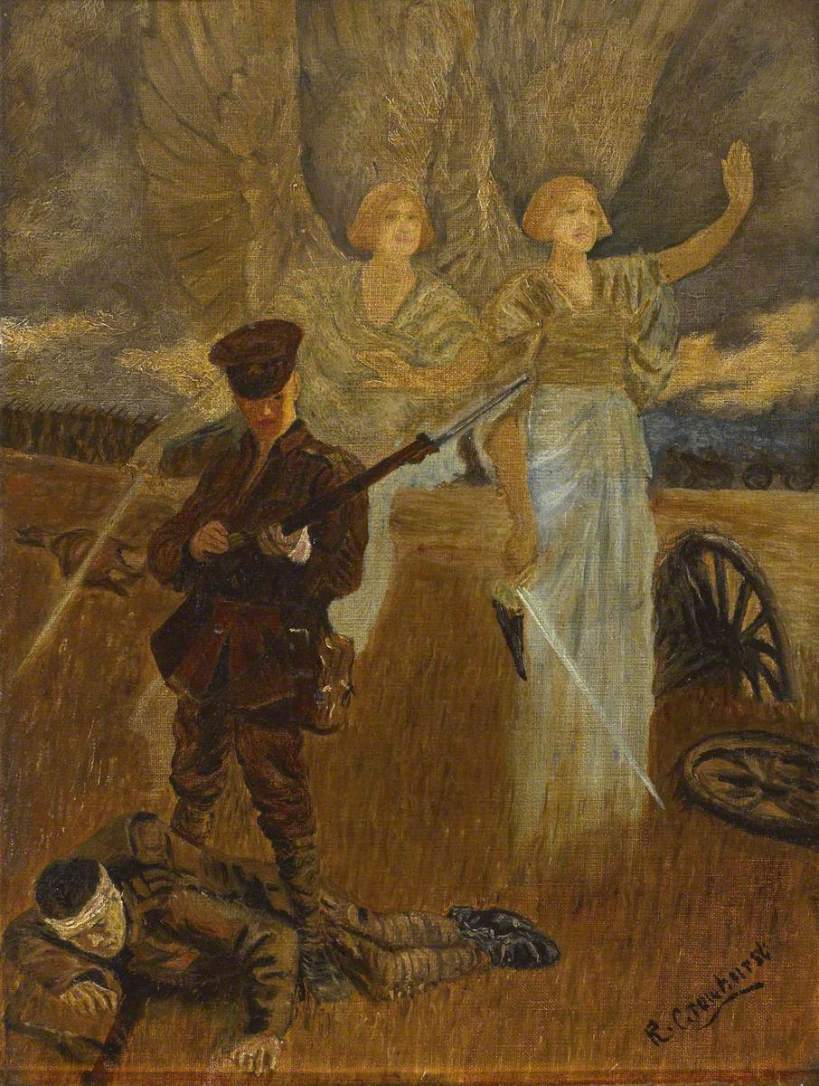
The third tale is one of Machen’s most famous, not because it is his best work or most identifiable of his style but because it has been noted as being the possible origin of the Angels of Mons legend. At the Battle of Mons on the French borders in 1914, it was claimed and published in the British Spiritualist magazine in 1915, that British soldiers were protected in battle by a host of Heavenly angels. However, in 1914 The Evening News newspaper had published Machen’s story The Bowmen, in which a battalion headed by Saint George intervenes in a conflict between World War I British and German forces.
Out of all the stories within the Holy Terrors film The Bowmen could have been the most problematic for a low budget production. By the effective use of old newsreels of wartime footage, Goodall skillfully conquers this problem and overall the artistry of the entire film does not give the slightest impression at all that it is not studio funded. The photography, editing and production is on the contrary not only skillful but beautiful.
The fourth segment of the portmanteau initiates us into the Ritual. It is however not a ritual of hooded or sky-clad figures in the depths of a wood or desecrated church but that of a playground game of schoolchildren. The simplicity of this has a deeply unsettling nature and again the actors of Holy Terrors deserve applause. To act without words uttered needs to tread a line between expression, subtlety and communicative skill lest it become exaggerated like a mime performance. Again, we find great casting is at work here, for the children have a look to them that would not see their faces out of place in antique Victorian or Edwardian photography.
The next tale, The Happy Children remains with the theme of strange youths. Unlike those in Ritual, there is a question arises as to whether these children are alive or even of human nature – a Celtic belief about Fairies is that they are spirits of the dead and the Happy Children indeed have an otherworldly sense to them. This segment again effectively uses the townscape of Whitby as a strange and beautiful filming location, and with good cause for this tale is set in Whitby. It is renamed Banwick but the tale is undeniably inspired by Machen’s visit to Whitby on a journalistic task to report on the town’s Jet industry. The story reveals Machen’s mystical sensitivity both of place and to the horrors of war. Whitby and other towns on the North Eastern English coast had been subject to wartime attack by the Germans and Machen’s reference also to the biblical slaughter of the innocents undertaken by Herod in his efforts to eliminate the infant messiah.
A phrase within the story describing Whitby as The Town of Magical Dream is a perfect description (it also is aptly used by Carolyn Waudby for her excellent essay on Whitby). The night after Winter Ghosts I walked Whitby’s streets and the pier and the 199 steps to Saint Mary’s Church and the Abbey, and it was not mere suggestion but there was a palpable otherness to the coastal town darkened save for the twinkling of Christmas lights. There was a definite presence, not unwelcoming for the most part save for the pool behind the abbey where I felt that I was not meant to proceed further so I didn’t and for a strange unsettling sensation in the Screaming Tunnel of the Khyber Pass. I know that I am far from being the only one to sense something strange in Whitby’s thin sea fretted air – Machen sensed the liminality as did Bram Stoker and Mark Goodall captures it in Holy Terrors as do Michael Smith and Maxy Neil Bianco in their atmospheric and poetic short film ~ Stranger on the Shore: Hounds of Whitby.
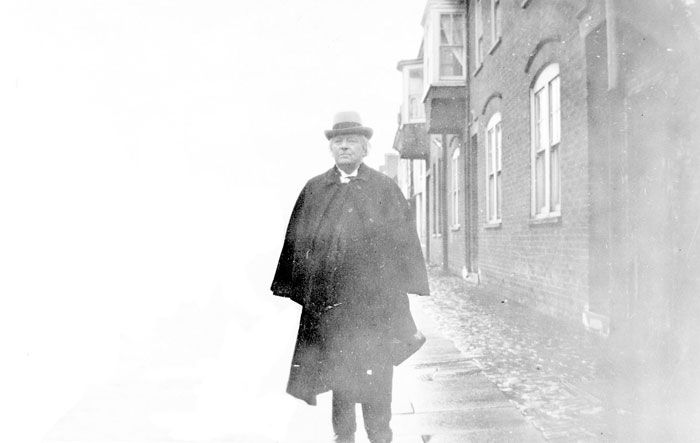
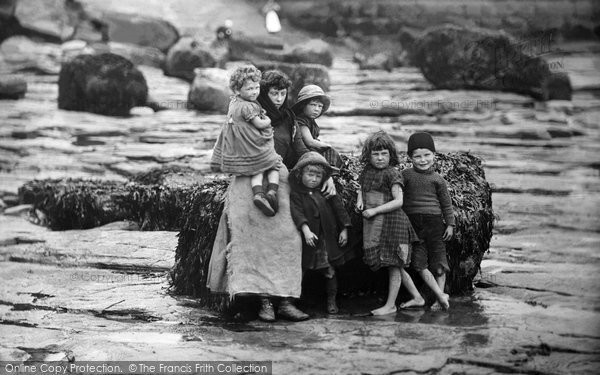
Francis Frith: The Peart family. Whitby 1891
Holy Terrors concludes with Midsummer and for the first time, the effective ambient monochrome palette is replaced with colour; but this is the colour of hand-tinted antique photographs, the faded pastels of half-remembered dreams and half-forgotten memories. It is a fitting place to leave the darkness and step into the light, but minding always that they are integral to and part of each other.
And on this note we will depart this house of souls, with the conclusion that whilst Holy Terrors may not suit the constitution of all, it is a film that has found its way under my skin and into my head and heart and for it its understated beauty and mesmeric invocations, it is something I feel that has touched me deeply. When I first read about this film with my mingled feelings of trepidation and tantalisation, I happily know now that I had nothing to worry about but happily a fair bit perhaps to fear.
During the Second World War, four lads looking for bird’s nests on the grounds of Hagley Hall in Worcestershire found a skull in a hollow elm tree. The police, investigating, found a woman’s skeleton there, clearly hidden in the tree after death, but no further clues were found. But after the case became known, in an unsettling development, variations on the words WHO PUT BELLA IN THE WYCH ELM? began to appear on walls across Birmingham and the Black Country. Someone knew who Bella was, evidently; but others took up the question, so whoever knew was safely anonymous. The question of who put Bella in the Wych Elm became part of the modern folklore of the Black Country – a fact which gives the lie to the idea that the modern age doesn’t allow for new folk legends to rise.
Tom Lee Rutter, a native of the area, has a pretty decent run of short films under his belt, but this one is more personal, part of the culture of the Black Country, a spooky, quaint piece. His grandmother and her friends used to go to Wychbury, “looking for Bella.” The story was used to scare naughty children: behave or I’ll put you in the wych elm.
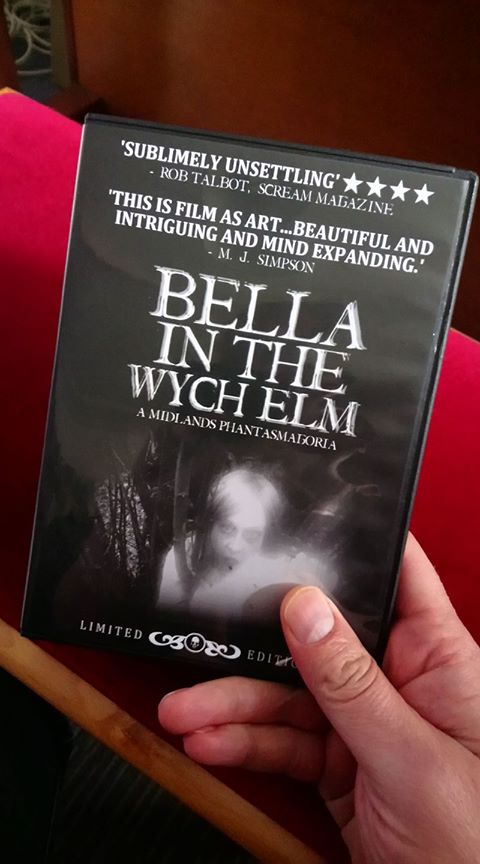
Tom’s Bella in the Wych Elm: A Midlands Phantasmagoria is a 35 minute documentary film which tells the story of the finding, and explores some of the rationales people attached to the mystery over the years. Was “Bella” a gypsy? A victim of human sacrifice? A murdered sex worker? Or someone else?
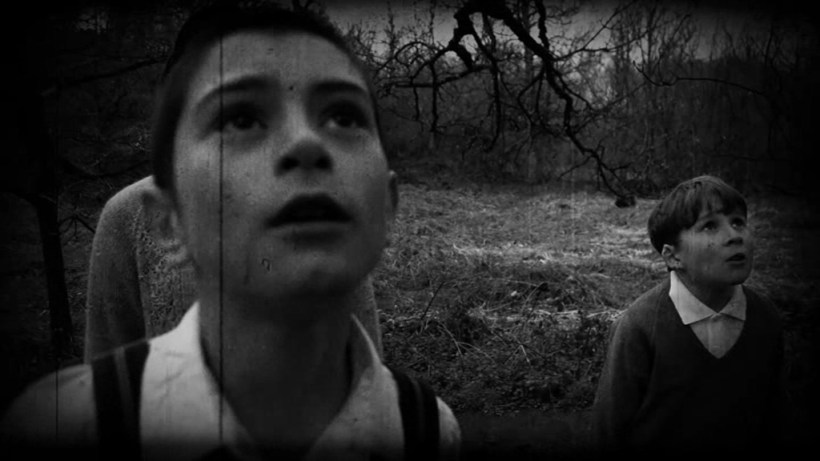
In style, the film owes a lot to James Marsh’s Wisconsin Death Trip (1999), with its use of the fiddle on the soundtrack, its black-and-white dramatisations and its variety of voices: whispered voices of a ghost, an anonymous letter-writer, the New Forest coven. The most time is given to the friendly voice of “Tatty” Dave Jones (actually a member of ska-punk band The Cracked Actors), who sounds like nothing more than the sort of storyteller that the Midlands always seemed to me to be full of – a friend who lived there for many years once described Birmingham as like that person who stands at the corner of a party and seems unprepossessing until you talk to them and realise they’re really one of the best people you’ve ever met, an assessment which I have always heartily agreed with. Jones tells the tale with a warm, engaging tone, and the scratchy, well-judged visuals surpass its budgetary limitations.
The main thing you have to do with a documentary, a thing that many independent documentarists forget, is that you have to have a thesis; a documentary is an art form in its own right (one of the muses, lest we forget, was a patron of history) and you have to have stakes with a piece of art, a direction in which your story will go. Bella in the Wych Elm succeeds at this right from the beginning. It gives a solution (a solution which some versions of the story, not mentioned in the film, discount), but the apparent conclusiveness of the solution in the film is set beautifully against the fact that it doesn’t make the event any less mysterious, nor does it diminish the way in which poor Bella has entered the local myth of the Black Country. It brings in Margaret Murray and the New Forest Coven, the witchcraft-related murders of the post-war years, and other, perhaps more mundane, but no less strange phenomena. And all of that serves the film’s central theme: This is where stories come from.
In that way, Bella in the Wych Elm succeeds spectacularly. It’s a smart, clever, beautifully constructed piece that reminds you that the mundane, the horrible and the numinous are often very close together and that the modern world still produces folklore.
The DVD comes with a couple of alternative versions of the film and some postcards to sweeten the deal, but they’re just extra decorations on an already excellent package. I cannot recommend this enough, as a document on British folklore, a solidly made documentary film and as a fine work of art from an independent director.












 Folk Horror Revival & Urban Wyrd Project ⨘