Seen in Half Dreams: The Fairy Investigation Society Interview Andy Paciorek

23659141_10155893352176952_4301718085418149521_n

Andy, thanks so much for agreeing to talk. First of all, can you just tell us something about your background and how you became so interested in fairy art?

Hi, thanks for asking me to talk. I have had an interest in strange and mysterious subjects and have also compulsively drawn since I was a child, so it was probably inevitable that I would someday end up drawing fairies. As a very young child I think I saw stuff, that I never really thought anything of at the time – faces in the trees and one time I remember playing on the fields at the back of my house with an unfamiliar child who was very pale with white hair and I think white clothing. Nobody else seems to have seen him or knew who he was, which was odd as it was a small village where most people knew each other. I think he said his name was Samuel. I never thought he was a ghost, angel, faerie (though some theories identify faeries as either being ghosts or fallen angels) – just a kid. He wasn’t an imaginary playmate either as I only ever saw him the once. As I got older I became more and more interested in supernatural subjects but paid little attention to faeries as still then I had the Tinkerbell impression of them.

So what changed things?

Well, in my reading I came across Passport to Magonia by Jacques Vallee and then the books of Hilary Evans and that brought me around to a new way of thinking about faeries, which inherently felt righter to me. On the art side as well as Froud and Lee’s
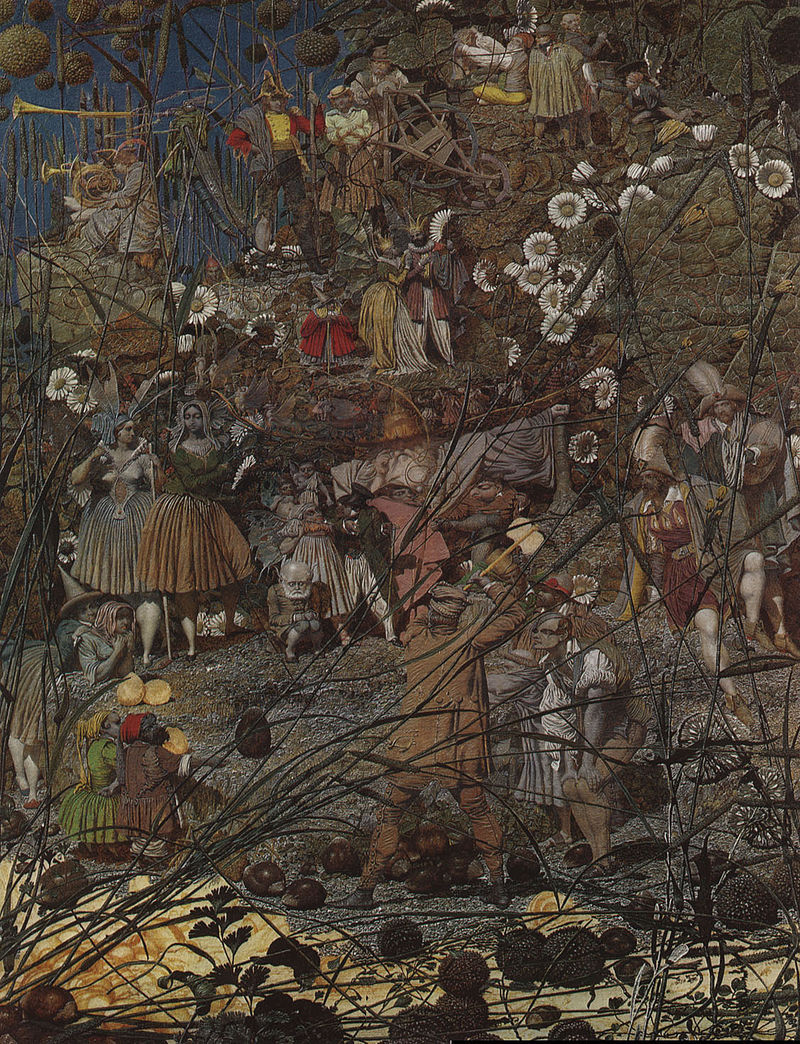
seminal Faeries, via the Pre Raphaelites and Aesthetic artists I became aware of the Victorian genre of Fairy painting and I became enamored especially with the works of Richard Dadd and John Anster Fitzgerald. There was a dark, mysterious underbelly to their work which really resonated with me.

Jeremy Harte has a very nice comment somewhere: he says that Brian Froud basically took Katharine Briggs’ Fairy Dictionary and drew it.
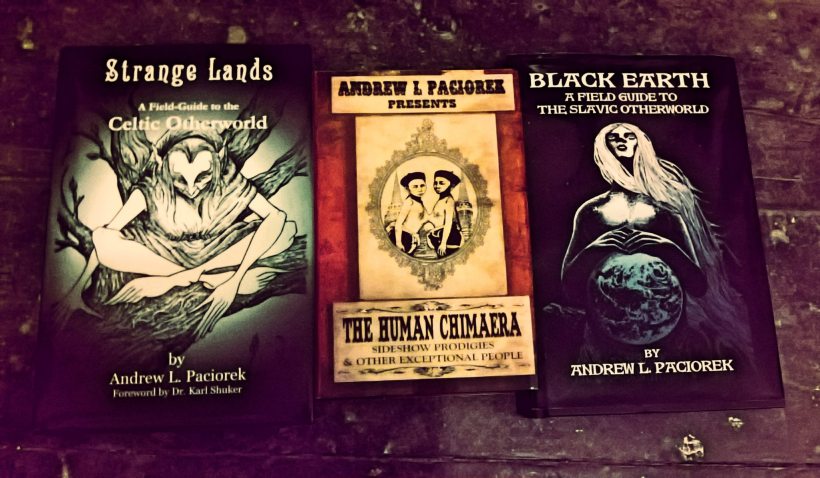
How does folklore writing inform what you draw, Andy? It is very influential and inspiring. How I came to write and illustrate my own folklore books, however, is a bit of a strange journey. At one point in my life an opportunity arose for me to work on a travelling carnival, so I literally ran away with the show folk for a few years, starting off in Wales and then travelling to the Far and Middle East. There was a girl who worked on the fair with us in the Philippines, who had a sort of a Goth look and one night I heard some Filipinos refer to her as a WokWok. And I asked them what that meant and they said Witch of the Night. I broached the subject with other locals and they informed me that the WokWok was a type of Aswang, a breed of differing vampiric or sinister entities and that piqued my curiosity. Then in Oman on one of the carnival games, the prizes were big Tasmanian Devils – Taz cartoon character stuffed toys and a local pointed at the toys and told me that people like that lived in the interior of the country, so I grew more and more interested in creatures and beings from different world folklore and mythology. Upon leaving the carnival life and returning to Britain I worked for a brief stint temping at Bizarre magazine in London. Whilst there a small filler feature was needed so I wrote a short ‘Ten alternatives to the Bogeyman’ which featured I think WokWok as well as Black Annis, possibly Tonton Macoute (Uncle Hears Me) and I cannot remember who else now but I went on to write about and illustrate far more than ten. I decided to illustrate a series of portraits of strange creatures from British and Celtic folklore. For research I had a massive pile of books scattered around me – Reverend Robert Kirk, W.Y Evans-Wentz, Katherine Briggs, Wirt Sikes, W.B. Yeats and many more and I thought it would be handy to have all this reference in a single book. So not finding one at a time, my proposed series of portraits became that book – Strange Lands: A Field Guide to the Celtic Otherworld containing over 170 illustrations and further descriptions of all manner of mystical beast and beings, many from the Faerie domain. Whilst I was still working on it John And Caitlin Matthew’s Element Encyclopedia of Magical Creatures came out, which is a bumper reference book. I would have possibly pulled my hair out in despair at the work I’d done, had Harper Collins not contacted and commissioned me to provide interior illustrations in the Encyclopedia. In the end the books have a different feel to them but actually complement each other pretty well.
DEVANA.JPG
And your latest published work?
Well, last year I published Black Earth: A Field Guide to the Slavic Otherworld, a book I had finished writing years ago but which span over time getting the illustrations done amongst other work I had on. Again, there are a number of Faerie type entities to be found. Slavic folklore is one of the most under-represented in English language or translated books, which is a shame as there is some rich interesting material to be found in those lands. I am pleased I tackled that as a subject and hopefully there will be further material published by other authors relating to that lore. I am tempted to do further Otherworld Field Guides; have a series of them – Japanese, Native American, Oceanic … etc. There is a wealth of possibilities but it is also a lot of work involved.
51. Phookas.JPG

As to your drawings I just want to start, if I may, with the phooka, a favourite Irish supernatural creature. How do you go about drawing that?

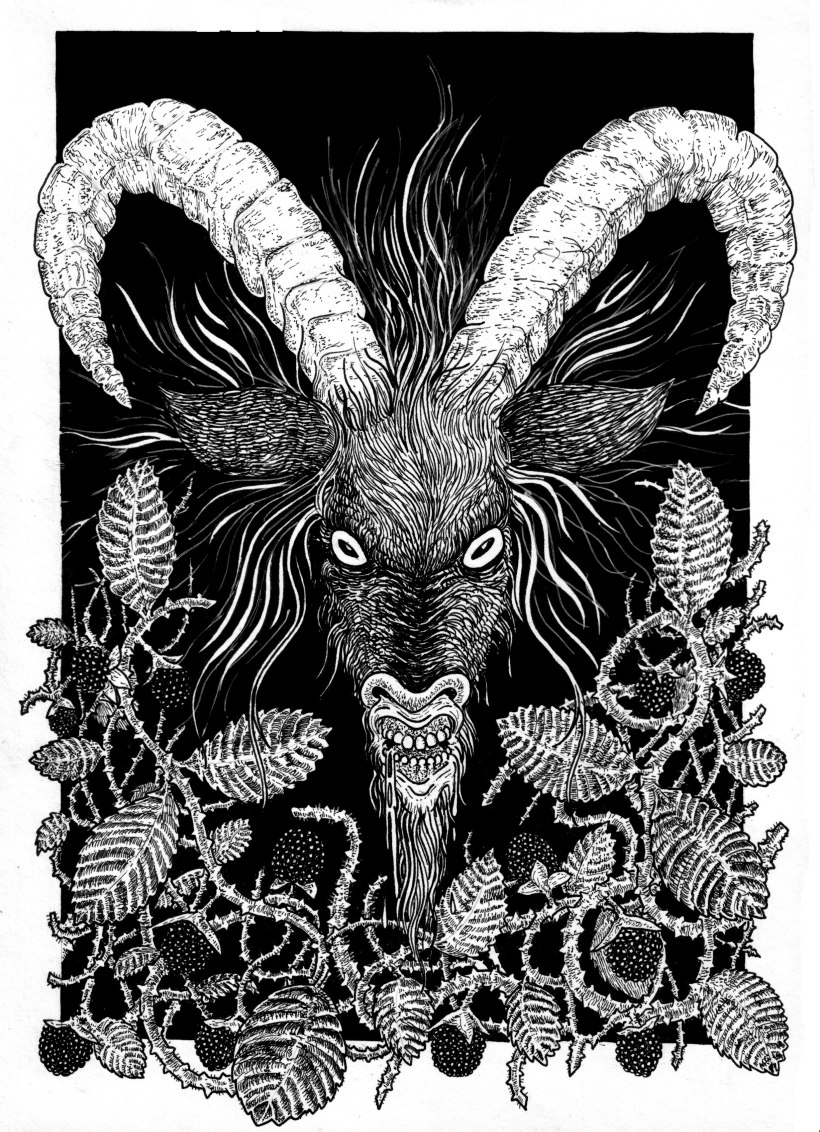
With Strange Lands, there was a lot of almost automatic-style drawing involved. After reading a text I would just draw with the being vaguely in mind. What was on the page quite often was initially little more than a scribble, but from that I would trace over and the pictures which were in the book. Whilst numerous entities virtually drew themselves, others had a little bit more conscious input from me. I knew I wanted a goat in the book and the Welsh Gwyllion could have also offered that opportunity but of all the shape-shifting forms the Phooka takes, the goat seemed to push itself forward. Brambles feature within the illustration in reference to the superstition that it is unwise to eat over-ripe blackberries as either the Phooka or the Devil himself had either spat or urinated on them. I am pleased I went with the goat aspect of the Phooka as a film of recent years I enjoyed was the Witch with its unlikely superstar of Black Philip the goat. I also prefer the sinister entities and illustrating them so shapeshifting bogies appeal to me.

There are so many fairy artists out there now and you’ve already mentioned a few. But who do you rate as being among the best? Who are your living inspirations? Who should we go and look for?
Alan Lee, Brian Froud, Charles Vess, all deservedly earned their position of being the successors of a tradition that followed Arthur Rackham, Dorothy Lathrop, Edmund Dulac and the other Golden Age illustrators and before them the great Victorian illustrators and fairie painters, but it is great to see that this tradition is continuing. Amongst those who regularly or frequently illustrate themes associated to Faerie, it is the darker earthier works that appeal to me as they maintain that capricious undercurrent and strange nature of the subjects, so apologies to those I have surely forgot but among the contemporary Faerie artists I admire are Karen Hild, Virginia Lee, Marc Potts, Cobweb Mehers of Eolith Designs, and especially Julia Jeffrey. Julia’s most recent body of work relating to the confessed Scottish Witch Isobel Gowdie is my favourite of her work, very sinister and evocative.
I’ve recently finished editing the Fairy Census 2014-2017. When people are describing fairy sightings frequently – I’d guess five or six times – people say, ‘it looked like a Brian Froud drawing’. What is happening here is modern artwork influencing sightings or is modern artwork taking from reality?

In talking with people about fairy artists, we think those who are ‘seers’ are very apparent. Among those whom I mentioned in the previous question are some whom I know or would expect to be Seers. There is an authentic feel to their work; it is not necessarily from literally seeing with the eyes but frequently just sensing and allowing those sensations to take form. With those who do that, sometimes it is as if the entities are rendering themselves through the conduit of the artist. The reasons for them being seers can vary. With Richard Dadd it could be his madness – he would simply smear paint on a canvas to begin and then paint the faces he saw peering out at him in the
pigment. For John Anster Fitzgerald there is a suggestion that his visions may have come from laudanum or opium half dreams. Some may simply be more sensitive to such things.
Location could also be a factor, Froud lives on Dartmoor which is notoriously ‘thin’, but the reasons why people may report Froud-like creatures is because they are seeing the types of creature Froud also sees. His earthier creatures are completely like those half-seen peering faces that can be found amongst foliage, tangled roots, tree bark and burrs, dry stone walls and such places. There is a stylistic difference amongst individual artists, but it may be that Brian’s work most closely captures the forms that numerous other people have seen. There is also the consideration of archetypes. If a collective unconscious exists, then art and reality will constantly influence each other I think
21054991_10159176435715484_700273241913332390_o.jpg

Let’s finish with a boring but fundamental question. If anyone is interested in commissioning you for art work or just buying one of your books, how do we get in touch?

My solo books are available mail-order only from

http://www.blurb.co.uk/user/andypaciorek

but books I have illustrated for Harper Collins and other publishers are generally possible to buy from bookshops, Amazon etc. I can be contacted at andypaciorek@yahoo.co.uk
Andy, thanks so much!

This Interview first appeared in Fairy Investigation Society; Newsletter 7. New Series. January 2018

Founded in Britain in 1927. The Fairy Investigation Society has members from many different walks of life with different views about fairies and fairy existence: what ties us together, in mutual respect, is an interest in fairy-lore and folklore.

Read the Fairy Census 2014 -2017 here –  fairy census 2014 -2017

Alongside Darren Charles, Andy Paciorek will be discussing witches, faeries and folk horror at the The Pagan Federation Scottish Conference on Saturday April 21st 2018

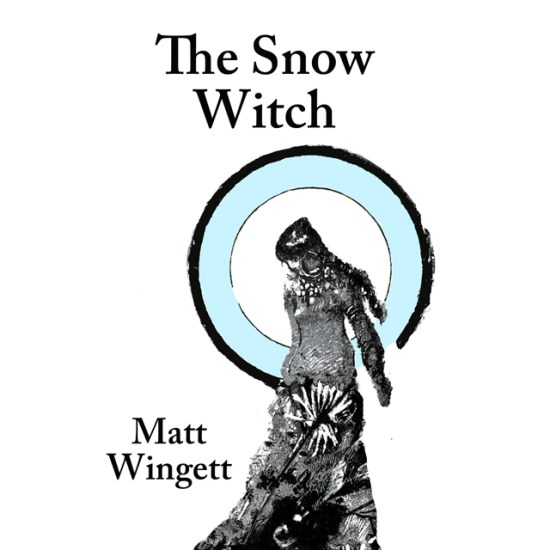
The Snow Witch – Free E-book

SnowWitchwoocommerceimg

The Snow Witch by Matt Wingett will be available as a free kindle download from Saturday 17th February – Wednesday 21st February. This story of obsession, loss, murder and magic has been getting great reviews on Amazon and on Folk Horror Revival and is highly recommended as a great read.

You can download it here, available for 5 days only for free, from 17th February –

https://www.amazon.co.uk/Snow-Witch-Matt-Wingett-ebook/dp/B0799R9NVH/

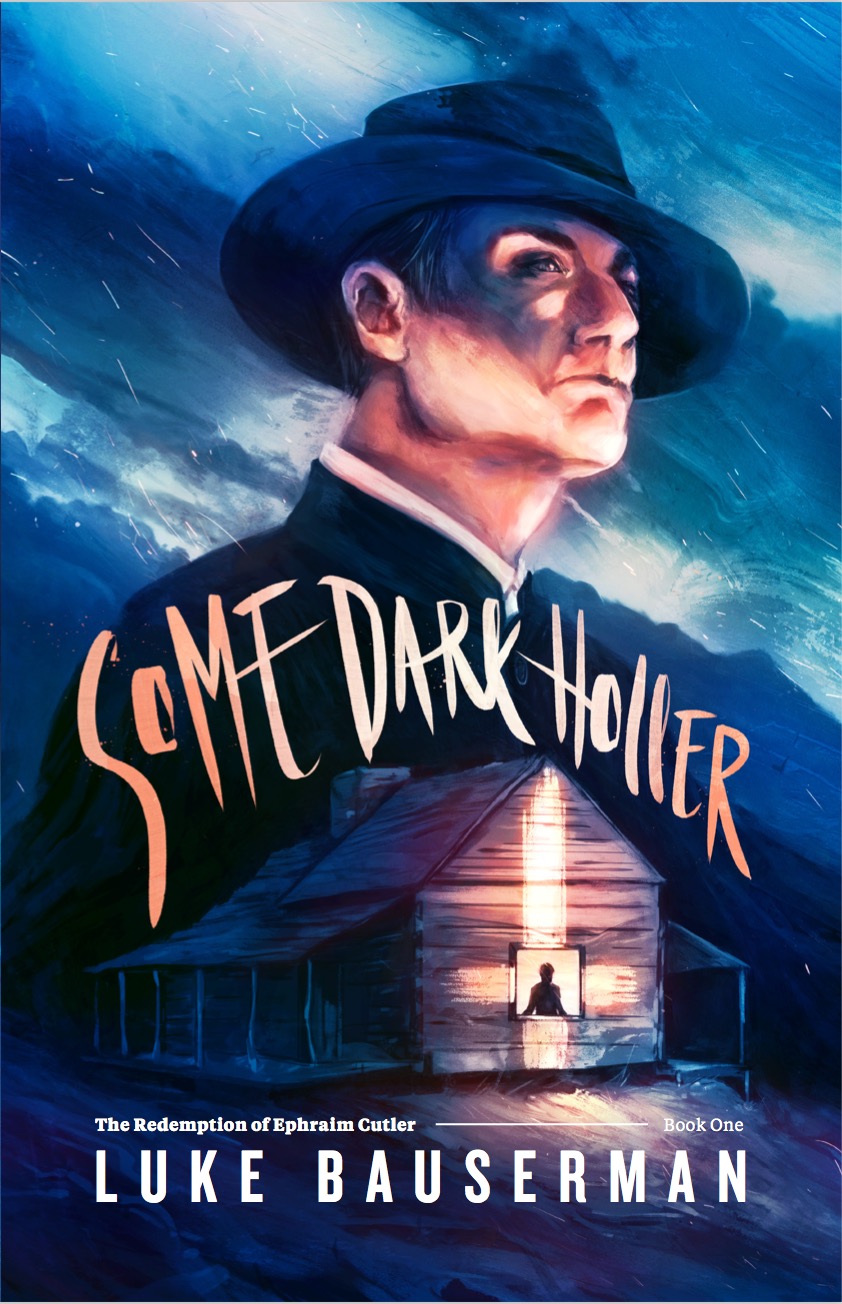
Book review: Some Dark Holler by Luke Bauserman

Ephraim Cutler is a 16 year boy, living in the backwoods of Appalachia in the aftermath of the American Civil War. His mother hasn’t been right since his father was killed in the war, killed by a Union bullet. She blackmails him into taking revenge by killing an innocent Yankee, so Ephraim, forced to choose between killing an innocent man or the death of his mother, commits murder. To try and redeem himself, he flees into the forest, but unknown to him, there’s more powerful and sinister forces than the local townsfolk after him, and soon he has a hellhound on his tail.

Some Dark Holler is richly evocative of it’s setting, drawing heavily on Appalachian folklore. I found this to be one of the most interesting aspects of the book, seeing how traditional European beliefs had changed when transplanted to America; the hellhound is a real dog reanimated by a black magic ritual rather than the spectral hound you may be more familiar with, there’s also a granny doctor, an old woman wise in the ways of healing, similar to the wise women of old. It certainly made me want to find out more about the folk tales the author drew on. Luckily, he’s produced a book on this very subject, which is available free from his website, which I’m looking forward to reading.

The plot itself moves along at a fair old gallop, with a fair few twists and turns. Although it’s the first book in a series, it’s satisfying as a stand alone book. I’ll certainly be picking up the sequel when it comes out this year.

More info at www.lukebauserman.com, where as well as his previously mentioned ebook, the author also blogs about local folklore, so well worth checking out.

Review by Scott Lyall

Wyrd Harvest Press: 10% discount and Free Shipping on all our books*

DRlxSSaXUAAkR7P

wyrd harvest logo.jpg

Claim 10% Discount + Free Shipping on all Folk Horror Revival / Wyrd Harvest Press books* by entering code BOOKSHIP18 at checkout at –

http://www.lulu.com/spotlight/andypaciorek

*offer expires at one minute to midnight Monday 5th February 2018
(To change prices to your local currency, select your nation’s flag at the top of the sales webpage)

country

Wyrd Harvest Press books explore the landscapes of Folk Horror and related realms in film, tv, books, art, music, events and other media and also psychogeography, hauntology, folklore, cultural rituals and costume, earth mysteries, archaic history, hauntings. southern gothic, ‘landscapism / visionary naturalism & geography’, backwoods horror, murder ballads, carnivalia, dark psychedelia, wyrd forteana and other strange edges.

100% of profits from FHR / Wyrd Harvest Press books sold in this online store will be charitably donated at intervals to different environmental, wildlife and community projects undertaken by the Wildlife Trusts.

whplog.jpg

wyrd harvest logo2a

Holy Terrors: Film Review

Holy-Terrors-Arthur-Machen-2017-Derby-Film-Festival

In August 2017 via the pages of Fortean Times Magazine I first heard of the film Holy Terrors created by Mark Goodall and Julian Butler much to my delight and anxiety. Not only was it a movie featuring 6 weird tales of Arthur Machen but it was made in Whitby! Machen and Whitby – two things I cherish very dearly so I was very eager to see this film but also worried that it might be awful. (Those worries were happily unnecessary.)

Capture3

Also at the time we at Folk Horror Revival were organising the Winter Ghosts event for the following December in Whitby. I mentioned to our Events Manager, Darren Charles how the film could’ve been a good addition to our bill if it were not already fully booked. Then much to my surprise and delight, I received an email from the film director Mark Goodall, who had heard about our event and was wondering if we would like to screen Holy Terrors there. Would we?? Is a bear Catholic? Does the pope … Yes! We were interested!
Some jiggling around of schedule and the film was added to the bill and was indeed an atmospheric and beautiful end-piece to the event.

Before discussing the film further, just a short resume of Arthur Machen, for although his light is belatedly beginning to shine brighter, outside of certain horror fiction circles, he is still something of an unknown quantity to many folk.

arthur-machen
Born in Wales in 1863, Machen’s career in weird fiction blossomed out of the Symbolist and Aesthetic fin de siècle of the 1890’s. Like a number of other artists and writers of the era, Machen’s work was a curious brew of spirituality and decadence. Blending paganism and Christianity both in his work and in his own personal mysticism, born the son of an Anglican minister he was a member of the Hermetic Order of the Golden Dawn, but did not renounce his Christian faith. He therefore, in a sense, has an air of the notion of Celtic or Insular Christianity, whereby it has been suggested that some of the earliest priests of the Celtic Church were possibly former druids some of whom preferred to preach in the outside cathedral of nature than within a church; and that numerous acolytes of which were ascetic hermits that lived in remote quiet places. Oddly enough it is often claimed that the Synod of Whitby marked the official end of the Celtic Church. (The Synod of Whitby (664 A.D.) was a Northumbrian synod where King Oswiu of Northumbria ruled that his kingdom would calculate Easter and observe the monastic tonsure according to the customs of Rome, rather than the customs practised by Irish monks at Iona and its satellite institutions. The synod was summoned at Hilda’s double monastery of Streonshalh (Streanæshalch), later called Whitby Abbey.)

Machen was one of the early masters of weird fiction, particularly a faction of which, with his own use of folklore (notably the use of fairies not in their tiny twee Disneyfied forms but as the strange human sized people of old lore) and spirit of place, may now frequently be referred to as Folk Horror.
Those who cite Machen as an inspiration or to express enthusiasm for his work include figures as diverse as the writers H.P. Lovecraft, Jorge Luis Borges, Stephen King, Ramsay Campbell, Alan Moore, Iain Sinclair and Sir John Betjeman through to musicians such as Mark E. Smith, Belbury Poly and Current 93. Notorious occultist Aleister Crowley was a fan of Machen’s work but reputedly it was far from being reciprocated, with Machen having a personal dislike for the man.

2514055_1a383703_120x120
So how would Machen’s subtle strange tales translate to screen?
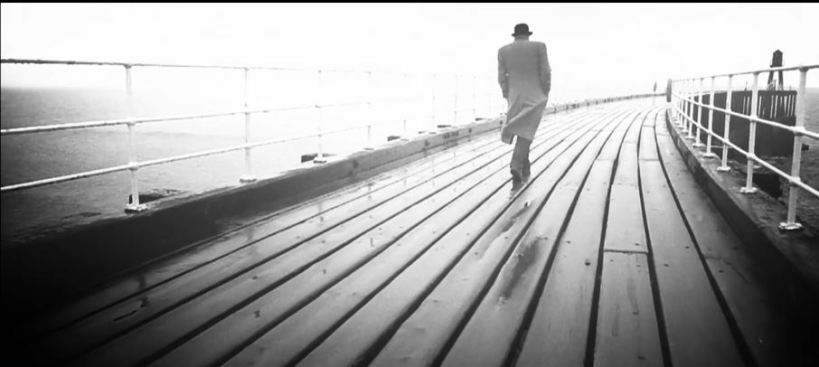
Holy Terrors slowly fades in to scenes of an empty shore and a desolate man. The hauntological soundscape of composer David Chatton Barker (Folklore Tapes) leads us to the body of a man beneath a bridge. Thus opens ‘A Cosy Room’ the first of the 6-weird tales of Arthur Machen. (Indeed, I can vouch it is a cosy room and one not devoid of otherly presence either as I recognised it straight away as a room that I myself have spent several nights in. In fact, after viewing Holy Terrors for the first time at Winter Ghosts, it was the room that I would return to sleep in that very night. The filming location for this segment was The Stoker Room of the cool and quirky hotel La Rosa in Whitby’s East Terrace. Overlooking a great view of Whitby Abbey and the harbour, the wonderful building-sized cabinet of curiosities that is La Rosa hotel has a plaque outside marking it as a place that author Charles Dodgson, aka Lewis Carroll of Wonderland fame amongst other things, stayed at several times. The Angel Hotel in New Quay Road is also suitably plaque-bearing as a residence where Machen stayed.)

The opening wordless narrative shot in atmospheric black and white marked in me the feeling that I was really going to like this film, but also mark it as a film that would not appeal to viewers who only like their horror visceral, fast and with a simple plot and conclusion. Like the tales of Machen, this film adaptation is steady, subtle, atmospheric and most often strange rather than horrific. Some of the tales do not build up to a definite explanation and conclusion but remain more as captures of a strange moment or sequence, rather like many reported real life anomalous experiences.

So, it is safe to say from the outset I could see that Holy Terrors will not be to all tastes but is deliciously to mine.

Capture4
We are then invited to taste The White Powder of the second tale. This is one of the Machen stories to have a more typical sense of narrative in that it follows an event to a solid culmination. It is a tale of both dread and decadence and has both the air of M.R. James ‘The Ash Tree and Kafka’s Metamorphosis but still remains essentially a Machen tale.
(an amusing synchronicity with the screening at Winter Ghosts was that the imbiber of the said White Powder of the film develops an odd black spot on his hand as an early symptom that something is amiss. The black spot very much resembled the black spot on the audience members’ hands that bore the blurred remains of the mark of the Folk Horror Revival sun symbol hand-stamp.)

The White Powder is a solidly told tale and it really brings forth the power of Goodall’s film-making. Relying strongly on an audio narration that bonds Machen completely with these new dreaming of his creations, the character that is etched within the faces, particularly the eyes of the actors in this film is a strong motif, that in its use becomes somewhat hypnotic. Another film-making skill that Goodall employs to great effect is making Whitby timeless; the use of soft focus, careful framing and light bleached backgrounds removes any trappings of modern life such as shopfront banners and so forth.

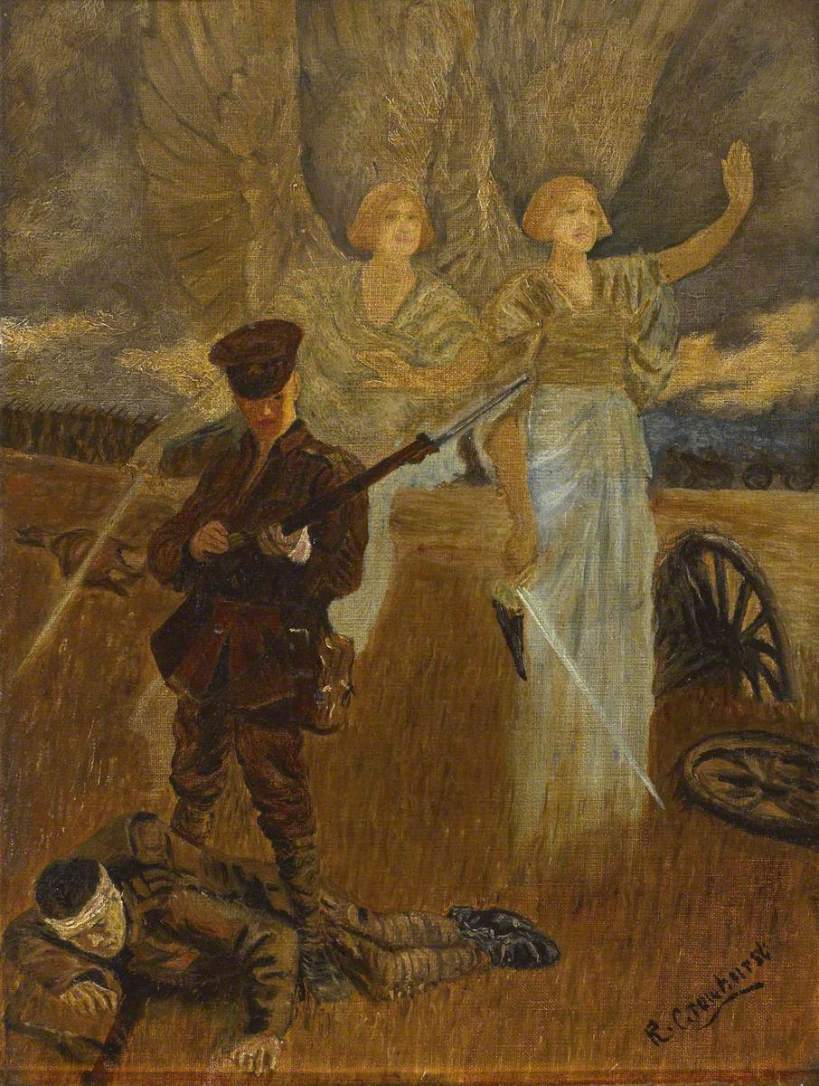
Crowhurst, R.; The Angel of Mons, c.1914
Crowhurst, R.; The Angel of Mons, c.1914; National Army Museum; http://www.artuk.org/artworks/the-angel-of-mons-c-1914-182603

The third tale is one of Machen’s most famous, not because it is his best work or most identifiable of his style but because it has been noted as being the possible origin of the Angels of Mons legend.  At the Battle of Mons on the French borders in 1914, it was claimed and published in the British Spiritualist magazine in 1915, that British soldiers were protected in battle by a host of Heavenly angels. However, in 1914 The Evening News newspaper had published Machen’s story The Bowmen, in which a battalion headed by Saint George intervenes in a conflict between World War I British and German forces.
Out of all the stories within the Holy Terrors film The Bowmen could have been the most problematic for a low budget production. By the effective use of old newsreels of wartime footage, Goodall skillfully conquers this problem and overall the artistry of the entire film does not give the slightest impression at all that it is not studio funded. The photography, editing and production is on the contrary not only skillful but beautiful.

The fourth segment of the portmanteau initiates us into the Ritual. It is however not a ritual of hooded or sky-clad figures in the depths of a wood or desecrated church but that of a playground game of schoolchildren. The simplicity of this has a deeply unsettling nature and again the actors of Holy Terrors deserve applause. To act without words uttered needs to tread a line between expression, subtlety and communicative skill lest it become exaggerated like a mime performance. Again, we find great casting is at work here, for the children have a look to them that would not see their faces out of place in antique Victorian or Edwardian photography.

Capture

The next tale, The Happy Children remains with the theme of strange youths. Unlike those in Ritual, there is a question arises as to whether these children are alive or even of human nature – a Celtic belief about Fairies is that they are spirits of the dead and the Happy Children indeed have an otherworldly sense to them. This segment again effectively uses the townscape of Whitby as a strange and beautiful filming location, and with good cause for this tale is set in Whitby. It is renamed Banwick but the tale is undeniably inspired by Machen’s visit to Whitby on a journalistic task to report on the town’s Jet industry. The story reveals Machen’s mystical sensitivity both of place and to the horrors of war. Whitby and other towns on the North Eastern English coast had been subject to wartime attack by the Germans and Machen’s reference also to the biblical slaughter of the innocents undertaken by Herod in his efforts to eliminate the infant messiah.
NGMA3_203_1024x1024

A phrase within the story describing Whitby as The Town of Magical Dream is a perfect description (it also is aptly used by Carolyn Waudby for her excellent essay on Whitby). The night after Winter Ghosts I walked Whitby’s streets and the pier and the 199 steps to Saint Mary’s Church and the Abbey, and it was not mere suggestion but there was a palpable otherness to the coastal town darkened save for the twinkling of Christmas lights. There was a definite presence, not unwelcoming for the most part save for the pool behind the abbey where I felt that I was not meant to proceed further so I didn’t and for a strange unsettling sensation in the Screaming Tunnel of the Khyber Pass. I know that I am far from being the only one to sense something strange in Whitby’s thin sea fretted air – Machen sensed the liminality as did Bram Stoker and Mark Goodall captures it in Holy Terrors as do Michael Smith and Maxy Neil Bianco in their atmospheric and poetic short film ~ Stranger on the Shore: Hounds of Whitby.

whitby-the-peart-children-1891_28866_large
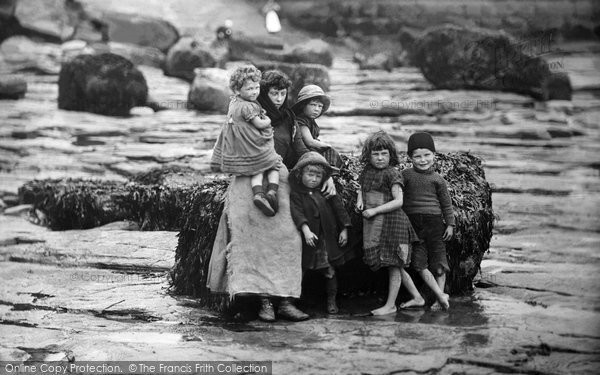
Francis Frith: The Peart family. Whitby 1891

Holy Terrors concludes with Midsummer and for the first time, the effective ambient monochrome palette is replaced with colour; but this is the colour of hand-tinted antique photographs, the faded pastels of half-remembered dreams and half-forgotten memories. It is a fitting place to leave the darkness and step into the light, but minding always that they are integral to and part of each other.
And on this note we will depart this house of souls, with the conclusion that whilst Holy Terrors may not suit the constitution of all, it is a film that has found its way under my skin and into my head and heart and for it its understated beauty and mesmeric invocations, it is something I feel that has touched me deeply. When I first read about this film with my mingled feelings of trepidation and tantalisation, I happily know now that I had nothing to worry about but happily a fair bit perhaps to fear.

22861689_1361936793929438_5666376929960203555_o

oj6qzdb614d5xqhacv9j

Holy Terrors DVD available here

Holy Terrors book available here

Review by Andy Paciorek

Winter Ghosts: What is This What is Coming? 6

b9.jpg

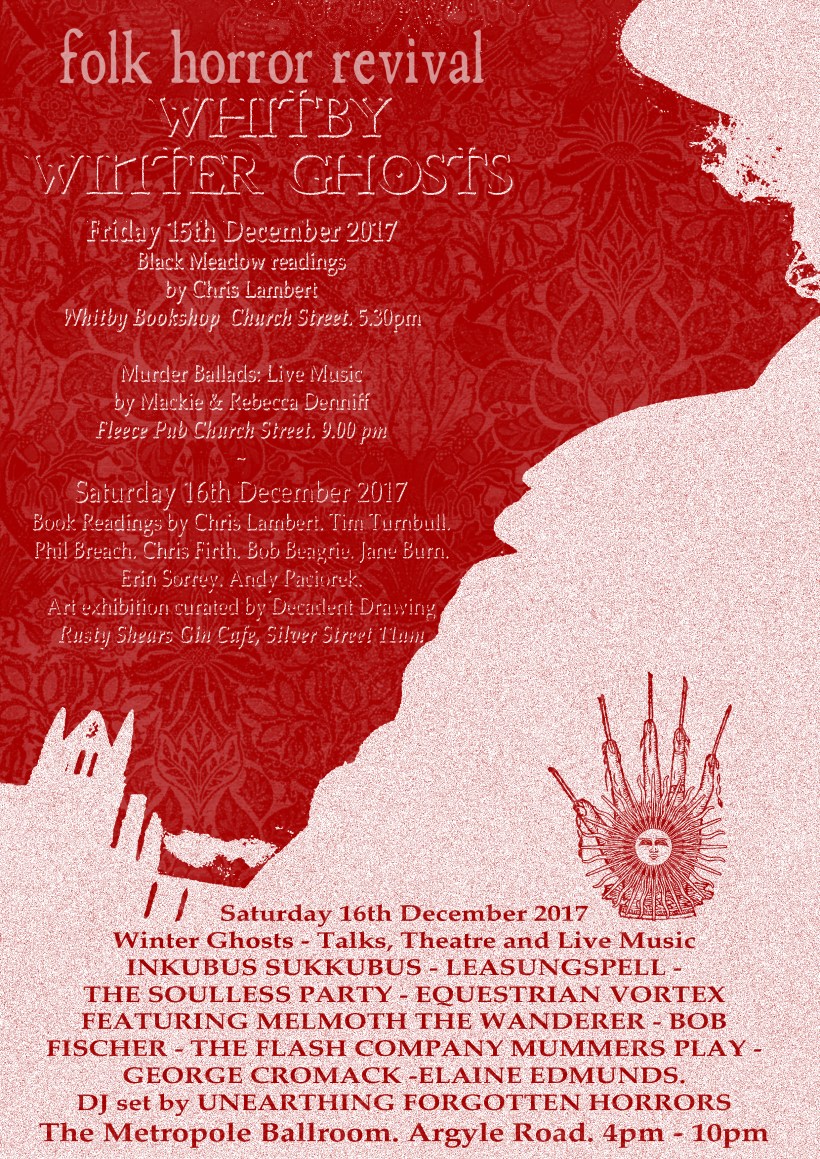
On the weekend of 15th and 16th December 2017, a strange mist will fall upon the coastal town of Whitby. From the sea fret will come haunting sounds and tales and more besides. Here over the coming days we shall in turn usher in the ghosts of winter …

ghostsc.jpg

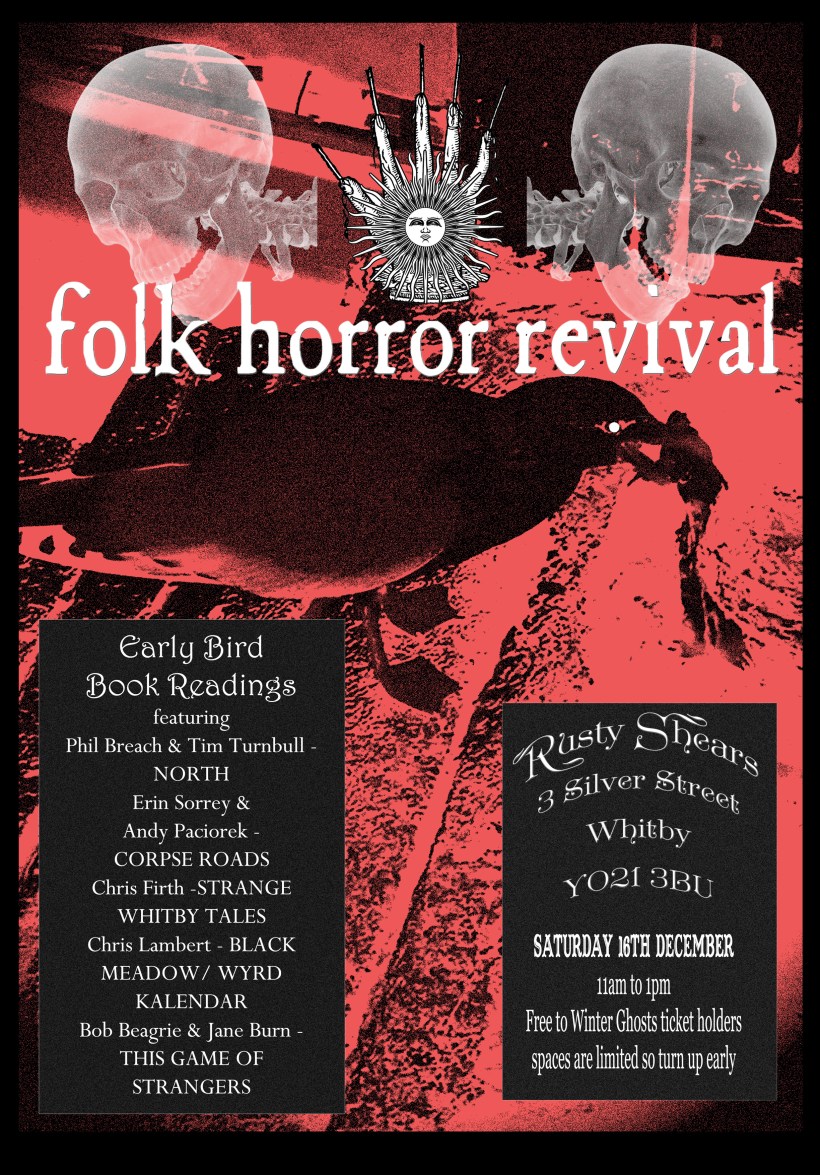
As part of the Winter Ghosts event at Whitby, there will be a session of book readings at the Rusty Shears Gin Cafe from 11am to 1pm on Saturday 16th December.
WEB.jpg

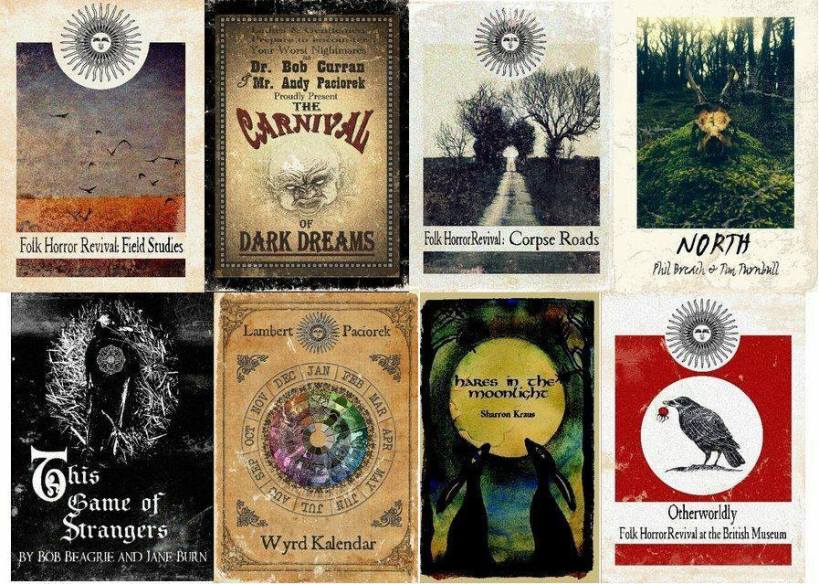
Reading from Folk Horror Revival: Corpse Roads will be Andy Paciorek
Reading from North will be Phil Breach & Tim Turnbull
Reading from Ghost Stories from Whitby will be Chris Firth
Reading from The Wyrd Kalender and The Black Meadow books will be Chris Lambert.
Reading from This Game of Strangers will be Jane Burn & Bob Beagrie

Join us at Winter Ghosts – Tickets and full line up – Here

wghost2.jpg

Winter Ghosts: What is This? What is Coming? 5

Winter Ghosts: What is This What is Coming? 4

Winter Ghosts: What is This? What is Coming? 3

Winter Ghosts: What is this What is coming? 2

Winter Ghosts: What is This What is Coming? 1

Winter Ghosts: What is This What is Coming? 1

b3.jpg

On the weekend of 15th and 16th December 2017, a strange mist will fall upon the coastal town of Whitby. From the sea fret will come haunting sounds and tales and more besides. Here over the coming days we shall in turn usher in the ghosts of winter …

To see full line-up and buy tickets visit here

folk horror revival @ British Museum

On Friday 15th December at Whitby Bookshop at  and on Saturday  17th December at Rusty Shears gin cafe on and at the Metropole Ballroom Chris Lambert (with The Soulless Party)  – Storyteller – Teacher – Traveller of Mist – Mythogeographer – Demiurge – Liar will be treating us to much mysteriousness from his impressive array of books.

Chris Lambert is the curator of the Black Meadow and its associated phenomena. He works closely with Kev Oyston as part of “The Soulless Party” to uncover the mysteries hidden within its dense mist.

a3791317364_10.jpg

He writes far too much. As well as the critically lauded Tales from the Black Meadow he has also recently published (with Folk Horror Revival progenitor and illustrator Andy Paciorek) a new collection of folk horror short stories entitled Wyrd Kalendar and Christmas on the Black Meadow.

He has had short stories published in Dark Spirits, The Ghastling, The Dead Files and Tales of the Damned. He has had four plays published and over 20 performed professionally including: The Simple Process of Alchemy, Loving Chopin and Ship of Fools. He occasionally dabbles with music too. In 2016 he curated Songs from the Black Meadow (Mega Dodo) a folk horror album featuring the music of artists from around the world. He is currently putting together a new album based on the Wyrd Kalendar which will be released by Mega Dodo in the autumn of 2018.

Starburst Magazine has this to say about Tales from the Black Meadow: “The stand out entries include “Beyond the Moor” a poem about a maiden accosted by a bandit who remains unafraid due to having been to the “beyond” of the title and returned. Also of note are “Children of the Black Meadow” where a bereaved mother resurrects her deceased kids as blackberry bramble homunculi; cyclical damnation tale “The Coal Man and the Creature” and the paranoia-inducing sucker punch “The Watcher From the Village” … this is a collection that strongly invites a second reading…”

Sebastian Baczkiewicz – Creator of BBC Radio 4’s “Pilgrim” said this about Wyrd Kalendar – “Gripping, sometimes terrifying but always surprising: this is the year described in the Wyrd Kalendar. Live it if you dare…”

For more of Lambert visit:
Blackmeadowtales.blogspot.co.uk
Wyrdkalendar.blogspot.co.uk
Musicforzombies.blogspot.co.uk
Lambertthewriter.blogspot.co.uk

You can buy Tales from the Black Meadow here: https://www.amazon.co.uk/Tales-Black-Meadow-Chris-Lambert/dp/148417173X
You can buy Christmas on the Black Meadow here: https://www.amazon.co.uk/Christmas-Black-Meadow-Chris-Lambert/dp/1539767248
You can buy Songs from the Black Meadow (the album) here: https://megadodo.bandcamp.com/album/songs-from-the-black-meadow
You can buy Songs from the Black Meadow (the book) here: https://www.amazon.co.uk/Songs-Black-Meadow-Chris-Lambert/dp/1502305399
You can buy Wyrd Kalendar here: http://www.lulu.com/shop/http://www.lulu.com/shop/chris-lambert/wyrd-kalendar/paperback/product-23371751.html

b1

Folk Horror Revival: Winter Ghosts

Hares in the Moonlight

2

A tale of magic and adventure for readers aged 8 – 12 in the tradition of Alan Garner and Susan Cooper. Twins Lucy and Jay rescue a caged hare and then follow it to a moonlit gathering of hares. They find themselves falling into a world of shapeshifting and becoming hares themselves.

To celebrate the Full Cold (Super)Moon, Wyrd Harvest Press are delighted to present Hares in The Moonlight – a magical tale for older children by the accomplished singer-songwriter Sharron Kraus

Save 10% with the code BOOKCALSAVE
at checkout at – http://www.lulu.com/…/hares…/paperback/product-23432343.html
Offer ends December 4th at 23:59

100% of profits from FHR / Wyrd Harvest Press books sold in the Lulu store will be charitably donated at Solstices and Equinoxes to different environmental, wildlife and community projects undertaken by the Wildlife Trusts.

poster

hare distressed

Pagan Dawn

fhr-colour-rough-1a

Pagan Dawn is a quarterly magazine featuring articles, reviews and research on Polytheism, Pantheism, cultural history and nature-based spirituality, published by the Pagan Federation in the United Kingdom.

In issue no 205, Samhain 2017 You will find an article about the Folk Horror Revival by Darren Charles & Andy Paciorek.
With imagery by Julia Jeffrey, Andy Paciorek & Graeme Cunningham.