Holy Terrors: Film Review

Holy-Terrors-Arthur-Machen-2017-Derby-Film-Festival

In August 2017 via the pages of Fortean Times Magazine I first heard of the film Holy Terrors created by Mark Goodall and Julian Butler much to my delight and anxiety. Not only was it a movie featuring 6 weird tales of Arthur Machen but it was made in Whitby! Machen and Whitby – two things I cherish very dearly so I was very eager to see this film but also worried that it might be awful. (Those worries were happily unnecessary.)
Capture3

Also at the time we at Folk Horror Revival were organising the Winter Ghosts event for the following December in Whitby. I mentioned to our Events Manager, Darren Charles how the film could’ve been a good addition to our bill if it were not already fully booked. Then much to my surprise and delight, I received an email from the film director Mark Goodall, who had heard about our event and was wondering if we would like to screen Holy Terrors there. Would we?? Is a bear Catholic? Does the pope … Yes! We were interested!
Some jiggling around of schedule and the film was added to the bill and was indeed an atmospheric and beautiful end-piece to the event.

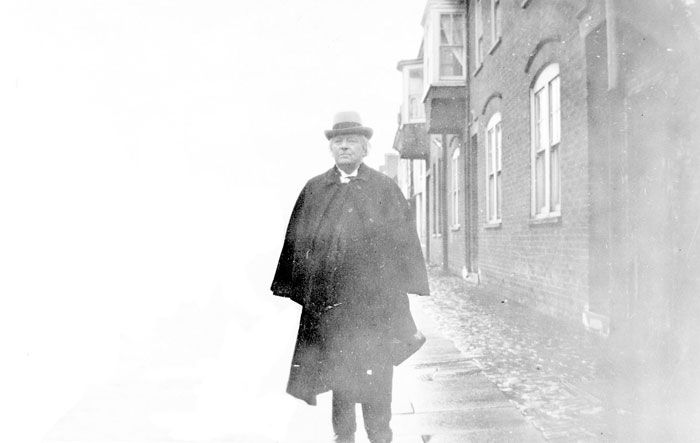
Before discussing the film further, just a short resume of Arthur Machen, for although his light is belatedly beginning to shine brighter, outside of certain horror fiction circles, he is still something of an unknown quantity to many folk.
arthur-machen
Born in Wales in 1863, Machen’s career in weird fiction blossomed out of the Symbolist and Aesthetic fin de siècle of the 1890’s. Like a number of other artists and writers of the era, Machen’s work was a curious brew of spirituality and decadence. Blending paganism and Christianity both in his work and in his own personal mysticism, born the son of an Anglican minister he was a member of the Hermetic Order of the Golden Dawn, but did not renounce his Christian faith. He therefore, in a sense, has an air of the notion of Celtic or Insular Christianity, whereby it has been suggested that some of the earliest priests of the Celtic Church were possibly former druids some of whom preferred to preach in the outside cathedral of nature than within a church; and that numerous acolytes of which were ascetic hermits that lived in remote quiet places. Oddly enough it is often claimed that the Synod of Whitby marked the official end of the Celtic Church. (The Synod of Whitby (664 A.D.) was a Northumbrian synod where King Oswiu of Northumbria ruled that his kingdom would calculate Easter and observe the monastic tonsure according to the customs of Rome, rather than the customs practised by Irish monks at Iona and its satellite institutions. The synod was summoned at Hilda’s double monastery of Streonshalh (Streanæshalch), later called Whitby Abbey.)

Machen was one of the early masters of weird fiction, particularly a faction of which, with his own use of folklore (notably the use of fairies not in their tiny twee Disneyfied forms but as the strange human sized people of old lore) and spirit of place, may now frequently be referred to as Folk Horror.
Those who cite Machen as an inspiration or to express enthusiasm for his work include figures as diverse as the writers H.P. Lovecraft, Jorge Luis Borges, Stephen King, Ramsay Campbell, Alan Moore, Iain Sinclair and Sir John Betjeman through to musicians such as Mark E. Smith, Belbury Poly and Current 93. Notorious occultist Aleister Crowley was a fan of Machen’s work but reputedly it was far from being reciprocated, with Machen having a personal dislike for the man.

2514055_1a383703_120x120
So how would Machen’s subtle strange tales translate to screen?
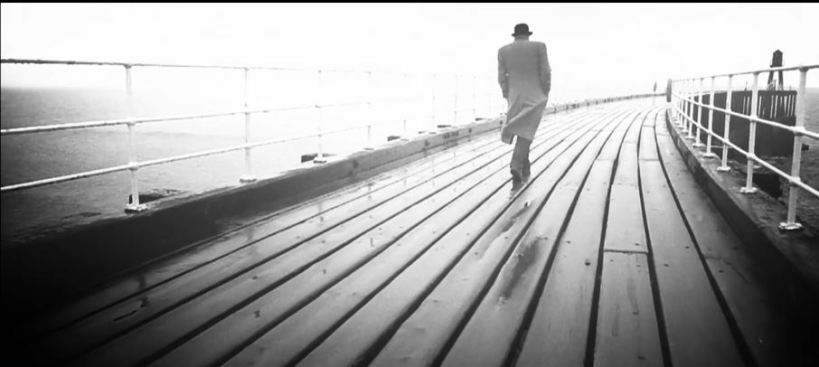
Holy Terrors slowly fades in to scenes of an empty shore and a desolate man. The hauntological soundscape of composer David Chatton Barker (Folklore Tapes) leads us to the body of a man beneath a bridge. Thus opens ‘A Cosy Room’ the first of the 6-weird tales of Arthur Machen. (Indeed, I can vouch it is a cosy room and one not devoid of otherly presence either as I recognised it straight away as a room that I myself have spent several nights in. In fact, after viewing Holy Terrors for the first time at Winter Ghosts, it was the room that I would return to sleep in that very night. The filming location for this segment was The Stoker Room of the cool and quirky hotel La Rosa in Whitby’s East Terrace. Overlooking a great view of Whitby Abbey and the harbour, the wonderful building-sized cabinet of curiosities that is La Rosa hotel has a plaque outside marking it as a place that author Charles Dodgson, aka Lewis Carroll of Wonderland fame amongst other things, stayed at several times. The Angel Hotel in New Quay Road is also suitably plaque-bearing as a residence where Machen stayed.)

The opening wordless narrative shot in atmospheric black and white marked in me the feeling that I was really going to like this film, but also mark it as a film that would not appeal to viewers who only like their horror visceral, fast and with a simple plot and conclusion. Like the tales of Machen, this film adaptation is steady, subtle, atmospheric and most often strange rather than horrific. Some of the tales do not build up to a definite explanation and conclusion but remain more as captures of a strange moment or sequence, rather like many reported real life anomalous experiences.

So, it is safe to say from the outset I could see that Holy Terrors will not be to all tastes but is deliciously to mine.

Capture4
We are then invited to taste The White Powder of the second tale. This is one of the Machen stories to have a more typical sense of narrative in that it follows an event to a solid culmination. It is a tale of both dread and decadence and has both the air of M.R. James ‘The Ash Tree and Kafka’s Metamorphosis but still remains essentially a Machen tale.
(an amusing synchronicity with the screening at Winter Ghosts was that the imbiber of the said White Powder of the film develops an odd black spot on his hand as an early symptom that something is amiss. The black spot very much resembled the black spot on the audience members’ hands that bore the blurred remains of the mark of the Folk Horror Revival sun symbol hand-stamp.)

The White Powder is a solidly told tale and it really brings forth the power of Goodall’s film-making. Relying strongly on an audio narration that bonds Machen completely with these new dreaming of his creations, the character that is etched within the faces, particularly the eyes of the actors in this film is a strong motif, that in its use becomes somewhat hypnotic. Another film-making skill that Goodall employs to great effect is making Whitby timeless; the use of soft focus, careful framing and light bleached backgrounds removes any trappings of modern life such as shopfront banners and so forth.
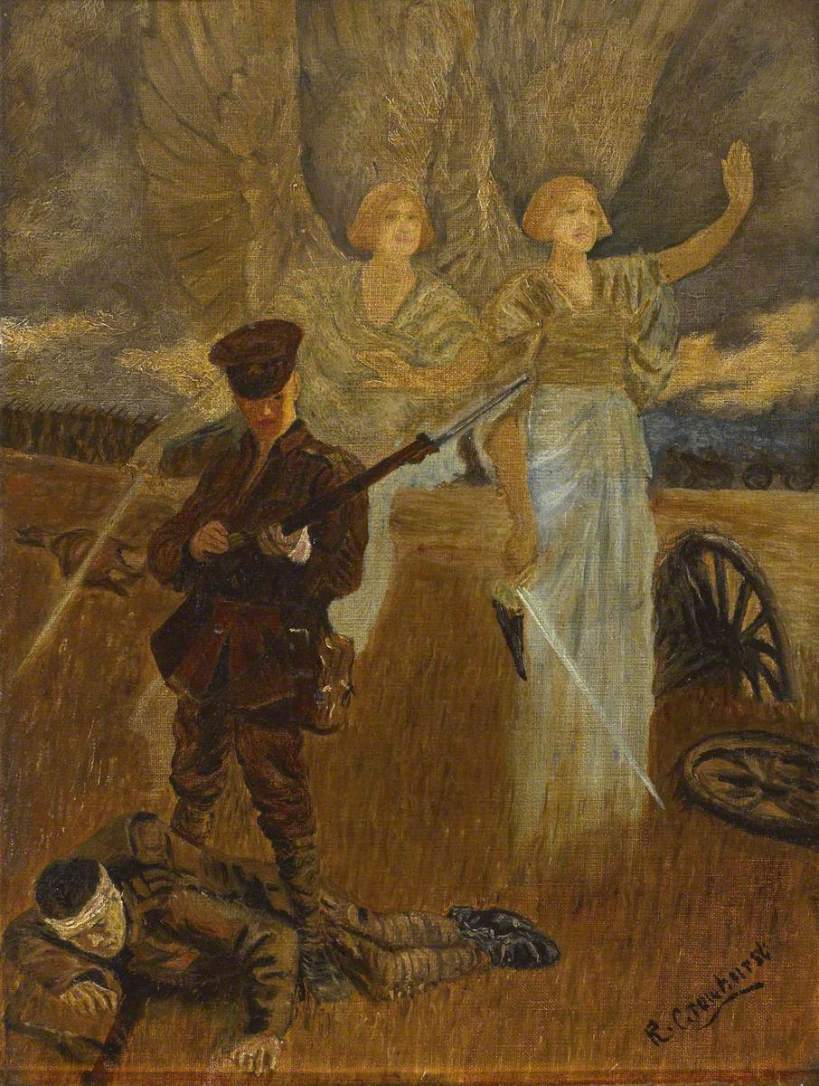
Crowhurst, R.; The Angel of Mons, c.1914
Crowhurst, R.; The Angel of Mons, c.1914; National Army Museum; http://www.artuk.org/artworks/the-angel-of-mons-c-1914-182603

The third tale is one of Machen’s most famous, not because it is his best work or most identifiable of his style but because it has been noted as being the possible origin of the Angels of Mons legend.  At the Battle of Mons on the French borders in 1914, it was claimed and published in the British Spiritualist magazine in 1915, that British soldiers were protected in battle by a host of Heavenly angels. However, in 1914 The Evening News newspaper had published Machen’s story The Bowmen, in which a battalion headed by Saint George intervenes in a conflict between World War I British and German forces.
Out of all the stories within the Holy Terrors film The Bowmen could have been the most problematic for a low budget production. By the effective use of old newsreels of wartime footage, Goodall skillfully conquers this problem and overall the artistry of the entire film does not give the slightest impression at all that it is not studio funded. The photography, editing and production is on the contrary not only skillful but beautiful.

The fourth segment of the portmanteau initiates us into the Ritual. It is however not a ritual of hooded or sky-clad figures in the depths of a wood or desecrated church but that of a playground game of schoolchildren. The simplicity of this has a deeply unsettling nature and again the actors of Holy Terrors deserve applause. To act without words uttered needs to tread a line between expression, subtlety and communicative skill lest it become exaggerated like a mime performance. Again, we find great casting is at work here, for the children have a look to them that would not see their faces out of place in antique Victorian or Edwardian photography.

Capture

The next tale, The Happy Children remains with the theme of strange youths. Unlike those in Ritual, there is a question arises as to whether these children are alive or even of human nature – a Celtic belief about Fairies is that they are spirits of the dead and the Happy Children indeed have an otherworldly sense to them. This segment again effectively uses the townscape of Whitby as a strange and beautiful filming location, and with good cause for this tale is set in Whitby. It is renamed Banwick but the tale is undeniably inspired by Machen’s visit to Whitby on a journalistic task to report on the town’s Jet industry. The story reveals Machen’s mystical sensitivity both of place and to the horrors of war. Whitby and other towns on the North Eastern English coast had been subject to wartime attack by the Germans and Machen’s reference also to the biblical slaughter of the innocents undertaken by Herod in his efforts to eliminate the infant messiah.
NGMA3_203_1024x1024

A phrase within the story describing Whitby as The Town of Magical Dream is a perfect description (it also is aptly used by Carolyn Waudby for her excellent essay on Whitby). The night after Winter Ghosts I walked Whitby’s streets and the pier and the 199 steps to Saint Mary’s Church and the Abbey, and it was not mere suggestion but there was a palpable otherness to the coastal town darkened save for the twinkling of Christmas lights. There was a definite presence, not unwelcoming for the most part save for the pool behind the abbey where I felt that I was not meant to proceed further so I didn’t and for a strange unsettling sensation in the Screaming Tunnel of the Khyber Pass. I know that I am far from being the only one to sense something strange in Whitby’s thin sea fretted air – Machen sensed the liminality as did Bram Stoker and Mark Goodall captures it in Holy Terrors as do Michael Smith and Maxy Neil Bianco in their atmospheric and poetic short film ~ Stranger on the Shore: Hounds of Whitby.
whitby-the-peart-children-1891_28866_large
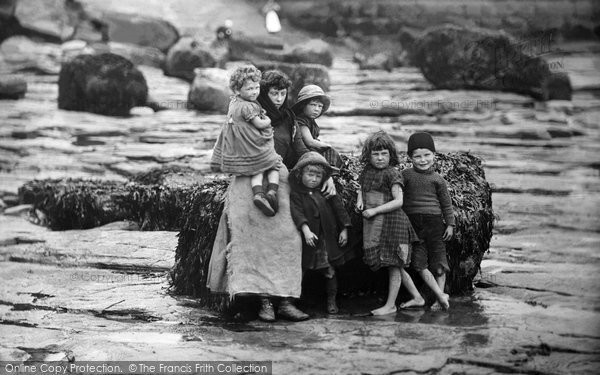
Francis Frith: The Peart family. Whitby 1891

Holy Terrors concludes with Midsummer and for the first time, the effective ambient monochrome palette is replaced with colour; but this is the colour of hand-tinted antique photographs, the faded pastels of half-remembered dreams and half-forgotten memories. It is a fitting place to leave the darkness and step into the light, but minding always that they are integral to and part of each other.
And on this note we will depart this house of souls, with the conclusion that whilst Holy Terrors may not suit the constitution of all, it is a film that has found its way under my skin and into my head and heart and for it its understated beauty and mesmeric invocations, it is something I feel that has touched me deeply. When I first read about this film with my mingled feelings of trepidation and tantalisation, I happily know now that I had nothing to worry about but happily a fair bit perhaps to fear.

22861689_1361936793929438_5666376929960203555_o

oj6qzdb614d5xqhacv9j

Holy Terrors DVD available here

Holy Terrors book available here

Review by Andy Paciorek

Folk Horror Revival Young Artist of The Month

The Folk Horror Revival Young Artist of The Month is an award for children under 12 years old. Many of our group members come from an arts background and so we’d like to encourage and inspire the next generation too.
We don’t mind if the work is based on other artists work as we understand that all artists learn from copying, plus its great to see the inspiration behind the work. Drawings, paintings or any other medium are welcome. The drawings must be inspired by either folk horror, folk tales (including fairy tales), folk traditions, ghost stories, magic, myth, legend or even the seasons.

Every month we will be giving away a copy of Sharron Krauss’ book Hares in The Moonlight(published by Wyrd Harvest Press) to our favourite artist. For more information about this great book, please follow the following link:

http://www.lulu.com/shop/sharron-kraus/hares-in-the-moonlight/paperback/product-23432343.html

The winner will be announced during the last week of every month and will be judged by Folk Horror Revival administrators John Chadwick and Chris Lambert.

Please don’t worry if the entry is submitted on the last few days of the month as all entries will roll into the following month if they arrive after our decision making.

Submit all entries digitally, as a .jpg file preferably, to fhryoungartistawards.

Best of luck!

Book Review: American Ghost by Paul Guernsey

American Ghost by Paul Guernsey

Thumb Rivera is a small time drug dealer who makes the mistake of trying to get in league with the local biker gang, which ends badly for him. American Ghost follows his efforts to solve his own murder from the afterlife. Paul Guernsey’s third novel is basically a supernatural detective story with a heavy dose of dark Americana, featuring backwoods biker club houses, trailer meth labs and abandoned murder houses.

The story is structured in an interesting fashion, with Thumb’s spirit travelling through time and space, with no knowledge of how the afterlife works, this being revealed slowly to him via other trapped spirits he meets on the way, including the ghost of a man who died in a road accident, who now lingers in the spot he died. By and large Thumb has to observe how life moves on without him, but learns to communicate with two living people, a hapless ghost hunter and a pig farmer who is also a frustrated novelist, who provide a conduit to the land of the living.

The story is well constructed and keeps you engaged as the plot unfolds, as Thumb comes closer to discovering who killed him and why. The afterlife Guernsey constructs is fascinating, with it’s own internal logical and laws.

I’m not usually much of a fan of crime fiction, but this supernatural twist on the murder mystery made it much more enjoyable. If you fancy a haunting (in both senses of the word) mystery novel, then this is for you.

Paul Guernsey also edits The Ghost Story, which has much of interest to revivalists.

review by Scott Lyall

Review – The Stone Tapes – Avebury

Was this sent to me in the post or did I discover it in a cavity between the two damp granite walls of a forgotten stately home? Did I, driven by the impulse of a voice within me, frantically tear it from the mud and sod of a field deep in the heart of the West Country? Was I surrounded by ancient stones that seemed to sing out to me when touched or gently caressed? I am uncertain. Is this a genuine recording created using up to date digital technology or are they the sounds captured in the lusum magnetite of the dank walls, playing back when the atmospheric conditions are just right? There is an uncertainty here. This uncertainty is frightening and this fear is rich and sublime.

I listen again to ensure that it is not simply my own imagination or a half forgotten dream, but there it is; the voice in the static, the seemingly innocuous information about Avebury, the snatches of phone conversation with one voice strangely distorted. Is it deliberate? I don’t know. But I am unsettled, I am frightened and this fear is alive and immediate. But I welcome this and I stroll towards it all, arms wide.

In West Kennet the ritual has begun and my head spins, half formed voices dance out at me from within the ether, the whirling electronic dervish excites, inviting me to join the dance but I must not. I must resist. I take shelter in the lychgate, the rain pummelling down all around me and for a moment all is calm.

The rain stops and I venture towards the Owl and Druid Stone. I know I should not touch it but my hand is pulled forwards. The voices and tones thrust into me like lightning into bark. I am among the petrosomatoglyphs, the damp and the drip, the indistinct. The sound grows, it ululates through me as I spin, the light between the stones scratching at my retinas with every pass. My feet leave the ground, stray ends of grass tickling at my bare feet as I rise a narrow herepath before me, made of silver and granite. On closer inspection the path is festooned with tiny carvings, myriads of spirals, symbols, laughing mouths. The mouths move and speak and sing and question and grin. I am lost. I fall.

Reality seeps in. A voice clear and distinct on the end of a crackling line gives thanks. But, it flits away and deeper voices and drifting tones chant around me.

A cry. Someone is lost. But how can you be lost if you stand in one place? How can you be lost if you have not moved from the centre of a field? The sound builds, a low hum, growing. Reassuring dots and bleeps try to break through, but something is crawling in the dark. Something is in the way. I cannot move.

I am overtaken. I should not have listened to the Stone Tapes for madness seeps through. Sometimes we look to deep into the dark, sometimes we travel too far.

I have removed the headphones but Avebury is still within me. The sounds among the stones are sounds among the synapses. The stones are seen when I shut my eyes, when I blink, when the sunlight scrapes across the iris, the stones creep through into the dark.

Do not listen.

Do not listen.

Do not lis

Do not

Do

Sink. Tread. Spin.

Let it in. Let the stones in. Let them all in.

Chris Lambert – January 2018

REVIEW – Rowan Amber Mill `Harvest The Ears’

The Rowan Amber Mill
Harvest The Ears
(https://rowanambermill.bandcamp.com/album/harvest-the-ears)

The Rowan Amber Mill have been quietly but steadily pursuing their own eerie ruralism and arcane take on psychedelia since 2008’s ‘Folk Devils and Moral Panics’, notably releasing the ‘Book of the Lost’ project with fellow traveller of these roads, Emily Jones, in 2014. This latter recording was an homage to such films as The Wicker Man, Witchfinder General, Blood On Satan’s Claw and Psychomania and ably constructed a soundtrack for an imaginary composite movie, replete with accompanying lobby cards and a suitable mythos. Aficionados of both modern day acid folk troubadours such as Sproatly Smith and Sharron Kraus as well as the haunted electronics of the Ghost Box label are strongly encouraged to wander not only the dark woods of ‘Harvest The Ears’, but also those of the Amber Mill’s back catalogue (a twisted folk version of Gary Numan’s ‘Are Friends Electric’ is one suggested highlight).

The Rowan Amber Mill’s most recent offering is a summing up and compilation of sorts, gathering new, unreleased and remastered songs together under the appropriate banner ‘Cuts From The Folk Horror Archive Vol 1’.

The extended title track of the afore mentioned ‘Book Of The Lost’ opens the album, a Vincent Price styled narrator and a shimmering wash of harpsichord and vintage synth immediately creating an effective atmosphere somewhere between John Barry and Paul Ferris’ s essential score for Witchfinder General. The full length ‘The Book of The Lost’ is a master work and this lengthier version of a track cut from its parent album is no less essential. The melancholic beauty of ‘Separations’ follows, part electronic madrigal and part woodwind imbued lament; this is truly a folk song of the forest. Next, ‘The Witch Twists The Pins’ is a sinister nursery rhyme, echoed vocals framed by the darkest of psych folk to conjure an evocative and magical musical incantation. A highlight of an album filled with many such strong points, this would be worth the cost of admission alone but there is much, much more. ‘Face Of Flowers (Woodcut)’, from the genius ‘Heartwood’ album, utilises harmonised vocals, insistent acoustic guitar and spectral strings in manner that surely has Paul Giovanni nodding his agreement from above. ‘A Hunting’ glistens into being from a few stately harp notes, growing and layering with both analogue synths and waves of choral voices, creating a welcome sense of unease and beguiling nostalgia. This then segues into ‘Pit Of Horror’, a swirling and dramatic instrumental that surely would have been gracing the soundtrack to a 1970’s children’s TV show of a more pagan bent, such as ‘Children Of The Stones’ or ‘The Owl Service’, had it been of that age. ‘The Witch Twists The Pins’ agreeably returns in instrumental form, revealing hitherto hidden detail, until it leads into the final track ‘The Call Of The Black Meadow 1, 2 and 3 (Backing and FX)’. A track previously used on The Rowan Amber Mill’s promotional video for the ‘Songs From The Black Meadow’ album (inspired by Chris Lambert’s book ‘Tales From The Black Meadow’), this is a haunted house of a song, stripped back to effects and sounds redolent of Daphne Oram or The BBC Radiophonic Workshop with solar winds and ghostly electronics whispering in and out of focus to powerful and disturbing effect. And then it is over and the listener is left with an enduring and pleasant feeling of disquiet, appropriate given the folk horror nature of these compositions.

This is an album then that belies its compilation or assorted collection status; it genuinely works as a piece in its own right and sits comfortably and confidently alongside the other Rowan Amber Mill recordings. Highly recommended to those who are keen on investigating the musical side of the folk horror revival, this is indeed a rich harvest for the ears. Time to gather the corn.

Grey Malkin January 2018.

Folk Horror Revival T-shirts – January Sale

26166143_390365698052762_1726852979878751518_n

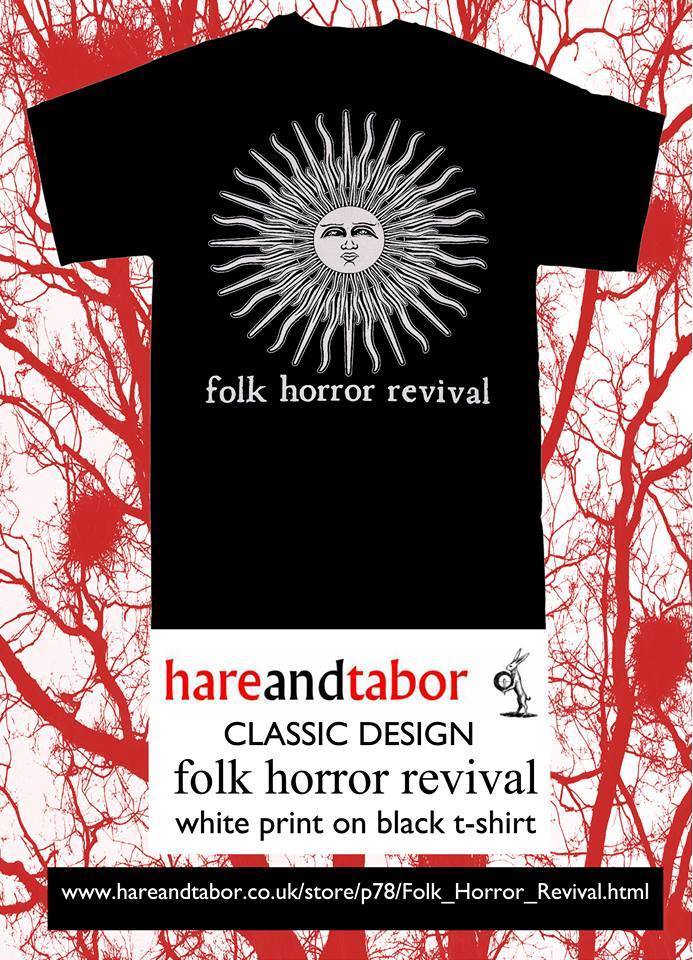
If you want to grab one of the Folk Horror Revival t-shirt designs from Hare and Tabor they currently have a sale on now! Lots of other great designs and tea towels available there as well.

20% OFF EVERYTHING in store! Simply use the code HAREANDTABORJAN2018 at the checkout.

http://www.hareandtabor.co.uk/store/p78/Folk_Horror_Revival.html

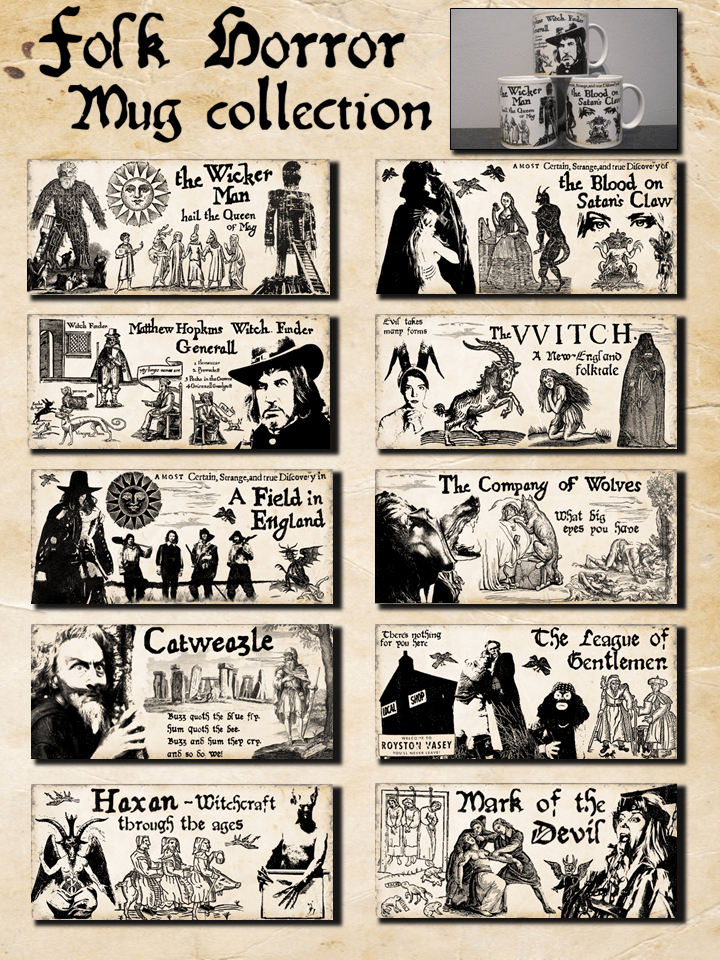
Midnight Mugs ~ The Folk Horror Collection

26235333_10155980737376948_1934173149_n
Presented for your ceremonial sups of many a strange brew, Midnight Mugs
present the Folk Horror Collection.

26241938_10155984565686948_350281963_n.pngEnjoy your victuals in reverence to ~

  • The Wicker Man
  • The Blood on Satan’s Claw
  • Witchfinder General
  • the VVitch
  • A Field in England
  • The Company of Wolves
  • Catweazle
  • The League of Gentlemen
  • Haxan
  • Mark of the Devil
    and new fresh from Gods’ own country …
  • Harvest Home23721778_10155845818951948_2017156580_n

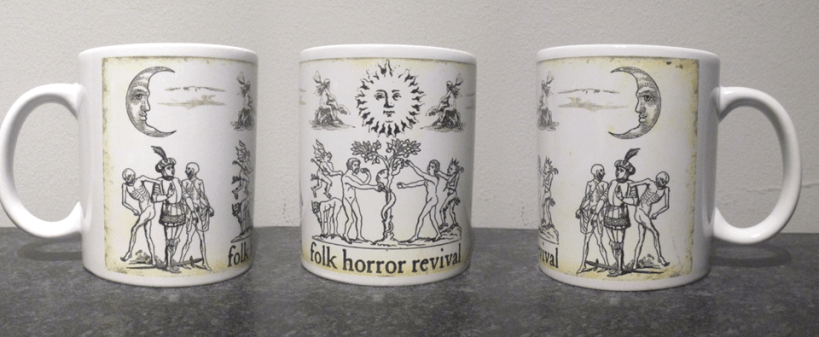
Also available ye olde Folk Horror Revival mug!! Oh, joy of joys !! 🙂

23805790_10155864059616948_980477774_n

To purchase these fine drinking vessels ~
Contact Steve via the Midnight Mugs Facebook Group
or telephone him on (UK) 07980 871 769
or email at stevie7771@hotmail.co.uk

Mugs are £6 each + postage at cost..

UK postage is £4  for 1-4 mugs (2nd class signed for)

5+ mugs is £8 postage.

Contact  Midnight Mugs for information regarding Overseas shipping

Payment by PayPal preferred.

24130230_10155883208176948_5891266257281957438_o.jpg

Wyrd Harvest Press: Charity Donation – January 2018

a33f1946e8475e0a4e4f456a9c1e541b--pentacle-hedgehogs

For this season’s charity donation of all the profits from sales in our Wyrd Harvest Press online bookstore ( http://www.lulu.com/spotlight/andypaciorek ) we are happy to donate £368 to Sheffield Wildlife Trust’s Hedgehog Hero appeal (as voted for in a poll by members of this group.)
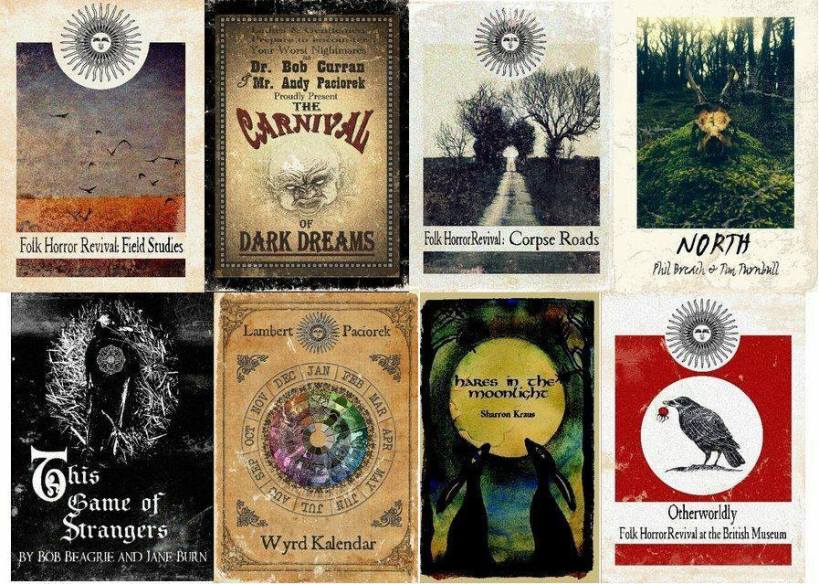
Folk Horror Revival / Wyrd Harvest Press donate all sales profits from their range of very good books to Wildlife Trusts environmental charity projects, 4 times a year (Folk Horror Revival: Field Studies is recommended as essential reading for all fans of folk horror, especially those entering into discussion or posting on the facebook group as it contains essays and interviews with many leading lights of both classic fh and of the ongoing Revival).
A host of intriguing books are planned for 2018 from a diversity of talents.
Thank you to everybody who supported these very worthy causes by buying our books

Beyond the pale. into 2018

There have been several notes of Thanks issued from the Folk Horror Revial Inner Sanctum over the last few days. I do not need to repeat all individual names but I do need to to echo again the great gratitude to those that made a great year for Folk Horror Revival. There has been difficulties along the way but also a lot of fun, talent, hard work and generosity that has really taken some of us from moments of despair into joy of the creation of something special and sincere. So again Thank You very much, you know who you are or should do.

The year culminated with Winter Ghosts and presented here is a poem written especially for the event by Erin Sorrey. Erin has been a great support to me through the year and FHR journey as well as being a talented element of the Revival itself . Much love, thanks and respect.

Myself (Andy Paciorek), Darren Charles and all the Folk Horror Revival cult wish you all a peaceful, pleasant, prosperous and a somewhat horrifically haunting 2018.

PEI december 2015 crystals 060EDIT.jpg

WINTER GHOSTS

The dark sky meets the dark sea,

Guardians of eternity-

A mystic gateway.


From off the ocean, sweeps a spectral howl.

Spirits lost in fathoms and tides;

Are beckoned by the frosty shore.

Nostalgic for decades gone-

The past where they pained and played.


I hear echos in the waves which I cannot explain,

Drowning exclamations and whispers.

The cold nights lure me here;

Strolling aphotic, empty piers.


I raise my collar to the icy wind-

As the awakened dead, wander cliffs and sand.

Words and Image ~ Erin Sorrey 

26167875_10159742019940484_5915334012224595824_n

white noise

to walk upon the crystal dust
of frozen rain and tears
the ghosts of winter
still follow in my wake
of the tracks
of my fallen footsteps
a silence of echoes
a stirring of souls
that glitter like yule lights
in charnel grounds
and beneath cathedral peaks
shadows cast by lunar rays
and electric lanterns
and dissipate
like melting snowmen
into white noise
Words and image – Andy Paciorekfade.jpg