Tickets still available – purchase soon to avoid disappointment …
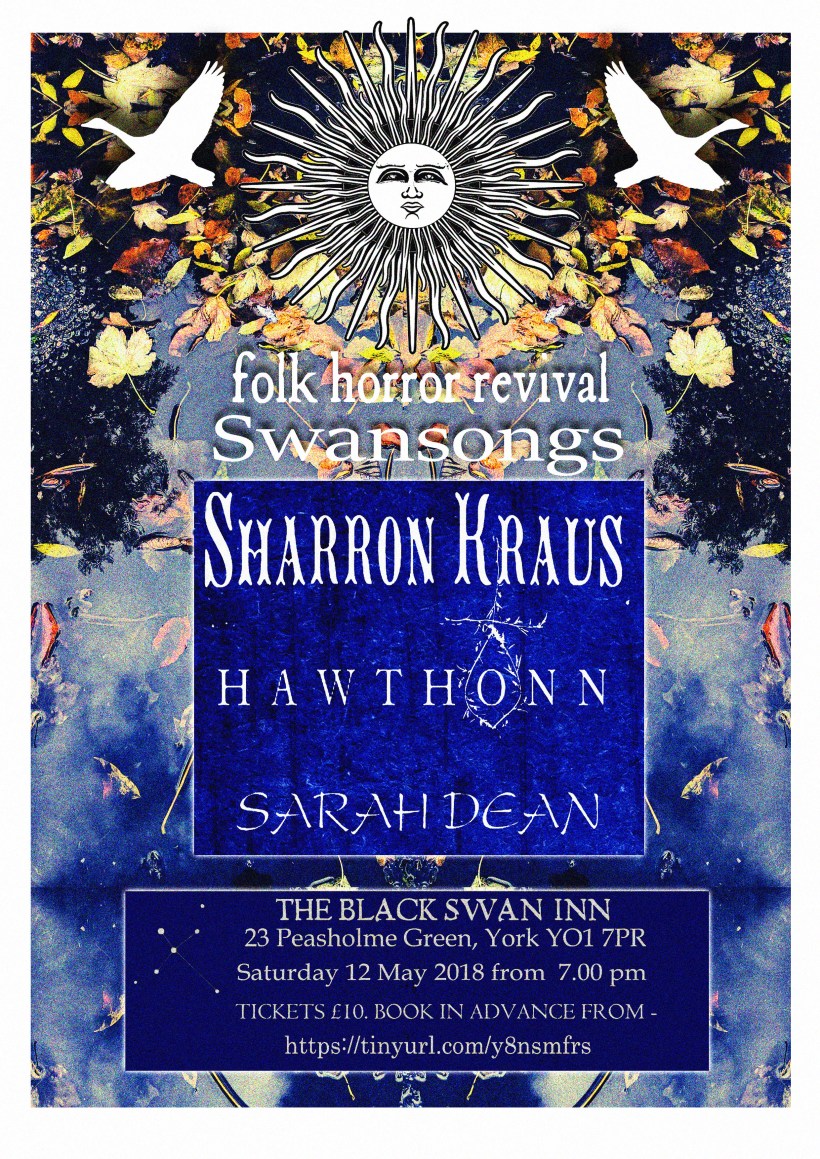
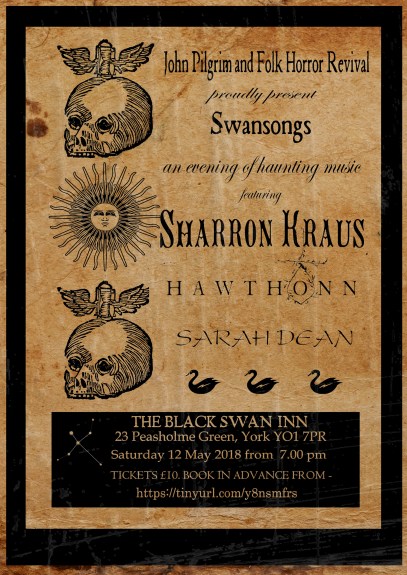
John Pilgrim and Folk Horror Revival proudly present ‘Swansongs’, an evening of haunting music at the Black Swan Inn, York featuring Sharron Krauss, Hawthonn and Sarah Dean.
Last year I was very privileged to be invited to the Fear in the Fens Festival as a guest speaker to present ` Otherworldly – an introduction to Folk Horror.’ As a part of that event there was screening of several amateur short films with a Folk Horror thread running through their themes and atmospheres. The best of this crop was the outstanding, spooky and tense `Toll Booth’. On my way home from this event due to railway works there was a bumpy bus ride along dark unfamiliar Norfolk roads and lanes during which I had the pleasure of chatting to the director of Toll Booth – Martin Stocks.
Since then I have kept an eye out for Martin and his work and it came as no surprise
when I saw Toll Booth picking up award after award at multiple film festivals. So far it had won 6 awards including the Gold Award for Best Thriller at LA Shorts Award; and Best Screenplay at Canada International Film Festival as well as being nominated for the Yorkshire Film Award at Leeds International Film Festival – making it eligible for the BAFTAS and Oscars!
The film is focused on Terry on his first night as the keeper of an isolated toll booth which is seemingly haunted by the fact that his predecessor disappeared from his post in mysterious circumstances.
Boredom – it is by no means a busy booth – starts to play on Terry’s mind and eventually he steps out into the mist to investigate and explore his new surroundings. However isolated as he is in this remote eerie landscape Terry oHostarts to get the feeling that there’s something out there lurking in the surrounding fog…something sinister and possibly otherworldly. The paranoid loneliness of the toll booth seems preferable however to the unnerving uncertainty of what is outside the protection of its flimsy clapboard walls.
Each customer who comes to pay their toll seem poised to be a terrifying new twist and each one adds to the nerve wracking tension…….until…
Black Lake
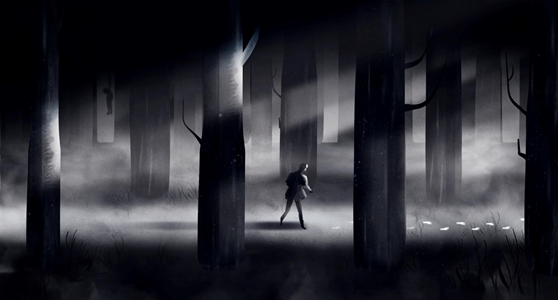
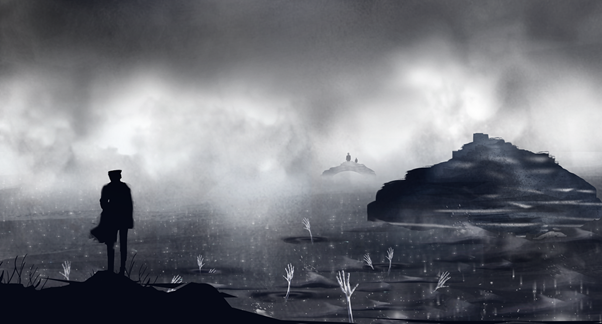
Somehow, whilst touring Toll Booth to film festivals around the globe, Martin has found time to start work on a very adventurous and ambitious project indeed – an animated short thriller called Black Lake.
….A man wakes in a dark, foggy, beautiful, yet hostile world after causing a fatal car crash. He navigates this place, initially spellbound by its stunning ethereal nature, and its pitch black lake with small floating stars. Dread quickly sets in as he realises the malevolent dangers lurking beneath the surface of this half-dead world. He is forced to confront his darkest fears and face the ultimate sacrifice to escape…..
Over to Martin –
“For this dark and compelling story, we are creating a starkly beautiful yet hostile world that our protagonist is thrown into. This project explores the concept of purgatory in a different and surprising way. It is also a taut narrative that will grab viewers by the throat and not let up until the end credits. We aim to produce a visually stunning thriller which will leave you breathless.
There is a multi-talented animation team on board to achieve my ambitious vision. This film will act as a proof of concept for a feature version that we are developing. as I think the script is one of the best things I’ve written. It explores complex themes like guilt, isolation and redemption – and creates a beautiful visual world. With the animation team we have in place I’m really excited to see them realise this stunning world. This film is also a big stepping stone for me as a director looking to move into feature films. Producing this with a proper budget will help me create a beautiful, compelling and touching film…… The success of Toll Booth has shown that I can produce films that engage with audiences and gain critical recognition. I want this film to be so good that it cannot be ignored by the industry and it helps my team get the exposure, recognition and opportunities they deserve.”
All of this vision needs support so if you want to help Martin and the team see their vision come to life there are options and rewards for those wishing to donate and be a part of an exciting project….
This is the follow-up to Martin Stocks’ (writer/director) short thriller Toll Booth. This has won 6 awards including, Best Thriller at LA Shorts Awards and Best Screenplay at Canada International Film Festival. It was nominated for The Yorkshire Film Award at BAFTA and Oscar-qualifying Leeds International Film Festival. A feature version is in development.
James Wren is producing, having made several feature films. The Man You’re Not features Reece Sheersmith and Joanna Lumley, and recently premiered at East London Film Festival. He also produced short horror/comedy The Monster with Film London, which screened at over 50 festivals and won numerous awards.
Gabhriela Swan Gabhriela is a London-based Illustrator, Designer and Concept Artist whose creative practice takes many forms. From environment visualisation and character design for film to animation and fashion. Easily-identifiable by their trademark ethereal aesthetic, her illustrations have been recognised by major industry brands from both fashion and film including The Mill, Digital Arts Magazine, Ted Baker and Paul Smith. Her sensitivity to project narratives and ability to communicate stories by new and innovative means has generated commissions given her mysterious, often supernatural imagery, evident across all projects, media and disciplines.
After John Pilgrim’s most insightful interview with Phil and Layla from Hawthonn, he has been in touch with Folk Horror Revival favourite Sharron Kraus to chat about her inspirational new album, her enchanting novella Hares in the Moonlight and Folk Horror’s revival, as well as talking about the upcoming Swansongs event at the Black Swan in York on May 12th. Anyway, I shall leave the floor clear for Sharron and John to guide us through the mist.
John Pilgrim: You are a good friend of Folk Horror Revival, having appeared on stage at the 2016 event at the British Museum and at the Hepworth Gallery in Wakefield last year. What do you make of the revival of interest in folk horror which is taking place more generally? What do you think accounts for this and do you have thoughts on how this might continue to develop?
Sharron Kraus: The question of why there’s now an upsurge of interest in folk horror is an interesting one but I’m probably not best qualified to answer it, as to me the real question is what’s taken everyone else so long?! If I were to speculate wildly about why folk horror is gaining in popularity now, though, I’d guess that it’s something to do with the fact that the world has recently become a darker, more chaotic place.
John Pilgrim: A deep spiritual connection with the landscape permeates much of your work. What were the formative experiences for you in connecting to the landscape and how has your connection and awareness changed over the years?
Sharron Kraus: I loved insects and trees as a child and forests have always been special places for me. I spent a year in Aberystwyth as a student and the landscape of Mid Wales cast a spell on me. For years after leaving there the kind of landscapes I’d found there appeared in my dreams. The first time I took LSD I was in a copse just outside Oxford with a couple of friends. We spent hours in what felt like an enchanted land and afterwards, though the vividness of the trip wore off, the things I’d discovered never left me. It feels like there are new layers to my experience of landscape being added all the time.
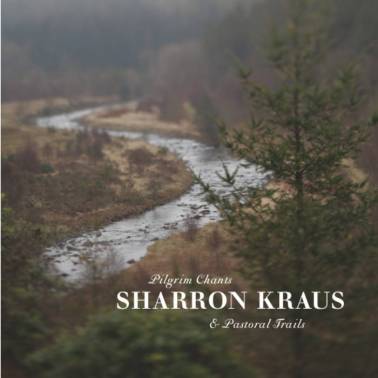
John Pilgrim: Your album Pilgrim Chants and Pastoral Trails has been described as inhabiting “an an eerie and wonderful world, somewhere between eisteddfod and witches’ sabbat” . and as being “suffused with a lovingly melancholic sense of place”. How did this album come about?
Sharron Kraus: I visited Mid Wales, after years of not having been back there and my heart swelled with love for the place. I drove up through the Elan Valley, stopping and walking here and there, and wherever I stopped I had a tantalising sense of there being music just out of earshot. I stayed with friends and told them how I was feeling and they diagnosed a case of ‘hiraeth’, which is a Welsh word meaning something like homesickness or deep longing for somewhere. I decided to move to Mid Wales and try to listen to the land and draw out its music. At the time I thought that what I was doing was only possible because of the ‘magic’ of the place, but the way of working that I developed – that kind of listening and opening up to the place – became something I could then apply to other things, working on different projects. Two collaborations I’ve worked on since then – one with poet Helen Tookey and one with writer Justin Hopper – have involved the same kind of ‘listening’ to the text and responding musically to it.
John Pilgrim: One of your songs is ‘Blodeuwedd’ which I am sure must derive from the Mabinogi – the earliest prose stories in Britain. Can you tell us more about your interest in this mythology?
Sharron Kraus: I read the Mabinogi whilst I was living in Wales and loved the fact that some of the settings in the stories were actual places around me – that made obvious the magic in the land I was living in. I found the stories confusing at first – they’re very condensed and seem to require unlocking – and my way in was through writing songs about the stories or characters I wanted to gain some understanding of. As well as Blodeuwedd, the woman conjured out of flowers, I wrote about Branwen, the Welsh princess who’s married to Matholwch, King of Ireland, and who trains a starling to take a message to her brother Bran in Wales, Efnisien, the troublemaker who starts a war between the Welsh and Irish, kills his own nephew by throwing him in the fire, then redeems himself somewhat by sacrificing his life to save his countrymen. I was writing about the characters in the stories, but also about my own experiences living in Wales, and about eternal themes found in the stories – like the plight of the migrant forced to seek work in a foreign land.
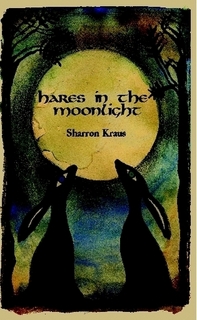
John Pilgrim: You have recently published ‘Hares in the Moonlight’, a tale of magic and adventure for readers aged 8 to 12, in the tradition of Alan Garner and Susan Cooper. What prompted you to follow this tradition in writing for this particular age group?
Sharron Kraus: I wrote ‘Hares’ for children of good friends of mine and wrote a story I thought they would enjoy. I didn’t exactly decide to write in a tradition, but was influenced by the writers and stories I’d enjoyed as a child, including Garner and Cooper. I was keen to write about magic in a way that conveyed something true, which is what I think the best magical children’s writing does. I think this is something children’s fiction shares with folk horror: both of these things try to convey something of the mysteriousness, weirdness or magic of the world we live in. John Pilgrim: You spoke on ‘Art as Alchemy’ at the ‘Psychoanalysis, Art and the Occult’ conference in London in 2016. Recognising that this is complex subject, can you say something about how you see art as a form of alchemy. How does this thinking apply to your artistic practice and day-to-day life?
Sharron Kraus: The basic idea is that through art we can take suffering, pain and darkness and transmute them into something golden. The way the crucible of creativity does this is one of the things I think of as true magic – not supernatural magic, but just our ability to take chaos and form something from it – the way we make something out of nothing. That’s a very short answer; for a fuller one, there’s a podcast of the talk I gave at that conference here: https://soundcloud.com/highbrowlowlife/sharron-kraus-ru-podcast.
John Pilgrim: Joy’s Reflection is Sorrow, your new album, will be released on Sunstone Records in June. What themes have you been exploring in this recording and what are the points of continuity and discontinuity with your previous work?
Sharron Kraus: Most of the songs on the new album were written in the year my Dad died, and the wider world started to edge its way towards darkness, so death and darkness are pretty central. The chorus of one song asks the question “What can we do when darkness falls; what can we do when evil calls?” and I think the album is my attempt to answer that question. I guess it’s a question that’s been there implicitly in my work for a long time but that came up to the surface on this one. Sonically this is probably the most poppy album I’ve recorded – kind of baroque-folk-pop. I think that’s partly due to my decision to try to write in standard tuning and using verse-chorus song structures more than I’d normally do. Maybe it’s also partly because the world got darker and I wanted to add some light.
John Pilgrim: You will be playing at the Swansongs event at the Black Swan – a haunted medieval public house in York – on 12 May. What might people expect and do you think the venue might influence your performance?
Sharron Kraus: Playing in an atmospheric venue always adds something and the darker and spookier the better! I’ll be playing a mix of songs and semi-improvised instrumental pieces with Guy Whittaker joining me on drums and percussion. We may have a special guest with us and whip up some Rusalnaia magic too!
Sharron will playing at our Swansongs event at the Black Swan in York on May 12th alongside Hawthonn and Sarah Dean. To buy tickets for this intimate evening visit the link below, but remember tickets are very limited and we would advise pre-booking to ensure admission.
To celebrate the Folk Horror Revival Swansongs event at the Black Swan in York on May 12th the Kalendar Host has produced a special walk upon the heath that explores the work of the artists at that concert – Sharron Kraus, Sarah Dean and Hawthonn. As well as this you will hear extracts of swan related poetry and tales and music from Passengers, Thom Yorke, The Ken Moule Assembly, REM and Saint Saens.
Swansongs | Folk Horror Revival
folkhorrorrevival.com
John Pilgrim and Folk Horror Revival proudly present ‘Swansongs’, an evening of haunting music at the Black Swan Inn, York featuring Sharron Krauss, Hawthonn and Sarah Dean.
At some point or other, we have all heard a version of the tale of the phantom hitchhiker. And while there are many variations, the basics of this well-known story always remain the same – a traveller picks up someone standing by the side of a lonely road, but at some point on the journey home they discover their passenger has mysteriously vanished. This classic chiller is said to have occurred all around the world, but one of the most famous examples of it is the haunting at Blue Bell Hill. In the heart of Kent, a road which connects Maidstone to Rochester runs over Blue Bell Hill, which the site of the remains of a Roman temple. As is usual for such ancient locations, the area has accumulated a certain amount of folklore and strange tales over the years, but the famous hauntings seem to have begun relatively recently with a terrible road crash. On the 19th of November 1965, a Ford Cortina was carrying four young ladies to the Running Horse pub in Maidstone. But along the way, by Blue Bell Hill, their vehicle a terrible accident occurred. No one is sure what caused the crash, but ultimately it took the lives of the three of the quartet, including one young lady who was to be meant to be getting married the following day.
By the mid 1970s, tales began to circulate in the local area and popular press of eerie figures encountered on the road, often a young woman in white, with some versions reporting she wore a bridal dress. However over the years other figures were reported too, children and old hags, and little by little the Blue Bell Hill area has gained a reputation for being something of hotspot for paranormal activity, with stories of weird cryptids, such as a gorilla-like creature and phantom black cats, being spotted in the area. It would seem that once an eerie story sprouts upon a landscape, it soon proliferates, and others soon come to join it.
Now there has always been a lot of cross-over between the world of folklore and weird fiction, with Bram Stoker drawing on many old legends to create the modern pop culture incarnation of the vampire, while MR James and many tellers of ghostly tales who followed him have often inspiration in local legends and historical curiosities. However once what were once called gothic, weird fiction or sensations novels had coalesced in the early 20th century into the modern horror genre, increasingly creators looked not to the strange stories told by the fireside or passed around the local area, but instead reworked, reanimated and revises tropes and concepts from early horror stories instead. However in the late ‘60s and early ‘70s the seeds were sown for a new sort of horror, or rather some old wild terrors reappeared in the field. And whichever way you wish to look it, these works which looked again to the lore of the countryside and the landscape of old stories, have blossomed into today’s folk horror revival.
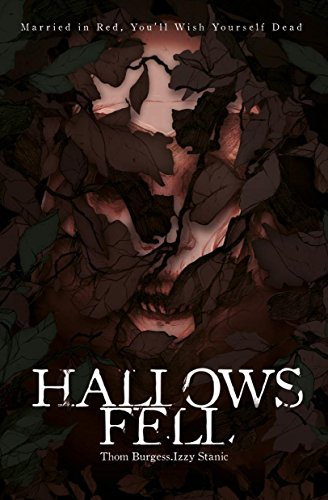
Now one of most interesting new voices to emerge in the current folk horror revival is writer Thom Burgess who has been busy creating a series of deliciously eerie little graphic novels. In his first venture in collaboration with artist Joe Becci, we explored the lore of haunted houses in Malevolents – Click Click (2014). This accomplished chiller was followed by The Eyrie (2017) in which Burgess this time teamed with Barney Bodoano brought us a fascinating and extremely creepy tale that explored all those old stories of smugglers creating ghostly tales to distract unwelcome eyes from their midnight activities. However while The Eyrie delivers some fine chills playing with these folkloric ghost stories within ghost stories, Burgess’s latest offering Hallows Fell goes on step further.
This time partnering with artist Izzy Stanic, Hallows Fell has us ride shotgun with Simon, a businessman on his way home to his fiancee and a house-warming party. Now Simon is a city boy and this ill-fated trip into the countryside will see him very much out of his comfort zone and indeed rapidly become very out of his depth. For Simon’s route is to traverse Bluebell Hill after dark, and there we will discover that there is indeed a very dark truth to all the strange tales that have circulated about this area.
On one hand, the story taps into our own experiences and anxieties – after all, haven’t we all at some point of other had a journey that turns into a nightmare, and indeed many of us will have ended up horribly lost on country roads trying to find the location of some event we are now late for. Indeed while Simon is not exactly a world champion nice guy, as his journey takes increasingly dark and sinister turns, you can’t help but feel a little for his plight.
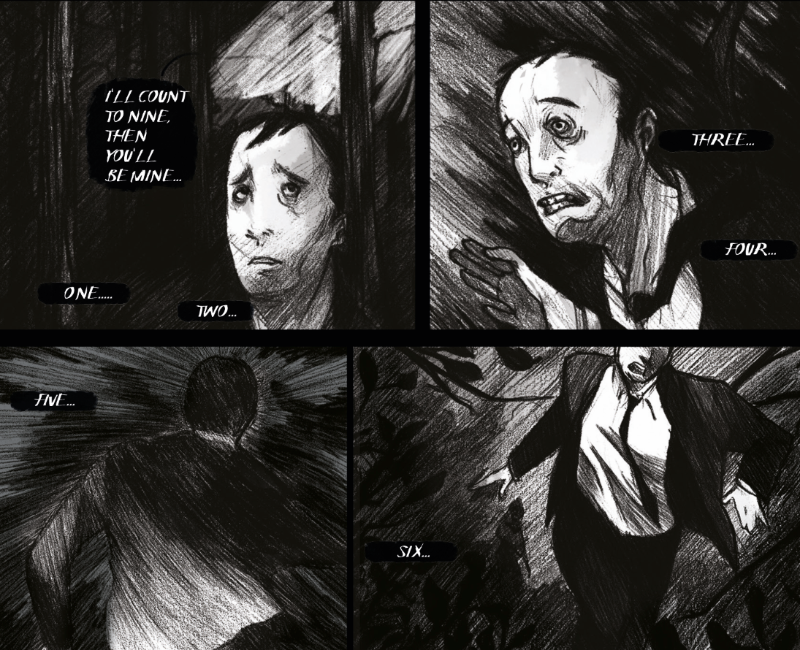
As with his previous excursions into horror comics, once again Burgess has teamed up with a highly individual artist, this time Izzy Stanic. And once again he has found a perfect partner for his script. While many comics are still following the time-honoured styles pioneered by House of Marvels or their Distinguished Competitors, Stanic’s art is delightfully unique, and has been very much tailored to the tale. Here we have clean lines married with thick shadows and dense pencil shading. She captures the look of rural England by night perfectly, from silhouetted woodlands and country pubs to lonely bus stops and deserted roads. in the middle of nowhere. It’s expressive and atmospheric, and when the script calls for it, truly haunting and horrific.
However what also gives Hallows Fell additional power is the nature of the nightmares waiting in the shadows by the roadside. For Burgess explicitly draws upon the curious tales and haunting legends that surround the Blue Bell Hill area. And this isn’t just a case of using a single legend from local lore and dressing it up as a horror tale. Much like his previous tale The Eyrie this is a story that is about stories, and is clearly a development and anb an expansion of that approach. Here there is a layering of several different stories, with Hallows Fell weaving an intricate web of legend and lore, one that ensnares Simon and draws him closer and closer the dark source from which they spring.
All in all, Hallows Fell is another crackingly creepy tale, offers a great deal of folkloric fear and fun for all you revivalist out there. Very much like the spooky folk tales that have inspired and informed it, it is dripping with eerie atmosphere, and like the benighted country lanes and roads it invokes, takes many dark twists and turns.
Phil and Layla from Hawthonn have just released a critically acclaimed album ‘Red Goddess: Of this Men Shall Know Nothing’ on Ba Da Bing records. They will also be appearing at our Folk Horror Revival event, Swansongs which takes place in York on May 12th at the Black Swan. John Pilgrim caught up with Phil and Layla for a chat about the new album, their influences and what we can expect from the upcoming gig.
Your new album is Red Goddess: Of this Men Shall Know Nothing. Who is the Red Goddess and what is it that men shall know nothing of? What clues does the album provide in these respects?
Phil: For a long time the new album didn’t really have a title. We had a lot of themes that we touched on: mugwort (‘In Mighty Revelation’), menstruation (‘Lady of the Flood’), hysteria (‘Eden’), the post-mortem exploitation of women’s bodies (‘Misandrist’), and dream… all things which I suppose could be considered as relating to the feminine experience. Originally I’d given the album the working title Flood, but I don’t think either of us were 100% happy with that…
Layla: We had been reading several books around the time we were working on the album, particularly Penelope Shuttle and Peter Redgrove’s The Wise Wound, which had a lot of invaluable knowledge on the sacred feminine and many jumping off points for inspiration, and also Peter Grey’s The Red Goddess, which explores his vision of Babalon: the Scarlet Woman, or Mother of Abominations – a goddess found in Thelemic mysticism. The idea that she represents earth and sexual impulse made her a fitting matron deity for this set of recordings.
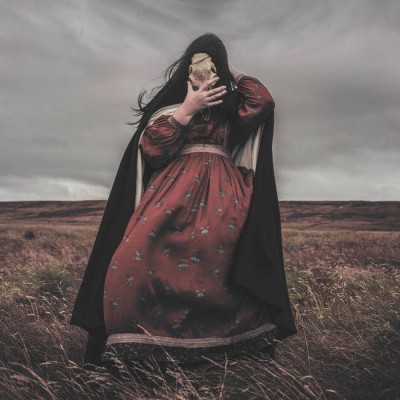
Phil had also found a painting by Max Ernst called Of This Men Shall Know Nothing, which in the early stages of designing the album cover he had wanted to recreate in tableaux. The final cover photo by Narikka contained some coincidental resonances to the Ernst image, and the title of the painting seemed to echo concepts within the album of feminine wildness, and the perceived unknowableness of the female nature.
Phil: The Ernst picture has also been interpreted as depicting sexual alchemy, which also ties in with much of Peter Grey’s writing on Babalon and the goddess’ connection to sexual magic and the three ‘Fs’: f(e)asting, flagellation and fucking!
Red Goddess has already been critically acclaimed. Ben Chasny, of Six Organs of Admittance, had this to say:
“Hawthonn is the real deal. Equally adept at transcribing crow calls into musical scales as they are at creating horizon melting atmospheres, Red Goddess raises the bar for musicians interested in composing straight from the creative imagination. For fans of Jocelyn Godwin, John Dee and Folk Horror as much as the darker spectrum of British music, this is a record of staggering breadth.”
Following on from this, here, can you say something on how you went about composing Red Goddess and the role of the creative imagination in this project? How did the experience develop your theory and practise of the creative process more generally?
Phil: I think imagination and creativity are inextricably linked. Many of our favourite artists and poets place great emphasis on imagination, reverie and sudden illumination. Of course, that doesn’t mean there’s not a lot of hard work to do in bringing these visions to fruition, but it is the imaginative aspects that dominate their experience and make the whole enterprise worthwhile. There are often equal amounts of technique and imaginative work going on in a piece – and, as in poetry, we often try to bring disparate symbols together into a whole. Layla’s work on ‘In Mighty Revelation’ really worked well in this respect: she brought together sounds recorded at an abandoned cooling tower with a recording of Rin’dzin Pamo’s thighbone trumpet blasts (- using an instrument anointed with her menstrual blood -), which evokes a very interesting sonic atmosphere and attendant mental imagery: a decaying post-industrial temple, open to the stars (- as we recently discovered were the ancient Indian temples of the cult of the Yoginis, female tantric deities -), and the sort of space where edgeland herbs blossom: in particular mugwort, which rather became our ‘vegetable ally’ for this album (our previous collaborations having explored hawthorn and yew!). Conjuring mental spaces to accompany the sound – and continuing to explore them through the ongoing process of producing the music – is a very important part of our practice, but only one amongst a whole other lot of imaginative and creative techniques we use!
Layla: Dreams, for example, have been integral to the creative process for Hawthonn from the start and continue to be so. The latest track we’ve been working on is conceived around a dream I had recently that I was reading a grimoire of Andrew Chumbley’s, whilst a portrait of him next to me began to shapeshift into a demon. The dream sound/landscape was incredibly vivid and evoking those sounds, feelings and thoughts again has made it a compelling project on both a creative and imaginative level.
The cover image for the album is powerfully striking. How did this come about? What was the location and what was its significance to you?
Layla: The cover image came about due to a set of lucky coincidences/syncronicities, I had followed a photographer, Aki Pitkänen, alias Narikka, on Tumblr after a friend of mine posted a pagan/magic themed set of his. I thought his work was exceptional, so showed it to Phil.
Phil looked him up on Facebook and that same day Aki had posted to say he was looking for collaborators/models to work with in our home town of Leeds the following month. We got in touch and found we had a lot of shared interests, and agreed to take him up on Ilkley moor as apparently they have no moors in his home country of Finland and he’d always wanted to shoot on one!
A friend very kindly drove us all up to Whetstone Gate, and as I still didn’t really know what Aki wanted as a backdrop I had planned a walking route to take him to various antiquities that held personal significance to us… but ultimately Aki just wanted “bleak” as the backdrop so most of the photos he took of us are from a particularly desolate spot near the Badger stone, overlooking a huge barrow that most people don’t even know is there.
We had a few hours of larking around with skulls before the proper Yorkshire weather hit us, and then I was extremely glad to be wearing a thick wool cloak! He sent us that shot almost immediately when we got home and we knew right away that one of them was the cover, which we had been stuck on for a couple of months.
Both of us have a long love and personal connection with Ilkley moor so it seems doubly fitting that the cover was shot there – Phil recorded some of his earlier music as Xenis Emputae Travelling Band on the moor and we have spent many hours wandering there together. It’s especially wonderful in the mist, when the edges of the real world are completely erased and all you can see are the soft curves of land in front of you. It’s a beautiful, liminal landscape that can become quite frightening after dark!
As a duo of ‘Mugwort-smoking surburban witches’ in what ways do you seek to connect with the ‘old ways’ and the hidden currents of Old Albion ?
Layla: I think we both have quite vivid, mystic connections with landscape. Our relationship with the world we inhabit both on a physical and imaginal level is essential to both our personal practices and our music. We don’t try and claim any tradition. Although Traditional Witchcraft has been a source of inspiration at times, we are more interested in the poetic relevance of the landscape and it’s past inhabitants: a palimpsest of activity and meaning, which we unearth and interpret in our own way. The place where we live is rich in Romano-Celtic history so we have made dedication to, and drawn inspiration from, an Iron age shrine in the woods and a sacred river that flows nearby. The two deities associated with them – Cocidius and Verbeia – have formed a god/goddess duality in our personal mythos, which has become a particular backdrop to our more recent music.
Phil: Cocidius and Verbeia are very much deities embedded in our northern landscape, and they derive their names from the meetings of two cultures: Roman and Celtic. In some ways, thinking deeply about this – and the political climate of our time – has forced us to revise our thoughts on religious syncretism and the bugbear of cultural appropriation. We want to distance ourselves from the idea of pantheons being nationalistic and tied up with rigid ideas of cultural identity, which have become increasingly toxic. We emphasise the highly syncretic nature of religion in the ancient world as a potential alternative, and one that does not dilute the power and individuality of deities by reducing them simply to interchangeable masks of pop-Jungian archetypes. On our track ‘Lady of the Flood’, we borrowed from the Graeco-Egyptian magical papyri, which are masterpieces of heady magical lore and symbolism, incorporating fragments of ancient Egyptian ceremonialism, Greek mythology and Gnostic cosmology into something that more visceral and powerful than its component parts. In some ways, it is the Roman presence in England that also connects us to Egypt, and I find it fascinating that the English witch Andrew Chumbley incorporated so much Egyptian lore into his ‘Sabbatic Craft’, which at first glance seems very much rooted in the British landscape, but again yields work that is highly eclectic, but utterly spellbinding and aesthetically ravishing in its execution.
You are clearly fascinated by occult thinkers and writers from previous centuries such as Heinrich Cornelius Agrippa and Dr John Dee. Do you see a contemporary relevance to such figures?
Phil: I think Dee is most relevant to my solo work, such as Hesperian Garden, which features compositions drawn from his Hieroglyphic Monad: a glyph which he believed had profound implications for all arts and sciences. I do find it quite funny how such an establishment figure – a courtier and member of England’s elite – has become such a countercultural hero, although there is no denying that he was a deep and eccentric genius. Agrippa, similarly, is a rather profound inspiration personally, but in Hawthonn we often concentrate on the works of more contemporary occultists and artists: John Balance, Andrew Chumbley, Peter Grey & Alkistis Dimech, Penelope Shuttle & Peter Redgrove, and so on. I think my own work can be quite cerebral and uncompromising sometimes, often with quite dense swathes of sleeve-notes or accompanying texts, but with Hawthonn we strive toward something more direct and relevant to the present.
You will be playing at ‘Swansongs’ at the Black Swan in York on 12 May. What can people expect from your performance?
Phil: The three Fs! Haha, only joking…
Layla: I was so nervous but dead-set that we’d play live this year, the first gig was an absolute joy to do, so I’m hoping the York gig will be equally transcendentally fun! Ritual elements, death whistle, singing bowl, synths and bone rattles… I hope it’s a little bit spooky and we can coax the resident ghost out for a duet.
Phil: Hah, in that case, we definitely have to re-use the Spiricom frequencies that we used in our first album. After that particular recording session, our infant son woke up sat on our bed babbling excitedly to thin air! We managed to record that and include on our track ‘Thanatopsis’! I hope that whatever happens, it will be a mesmerising and sonically engaging experience even for those who don’t buy into the occult side of things!
Lastly, can you tell us something amusing that has happened while working together recently as Hawthonn?
Phil: Well, we’re often quite serious when it comes to Hawthonn and how we go about working on these pieces. They are often entwined in our interests, obsessions, dreams etc, and we have quite critical listening sessions while each piece develops. Sparks often fly, but that process definitely enhances the quality of our output tenfold. Our friend Gretchen (of the noise rock band Guttersnipe) said she imagined us working together in perfect hippyish harmony – but our ‘studio’ is definitely an infernal forge, and what we create there is far more robust for it!
However, one amusing thing that did happen was when we decided to make a kangling, or thighbone trumpet, which is an important tool in chöd rituals of Tibetan Buddhism, which involve the use of fear to cut through the ego. Being made of a human thighbone, the kangling has a unique, utterly unnerving and haunting sound. We were very interested in making our own, and a friend of ours told us that he had some human bones from a medical skeleton that had been given to him by someone else who felt uneasy keeping them around. So, we gathered all the material, including dust masks, hacksaws, knitting needle (for poking through the marrow), and so on. I took the bone outside to cut it, and sat with it for a while, sombrely meditating on death and thanking the original donor from which it came.
As I began to saw the top end off, however, it became apparent something wasn’t right. The bone was too hard… and solid. It turned out to be a very convincing plastic cast! At that point, it seemed like the universe was having a cosmic joke at my expense, and the solemnity of the occasion was undermined somewhat! It was even more amusing to think of our friends respectfully transporting these bones from flat to flat as they moved around Leeds, completely oblivious to the fact that they had never been part of a living thing!
Wow… we probably sound like a right pair of ghouls!
Swansongs takes place on May 12th at the Black Swan, York featuring live performances from Sharron Kraus, the aforementioned Hawthonn and Sarah Dean. Tickets are available from the following link.
The Devil and the Universe – The Church of the Goat
by Jim Peters
(this is an excerpt from an article that will feature in Harvest Hymns (Volume 2: Sweet Fruits)
It began with two cards selected from the 78-piece tarot card-set as utilised by the most famous occultist of the 20th century Aleister Crowley. ”The Devil” and “The Universe” were the cards pulled that would prophesize a name for a musical-magical-transcendental composition and transformation project…..
Ashley Dayour – (instruments and voice), David Pfister – (instruments and field recordings) and Stefan Elsbacher (percussion) set out to create music from magical systems. Their aim was to give up their musical creativity and allow the legitimacy of magic and religious mechanisms form musical rules. The process and its system dictated and created not just phonetic anarchy but also examples of sound perfection.
With this as their mission and the influence of Crowley’s tarot The Devil and the Universe were born. Using their transcendental music design and occult and religious iconography as inspiration they combined and reinterpreted these elements and influences to create a variety of musical offerings from Space Disco, Psychedelic Glam, Synth Pop, new wave and Black Metal. There is one musical style however that is very much The Devil and the Universe’s own and it is one they have christened `Goat-Wave’.
Watching The Devil and the Universe live is when all the various influences come into their own and combine to create a magical experience. I don’t mean that in a Disney way (there are no enchanted castles and princesses here!) but in a truly occult sense of the word.
The scene is set with images and film clips showing various robed figured in goat masks connecting with the landscape – communing and seeming taking inspiration from the sepia tinged rural landscape they roam across.
First to enter the Church of the Goat is Stefan (although you wouldn’t know it was him under his robe and mask) and he immediately starts pounding out a tribal rhythm as if to call the audience together – to get us all breathing, swaying and hearts beating in unison to one hypnotic beat.
Next David – once again fully robed and goated up – joins the swirling mist on stage and seems to merge with the visuals before joining in the rhythmic pulse. By now samples, field recordings and synth swathes envelop the audience entrancing them further as Ashley joins the others completing the Unholy Trinity. All three add to the growing sonic conjuration with the most unlikely of instruments – the wooden football rattle. Building the intensity until every person in the room – themselves included – is well and truly under the spell of The Church of the Goat.
There is no let up. Even when there is a change in pace or style or when new instruments are brought into the mix there is no pause between tracks – no chance to break the spell. The whole experience is built around that tribal primeval rhythm – it hypnotises, seduces, entrances and completely captivates the audience and when all three on stage become robed silhouettes pounding against the backdrop of creeping visuals the effect is magnificent. It is a shared experience – all those called to worship at the Church of the Goat do so as one.
The John Carpenter-esque synths, crunching guitars, perfectly chosen samples and field recordings – plus an array of percussive instruments – all play their part in the sonic alchemy but it is so much more than that. What makes The Devil and the Universe such an unmissable live experience is the sum of many parts – the music, the robes, the masks, the visuals, the lights, the audience and the rhythm….that never ending rhythm….the rhythm of the Universe…and The Devil.
Join the Kalendar Host in a haunting hike upon the Kalendar Heath this spring. Peppered with the sounds of spring, music on the theme of spring and extracts from three spring based tales from Wyrd Kalendar (available to buy here: http://www.lulu.com/shop/chris-lambert/wyrd-kalendar/paperback/product-23371751.html ). You will also be given the opportunity to pause in your trek as special guests from the Folk Horror Revival; Howard Ingham and Darren Charles, discuss a vital spring film and album for your edification and delight.
The Spring mix includes tunes by The Polyphonic Spree, Emil Richards, Donna Summer, St. Etienne, Aaron Copland, Children of Alice, Donovan, Massive Attack, Gao Liang, Ella Fitzgerald, Morcheeba, David Cain, Paul Weller, Pentangle, Scott Walker, The Producers, Jimmy LaValle, The Kinks, Two Door Cinema Club, The Hobbits, Sidney Torch and his Orchestra, Tom Waits, The Coffinshakers, The Lemon Drops, Igor Stravinsky, REM, Anne Ziegler & Webster Booth.
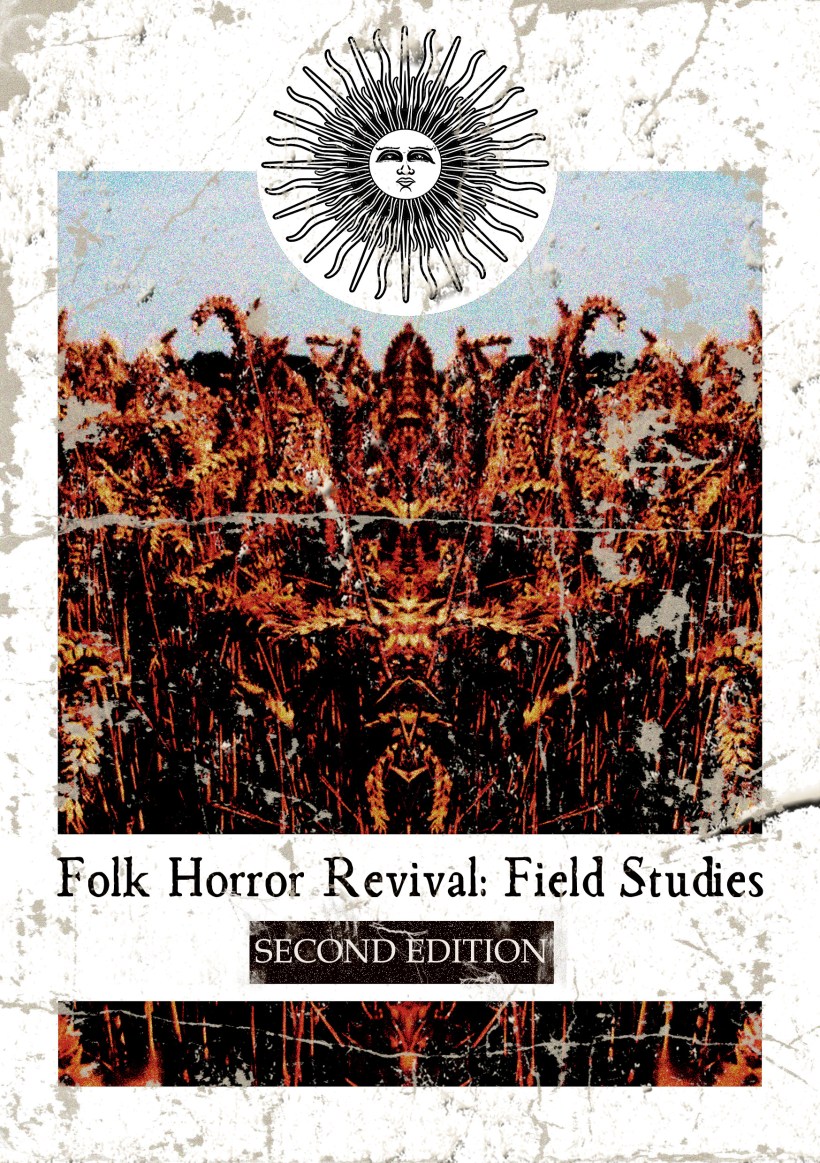
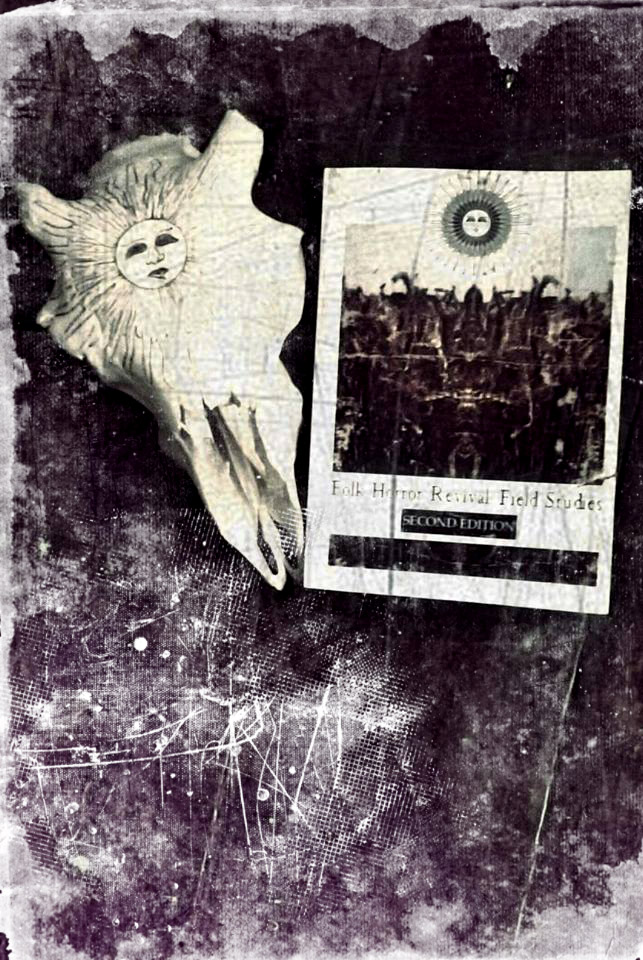
The Second Edition of Folk Horror Revival: Field Studies is now available from here
A new and revised edition of the seminal tome Folk Horror Revival: Field Studies. A collection of essays, interviews and artwork by a host of talents exploring the weird fields of folk horror, urban wyrd and other strange edges. Contributors include Robin Hardy, Ronald Hutton, Alan Lee, Philip Pullman, Thomas Ligotti, Kim Newman, Adam Scovell, Gary Lachman, Susan Cooper and a whole host of other intriguing and vastly talented souls. An indispensable companion for all explorers of the strange cinematic, televisual, literary and folkloric realms. This edition contains numerous extra interviews and essays as well as updating some information and presented with improved design. 100% of all sales profits of this book are charitably donated at quarterly intervals to The Wildlife Trusts.
Special Launch Offer – 20% off normal price*
+
A further 10% Discount + Free Shipping **
Use Code BOOKSHIP18 at checkout
* Offer available on Field Studies only. No Code needed. Offer ends 11.59pm – 19th March 2018. UK time
** Offer available on all Wyrd Harvest Press books. Use code BOOKSHOP18. Offer ends 11.59pm 19th March 2018 – local time










 Folk Horror Revival & Urban Wyrd Project ⨘