It is February.
Open the Wyrd Kalendar and venture into a cold world with a young woman who experiences the days of February that the rest of us miss.
It is a lonely month but you will have company from The Unthanks, Eels, The Incredible String Band, Colosseum, Jesus Jones, King Creosote, Chungking and others who muse on the month and its many frosty wonders.
Wyrd Kalendar is a Folk Horror Revival project that includes a folk horror mix inspired by each month, a book of short stories and illustrations to be published later in the year and an accompanying album to follow in 2018.
Extracts from Chris Lambert’s "February 31st" read by Natasha Trott
Tag: Folk Horror Revival
Story: A Poem by Carmit Kordov
Story
Yearning for the old language of my blood, bone, skin.
Searching for my stone, my soil
stained with grief
splintered with joy.
Echoes, wistful, reverberate a desire in me.
Layers of my past, senses, corrupt my present
force me toward a hard and piercing future.
But mollify too with soft promises.
I mourn the tanned, weathered experiences, pieces of myself.
I strain to hold them tight around me like protection against wind.
I seek out rivers, streams and ponds
forge through elemental forests
rejoice in the leaves’ breath harsh and tender
brush against walls, stone, foundations dense with histories
push along through familiar unfamiliar streets.
Forced to make choices, take paths one way only.
The present infiltrates, shoves and urges me forward
cuts into viscous layers of the past.
Here I am: child, girl, woman.
I am the storyteller.
I demand the past bind itself to me and keep with me in the present.
I am the story
I will not disappear.

Words and Picture (C) Carmit Kordov
Please visit Carmit Kordov Words and Pictures (https://www.facebook.com/carmitkordovwordsandpictures/ ) for more poetry, photography, writing and cultural content that veers towards Magic Realism.
This poem appeared in Corpse Roads (https://folkhorrorrevival.com/folk-horror-revival-corpse-roads/), a Wyrd Harvest Press book (https://folkhorrorrevival.com/wyrd-harvest-press/).

Unearthing Forgotten Horrors 23/01/2017

This week’s Unearthing Forgotten Horrors is the 100th episode of our time with A1 Radio. This special show features new music from The Daughters of Grief, Mortlake Bookclub and Mzylkypop, as well as tracks from Hexvessel, Circulus, Bruno Nicolai, Carlo Maria Cordio, Hermione Harvestman and Sidney Sager.
It also features my tribute to legendary Can drummer Jaki Leibezeit who very sadly passed away over the weekend.

It all happens Monday evening at 7pm UK time on a1radio.co.uk.
Unearthing Forgotten Horrors’ is an hour-long delve into the darker recesses of the musical underworld. A chance to immerse yourself in obscure horror soundtracks, dark drones, weird electronica, freaky folk, crazed kosmiche and some of the most abhorrent and twisted psychedelia ever committed to vinyl, CD or cassette.
(http://www.a1radio.co.uk/)
Hung, Drawn and Quarter off Andy Paciorek Books

25% discount off Andy Paciorek books.
Just add code GIVE25
at checkout at
http://www.blurb.com/user/andypaciorek

Offer valid until 28th January 2017Strange Lands is a deeply researched and richly illustrated information guide to the entities and beasts of Celtic myth & legend and to the many strange beings that have entered the lore of the land through the influence of other cultures and technological evolution. At nearly 400 pages and featuring over 170 original illustrations, Strange Lands is an essential accompaniment for both the novice and seasoned walkers between worlds.The following text from the foreword by Dr Karl Shuker ~ “Right from a child, I have always been fascinated by mythology and folklore, especially the rich corpus originating in the British Isles, and I have read very extensively on the subject. However, I can say in all honesty that Strange Lands is one of the most comprehensive single volumes on British mythological entities that I have ever encountered. Even Dr Katharine M. Briggs’s essential tome, A Dictionary of Fairies, universally acclaimed as the standard work on such beings, now has a rival in terms of the sheer diversity of examples documented. And where Strange Lands effortlessly outpoints even that classic work is of course in its illustrations, which are truly breathtaking in their beauty, intricacy, and vibrancy” from the foreword by Dr Karl Shuker

Containing over 100 original pen & ink portraits alongside biographic text, The Human Chimaera is an indispensable guide to the greatest stars of the circus sideshows and dime museums.
Includes a foreword by John Robinson of Sideshow World.
Includes a foreword by John Robinson of Sideshow World.

The Wyrd Kalendar – The January Mix
Join us as we explore the Wyrd Kalendar…
Preparing the way for the forthcoming publication Wyrd Kalendar (written by Chris Lambert and illustrated by Andy Paciorek for Wyrd Harvest Press) this explores, celebrates and exorcises the wintry spirits of January whilst giving a flavour of the delights contained within this book of folk horror themed tales…
All profits from Wyrd Kalendar will go to wildlife charities nominated by the Folk Horror Revival group…
Includes tracks by The Owl Service, The Animal Collective, Leonard Cohen, The Decemberists, Fleet Foxes, Pilot, The Divine Comedy and many many more…
Best wishes and "Hold to the resolution!"
Two Occult Biographies
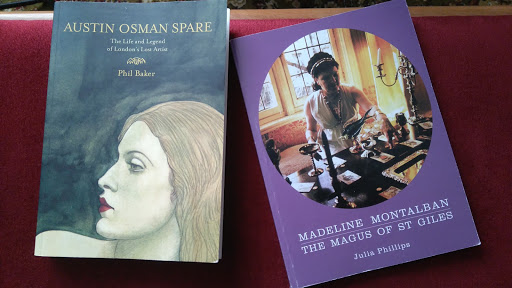
A review of Austin Osman Spare: The Life and Legend of London’s Lost Artist (Phil Baker, Strange Attractor Press, 2012) and Madeline Montalban: The Magus of St Giles (Julia Phillips, Neptune Press, 2015)
The chances are, you are more likely to have heard of Austin Spare than you have of Madeline Montalban.
Saying you’re into the work of Austin Osman Spare these days is like saying you’re into the work of Throbbing Gristle, or Nico’s solo work, or Scott Walker’s late era: sure, it’s not a household name, but he’s not exactly unfamous either, and if you have even a passing interest in the occult these days the chances are you’ve heard of him. And that’s OK! His posthumous reputation, although largely mythologised, is deserved.
For my part, Madeline Montalban was part of the furniture of my life since childhood. I could have told you who Madeline Montalban was when I was nine. Dad’s jumbled up collection of Prediction magazines meant that I rarely read them in order; I’d find them in caches around the house, all mixed up, and I don’t recall reading her obituary as a kid (although I must have: It’s in the issue with the picture of Battlestar Galactica on the front that includes Doreen Valiente’s article about the Necronomicon).
I remembered her mainly as having written most of the articles about the Tarot, mysterious and forbidden.
(As a kid I found once a mouldy miniature Tarot deck, rotting in my dad’s garage, but it smelled bad and I left it there, and it ended up binned.)
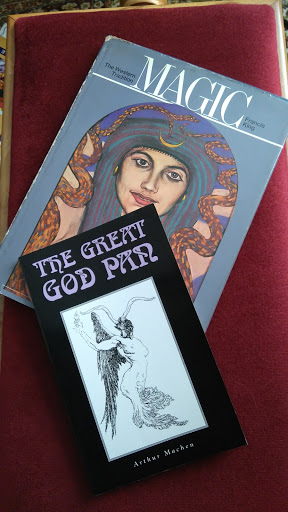
I had seen Austin Spare’s art before I’d known his name. The lascivious, bare-breasted and faintly malevolent Isis Unveiled on the cover of my Dad’s copy of Francis X King’s Magic: The Western Tradition and several of the illustrations within, that was Spare.
Phil Baker’s Austin Osman Spare: The Life and Legend of London’s Lost Artist(Strange Attractor Press, 2012)is about as comprehensive a biography as one could want of anyone, exhaustively researched, annotated and indexed. It’s a useful reference work without once being any less than enthralling. It’s the sort of thing people call a “tremendous achievement”.
Austin Spare (1886-1956) was feted as an artistic genius in his teens. It didn’t work out for him. He crashed out of Crowley’s Argenteum Astrum. W B Yeats (who always seems to come off like a colossal prick in anything I’ve read) picked a fight with Spare over the illustration of his poems. Spare tried to launch magazines and exhibit work, and founded his own magical system. As time went on, his star waned, and a succession of reversals and misfortunes beset him, culminating in him getting bombed out of his home and losing everything during the Blitz.
He ended up in poverty, but kept ploughing his furrow, in magic and art. He exhibited his paintings in pubs, and in his final few years got tangled up with the flamboyantly imaginative artist/occultist Kenneth Grant who, it’s fair to say, is the reason for Spare’s enduring fame and influence over the occult scene as it is today, particularly through the growth of Chaos Magic.
A good biography needs a linchpin, an idea that forms its heart, and Baker, right from the beginning, stresses that Spare was above all a Cockney. This serves as an effective centre to his story, if not for the unfortunate effect of causing me to imagine Spare’s voice being exactly like the voice of the Phantom Cockney from The Mighty Boosh (I respectfully submit that should the all-too plausible BBC4 dramatisation of his life ever come to pass, Noel Fielding is a shoo-in for the title role).
Spare was, so Baker says, the man Gerald Gardner, the father of Wicca, went to in order to extricate himself from curses, something Gardner seems to have had a problem with. Spare didn’t seem to go much on the man – when Kenneth Grant introduced Spare to Gardner, Spare would later opine that “Dr. Gardner has never met a pukka witch…”
I wonder if Spare ever met Madeline Montalban (1910-1982). Certainly their circles overlapped: she knew Crowley, Gardner and Grant to some extent or other. But I think that if anyone described her as a witch, pukka or otherwise, they would have been subject to her wrath to an exquisite degree.
This was not, as far as I could tell from Julia Phillips’ biography, Madeline Montalban: The Magus of St Giles (Neptune Press, 2015), an altogether unusual occurrence. Montalban was, it seems, a fierce presence, capricious and mercurial, and yet truly beloved by her friends and students.
Looking at the issues of Prediction I have which carry her work, all of which come from the last five years of her life, none of this comes as much of a surprise. She wrote most of the astrology section (although towards the end she got a colleague to ghost it for her), had a regular column on the Tarot, and every issue supplied a piece in the middle of the magazine that was only ever called in the contents “Madeline Montalban’s long astrology article”.
These articles were not always astrology. Looking at them in recent years I’ve often felt that she just turned in whatever the hell she wanted just because she could, and knew they’d pay her to print it, whatever. It doesn’t matter: these articles are almost entirely pretty great. It went both ways, I suppose. Prediction trusted her to bring in the esoteric goods just as much as she trusted them to print her writing. Prediction was still publishing articles by her at least into May that year, although interestingly, one of the last articles she supplied, “The Throne of Understanding”, a cracking piece about using the Old Testament of the Bible as a grimoire, was printed twice, in the February and March 1982 issues. No reference is made to that mistake in any of the issues I have (although I’m missing June and July of that year, so it might be in there). My own writing is heavily influenced by her.
I owe her an awful lot.
Phillips’ biography of Montalban is barely a quarter of the length of Baker’s biography of Spare. It neither has a table of contents nor an index and it’s arranged by rough topics rather than chronologically. I think that’s a deliberate choice: It’s apparent that the bulk of Phillips’ research relies heavily on first hand accounts of Madeline Montalban’s life from people who knew her and survived her, and this necessarily means that the book skews towards living memory, and hence the latter half of her life. By avoiding a chronological structure, Phillips also avoids a more obviously lop-sided book. And it’s the right decision.
I mentioned Austin Spare’s encounters with Gerald Gardner before, mainly for the sake of comparison. Here, there’s an entire chapter on Montalban’s association with the founder of Wicca, including evidence in Gardner’s own handwriting that he had also consulted Montalban on the subject of avoiding curses.
It seems that she was a close associate with Gardner, especially during the writing of High Magic’s Aid, Gardner’s pseudonymous Wiccan ur-text (it’s originally credited to “Scire”) written as fiction for the simple reason that in 1949, witchcraft was still illegal in England. It’s incontrovertible that Montalban was Gardner’s typist and sub-editor.
According to Phillips she claimed right up to her dying day that she actually ghostwrote the whole thing, based on Gardner’s jumbled notes. The whole affair is further complicated by Montalban’s refusal to have anything at all to do with Wicca after Gardner’s death in 1964, even to the extent of cutting off the late Michael Howard (a writer on magic, not the Tory grandee) for a few years after he was initiated into a Wiccan group. Phillips gives getting to the bottom of why this happened her very best shot, but, dependent on recollections of Montalban’s surviving friends and pupils, she has to throw up her hands and let the mystery remain unsolved.
And this is largely a problem Phillips faces, which Baker doesn’t. Austin Spare is heavily documented, both in his own words and those of others, as presented in contemporary accounts from throughout Spare’s life, and Phil Baker is able to show with sensitivity and depth how the man changed over the decades; Julia Phillips’ Madeline Montalban is in some ways frozen in the memory of those who knew her, in the way that the beloved people we lose over the course of our lives so often are. With so few accounts contemporary with the earlier phases of her life, we largely see the final twenty-five years or so, and what we see of her earlier life is through the lens of that later period. This isn’t Phillips’s fault. Her perspective depends on what she had to work on, and personal retrospective, with all its problems, is the bulk of that.
In her lifetime, Madeline Montalban was undeniably far better known than Austin Spare was in his, but their afterlives seem to have afforded them opposite trajectories, I think. Spare, richly documented and mythologised, is collected by celebrities and rock stars and thanks to Kenneth Grant and Pete Carroll, is now very much part of the furniture of the occult stage. Montalban might have been published every month in an internationally distributed print magazine during the peak life of print and the heyday of public interest in the occult, but barely three decades after her death, her life is already beset with lacunae, her early existence a cipher, beloved and well-remembered in anecdote only by survivors and committed enthusiasts.
The record of her role in the history of twentieth century British occultism is in danger, even with work like this, of being forgotten. Her unwillingness to publish her writing in a more permanent form is part of it, I think; she refused to write in book form on principle, according to Phillips. As a result, her legitimately vast body of work (for example, in five years’ worth of magazines I have easily a couple hundred pages of text by her) lies largely in ephemera, in pamphlets, correspondence courses and mainly in a magazine that, reduced to a shadow of its former self, finally ceased publishing about four years ago. In a world where it seems that most things are always available in print or PDF, Madeline Montalban has become increasingly hard to track down.
Of course, one wonders if she would have had more acolytes and prophets had she not been a woman, a disabled woman at that (she’d had polio as a child, with the consequences that brought), and a powerful, awkward, difficult figure. History is kinder in general to difficult men than it is to difficult women. We call difficult men free thinkers and iconoclasts, grand, heroic labels. We call difficult women bossy and selfish, diminutives designed to make them seem childish and ridiculous. It’s easy to do.
She mattered. I suspect that it goes against her own wishes (and hence against the wishes of her literary executors) but I can’t help thinking that perhaps someone should compile Madeline Montalban’s writing into a more permanent form before it vanishes altogether. Before we lose her entirely.
Howard David Ingham
A version of this article was originally published at Chariot (chariotrpg.blogspot.com).
Unearthing Forgotten Horrors 09/01/2016

On this week’s Unearthing Forgotten Horrors I continues revisiting some of my favourites of 2016. So expect tunes from Goat, The Stone Tapes, John carpenter, Jenny Hval, Inkubus Sukkubus, Demdike Stare Luciferian Light Orchestra, In Gowan Ring and a brand new track from Mzylkypop. Tune in Monday evening at a1radio.co.uk from 7pm UK time.
Unearthing Forgotten Horrors’ is an hour-long delve into the darker recesses of the musical underworld. A chance to immerse yourself in obscure horror soundtracks, dark drones, weird electronica, freaky folk, crazed kosmiche and some of the most abhorrent and twisted psychedelia ever committed to vinyl, CD or cassette.
|
The Great Lafayette; an extraordinary interment
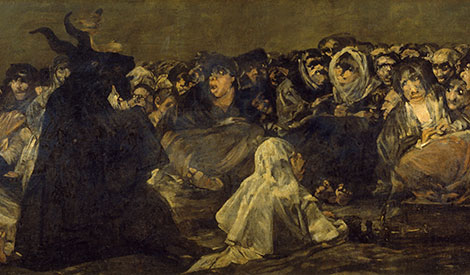
In 1911 one man dominated the vaudeville stage, commanding yearly earnings of what would amount to almost £4million in today’s money. He was lauded by his audiences, sneered at by his detractors and loved by those he himself loved the most; his dogs. He was The Great Lafayette, master magician and illusionist.
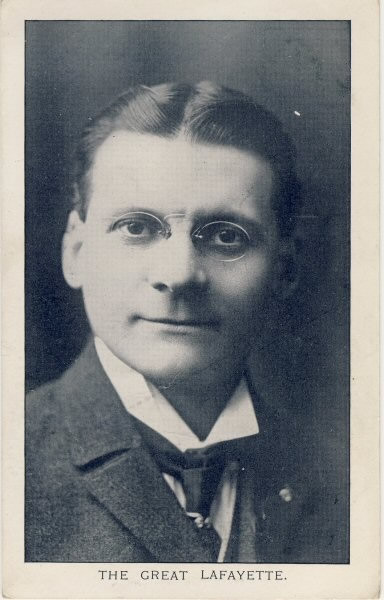
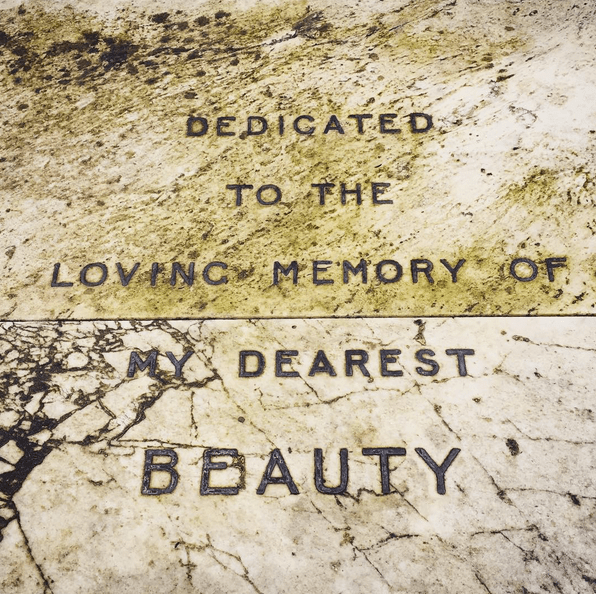
The Great Lafayette was born in Munich, 1871, as the not-so-great Sigmund Neuberger before emigrating with his family to America and creating his life on the stage. He did not mix well with other people, he could be domineering and demanding, but he doted on his dogs, most especially the slender hound he was given as a gift by fellow illusionist Harry Houdini. Beauty ate the finest food, wore jewelled collars and slept on silken cushions. When Lafayette was on tour, Beauty stayed in her own suite of rooms.
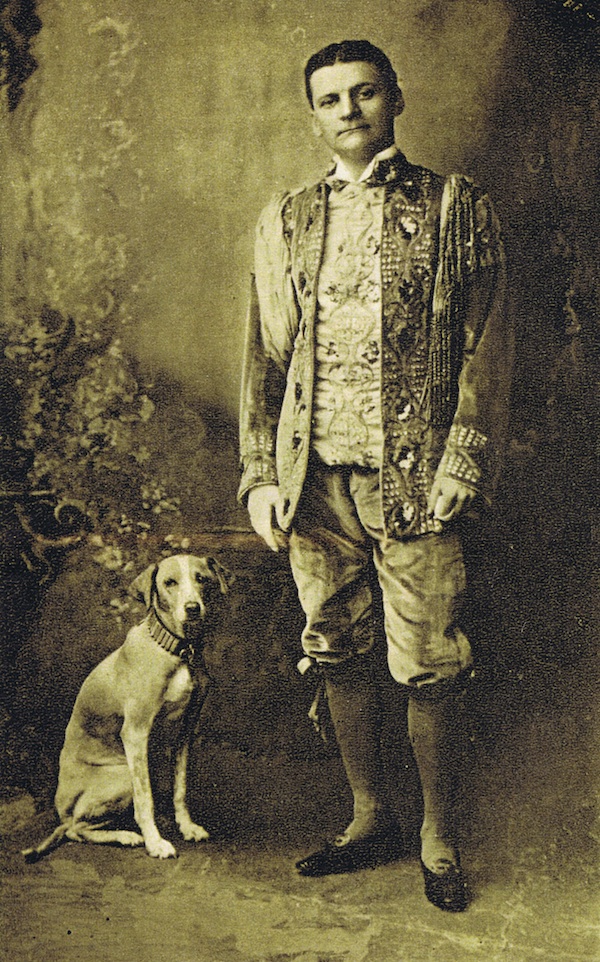
It is no surprise that when Beauty died unexpectedly, shortly before a run of shows in Edinburgh, Lafayette was inconsolable in his grief. Lafayette demanded that she be buried formally, in a proper grave and in a human cemetery. Officials responded that a pet could only be buried in its owner’s grave so, in order to achieve this goal, Lafayette bought a plot in Edinburgh’s Piersfield cemetery where Beauty would lie, awaiting the day when her master would join her.
Wrapped tightly in a cloak of despair and loss, Lafayette is claimed to have said that her death had shattered his very soul and she would not have long to wait.
He was right.
Less than a fortnight later, Lafayette was performing in the Empire Theatre when something went terribly wrong. A pyrotechnic element of the show, some say an oriental lamp and others a wall sconce, ignited one of the theatre’s curtains, the wooden set dressing was consumed rapidly and the entire stage was enveloped in a roaring inferno. Lafayette himself is said to have escaped the fire but, realising that his black stallion was still in danger, returned to the flames. He was last seen desperately attempting to lead the horse to safety.
Eleven performers, including Lafayette, died in the fire. Amazingly, nobody in the audience was harmed although the theatre itself was razed to the ground. Confusion reigned as a charred body, pulled from the ashes and believed to be Lafayette, was later identified as a body double used in some of the magician’s routines. Where then, was the great illusionist himself? Speculation ran riot.
Legend states that a workman, sifting through the rubble of the theatre some days later, stumbled across a curious find; a papier mâché hand, itself intact but detached from the statue it had come from, that pointed ominously to a corner of the destroyed theatre. The workman followed the silent instruction and found Lafayette’s body, horribly burned but identifiable from rings on his blackened fingers.
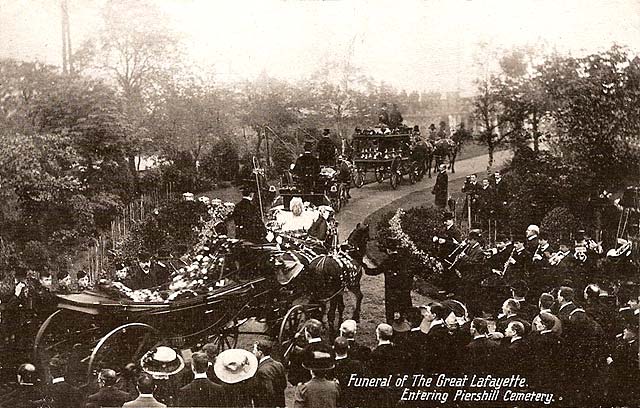
Given that his body was so badly burned, Lafayette was cremated and placed in an ornate urn. A grand funeral procession, described as “one of the most extraordinary interments of modern times”, carried the urn to Piersfield Cemetery where it was placed in the grave he had only recently bought, nestled between Beauty’s outstretched paws.

Daniel Pietersen, 08/02/17
FHR Charity Donation – January 2017

To mark the turn of the year, we have again charitably donated the sales profits from our books to different Wildlife Trusts projects as voted for by members of the Folk Horror Revival facebook group.
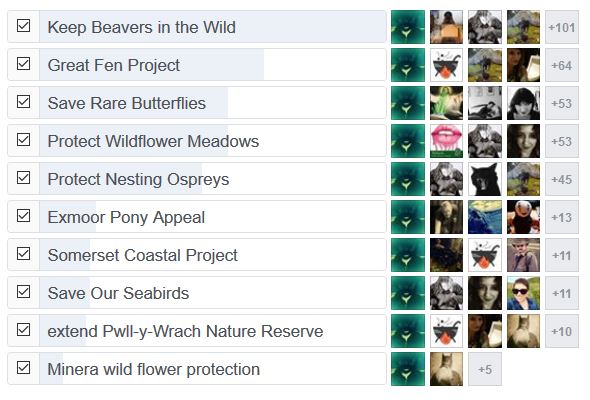
This time we have donated £530.46 to Devon Wildlife Trust’s Keep Beavers in the Wild Project.
Thank You to all those who voted and especially to those who have purchased our books. Wyrd Harvest Press will be releasing several exciting new tomes in 2017.


New Year Horrors List



 Folk Horror Revival & Urban Wyrd Project ⨘