Sumer is a’cumin in … Beltain with 15% off Wyrd Harvest Press books.
100% of sales profits are charitably donated to The Wildlife Trusts environmental conservation projects.
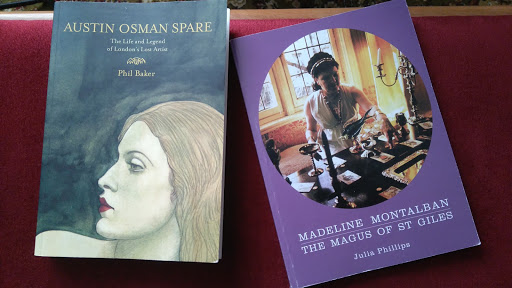
A review of Austin Osman Spare: The Life and Legend of London’s Lost Artist (Phil Baker, Strange Attractor Press, 2012) and Madeline Montalban: The Magus of St Giles (Julia Phillips, Neptune Press, 2015)
The chances are, you are more likely to have heard of Austin Spare than you have of Madeline Montalban.
Saying you’re into the work of Austin Osman Spare these days is like saying you’re into the work of Throbbing Gristle, or Nico’s solo work, or Scott Walker’s late era: sure, it’s not a household name, but he’s not exactly unfamous either, and if you have even a passing interest in the occult these days the chances are you’ve heard of him. And that’s OK! His posthumous reputation, although largely mythologised, is deserved.
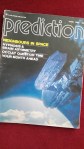
For my part, Madeline Montalban was part of the furniture of my life since childhood. I could have told you who Madeline Montalban was when I was nine. Dad’s jumbled up collection of Prediction magazines meant that I rarely read them in order; I’d find them in caches around the house, all mixed up, and I don’t recall reading her obituary as a kid (although I must have: It’s in the issue with the picture of Battlestar Galactica on the front that includes Doreen Valiente’s article about the Necronomicon).
I remembered her mainly as having written most of the articles about the Tarot, mysterious and forbidden.
(As a kid I found once a mouldy miniature Tarot deck, rotting in my dad’s garage, but it smelled bad and I left it there, and it ended up binned.)
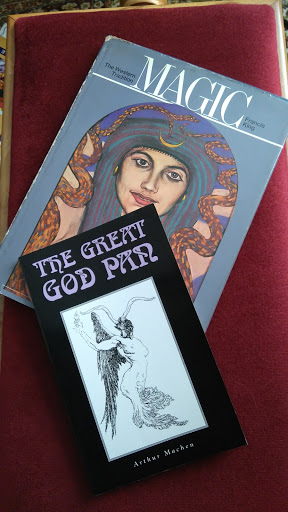
I had seen Austin Spare’s art before I’d known his name. The lascivious, bare-breasted and faintly malevolent Isis Unveiled on the cover of my Dad’s copy of Francis X King’s Magic: The Western Tradition and several of the illustrations within, that was Spare.
Phil Baker’s Austin Osman Spare: The Life and Legend of London’s Lost Artist(Strange Attractor Press, 2012)is about as comprehensive a biography as one could want of anyone, exhaustively researched, annotated and indexed. It’s a useful reference work without once being any less than enthralling. It’s the sort of thing people call a “tremendous achievement”.
Austin Spare (1886-1956) was feted as an artistic genius in his teens. It didn’t work out for him. He crashed out of Crowley’s Argenteum Astrum. W B Yeats (who always seems to come off like a colossal prick in anything I’ve read) picked a fight with Spare over the illustration of his poems. Spare tried to launch magazines and exhibit work, and founded his own magical system. As time went on, his star waned, and a succession of reversals and misfortunes beset him, culminating in him getting bombed out of his home and losing everything during the Blitz.
He ended up in poverty, but kept ploughing his furrow, in magic and art. He exhibited his paintings in pubs, and in his final few years got tangled up with the flamboyantly imaginative artist/occultist Kenneth Grant who, it’s fair to say, is the reason for Spare’s enduring fame and influence over the occult scene as it is today, particularly through the growth of Chaos Magic.
A good biography needs a linchpin, an idea that forms its heart, and Baker, right from the beginning, stresses that Spare was above all a Cockney. This serves as an effective centre to his story, if not for the unfortunate effect of causing me to imagine Spare’s voice being exactly like the voice of the Phantom Cockney from The Mighty Boosh (I respectfully submit that should the all-too plausible BBC4 dramatisation of his life ever come to pass, Noel Fielding is a shoo-in for the title role).
Spare was, so Baker says, the man Gerald Gardner, the father of Wicca, went to in order to extricate himself from curses, something Gardner seems to have had a problem with. Spare didn’t seem to go much on the man – when Kenneth Grant introduced Spare to Gardner, Spare would later opine that “Dr. Gardner has never met a pukka witch…”
I wonder if Spare ever met Madeline Montalban (1910-1982). Certainly their circles overlapped: she knew Crowley, Gardner and Grant to some extent or other. But I think that if anyone described her as a witch, pukka or otherwise, they would have been subject to her wrath to an exquisite degree.
img 20160818 094109
dsc 0238
This was not, as far as I could tell from Julia Phillips’ biography, Madeline Montalban: The Magus of St Giles (Neptune Press, 2015), an altogether unusual occurrence. Montalban was, it seems, a fierce presence, capricious and mercurial, and yet truly beloved by her friends and students.
Looking at the issues of Prediction I have which carry her work, all of which come from the last five years of her life, none of this comes as much of a surprise. She wrote most of the astrology section (although towards the end she got a colleague to ghost it for her), had a regular column on the Tarot, and every issue supplied a piece in the middle of the magazine that was only ever called in the contents “Madeline Montalban’s long astrology article”.
These articles were not always astrology. Looking at them in recent years I’ve often felt that she just turned in whatever the hell she wanted just because she could, and knew they’d pay her to print it, whatever. It doesn’t matter: these articles are almost entirely pretty great. It went both ways, I suppose. Prediction trusted her to bring in the esoteric goods just as much as she trusted them to print her writing. Prediction was still publishing articles by her at least into May that year, although interestingly, one of the last articles she supplied, “The Throne of Understanding”, a cracking piece about using the Old Testament of the Bible as a grimoire, was printed twice, in the February and March 1982 issues. No reference is made to that mistake in any of the issues I have (although I’m missing June and July of that year, so it might be in there). My own writing is heavily influenced by her.
I owe her an awful lot.
Phillips’ biography of Montalban is barely a quarter of the length of Baker’s biography of Spare. It neither has a table of contents nor an index and it’s arranged by rough topics rather than chronologically. I think that’s a deliberate choice: It’s apparent that the bulk of Phillips’ research relies heavily on first hand accounts of Madeline Montalban’s life from people who knew her and survived her, and this necessarily means that the book skews towards living memory, and hence the latter half of her life. By avoiding a chronological structure, Phillips also avoids a more obviously lop-sided book. And it’s the right decision.
I mentioned Austin Spare’s encounters with Gerald Gardner before, mainly for the sake of comparison. Here, there’s an entire chapter on Montalban’s association with the founder of Wicca, including evidence in Gardner’s own handwriting that he had also consulted Montalban on the subject of avoiding curses.
It seems that she was a close associate with Gardner, especially during the writing of High Magic’s Aid, Gardner’s pseudonymous Wiccan ur-text (it’s originally credited to “Scire”) written as fiction for the simple reason that in 1949, witchcraft was still illegal in England. It’s incontrovertible that Montalban was Gardner’s typist and sub-editor.
According to Phillips she claimed right up to her dying day that she actually ghostwrote the whole thing, based on Gardner’s jumbled notes. The whole affair is further complicated by Montalban’s refusal to have anything at all to do with Wicca after Gardner’s death in 1964, even to the extent of cutting off the late Michael Howard (a writer on magic, not the Tory grandee) for a few years after he was initiated into a Wiccan group. Phillips gives getting to the bottom of why this happened her very best shot, but, dependent on recollections of Montalban’s surviving friends and pupils, she has to throw up her hands and let the mystery remain unsolved.
And this is largely a problem Phillips faces, which Baker doesn’t. Austin Spare is heavily documented, both in his own words and those of others, as presented in contemporary accounts from throughout Spare’s life, and Phil Baker is able to show with sensitivity and depth how the man changed over the decades; Julia Phillips’ Madeline Montalban is in some ways frozen in the memory of those who knew her, in the way that the beloved people we lose over the course of our lives so often are. With so few accounts contemporary with the earlier phases of her life, we largely see the final twenty-five years or so, and what we see of her earlier life is through the lens of that later period. This isn’t Phillips’s fault. Her perspective depends on what she had to work on, and personal retrospective, with all its problems, is the bulk of that.
In her lifetime, Madeline Montalban was undeniably far better known than Austin Spare was in his, but their afterlives seem to have afforded them opposite trajectories, I think. Spare, richly documented and mythologised, is collected by celebrities and rock stars and thanks to Kenneth Grant and Pete Carroll, is now very much part of the furniture of the occult stage. Montalban might have been published every month in an internationally distributed print magazine during the peak life of print and the heyday of public interest in the occult, but barely three decades after her death, her life is already beset with lacunae, her early existence a cipher, beloved and well-remembered in anecdote only by survivors and committed enthusiasts.
The record of her role in the history of twentieth century British occultism is in danger, even with work like this, of being forgotten. Her unwillingness to publish her writing in a more permanent form is part of it, I think; she refused to write in book form on principle, according to Phillips. As a result, her legitimately vast body of work (for example, in five years’ worth of magazines I have easily a couple hundred pages of text by her) lies largely in ephemera, in pamphlets, correspondence courses and mainly in a magazine that, reduced to a shadow of its former self, finally ceased publishing about four years ago. In a world where it seems that most things are always available in print or PDF, Madeline Montalban has become increasingly hard to track down.
Of course, one wonders if she would have had more acolytes and prophets had she not been a woman, a disabled woman at that (she’d had polio as a child, with the consequences that brought), and a powerful, awkward, difficult figure. History is kinder in general to difficult men than it is to difficult women. We call difficult men free thinkers and iconoclasts, grand, heroic labels. We call difficult women bossy and selfish, diminutives designed to make them seem childish and ridiculous. It’s easy to do.
She mattered. I suspect that it goes against her own wishes (and hence against the wishes of her literary executors) but I can’t help thinking that perhaps someone should compile Madeline Montalban’s writing into a more permanent form before it vanishes altogether. Before we lose her entirely.
No minimum or maximum order amount.
*Offer valid through December 13, 2016.
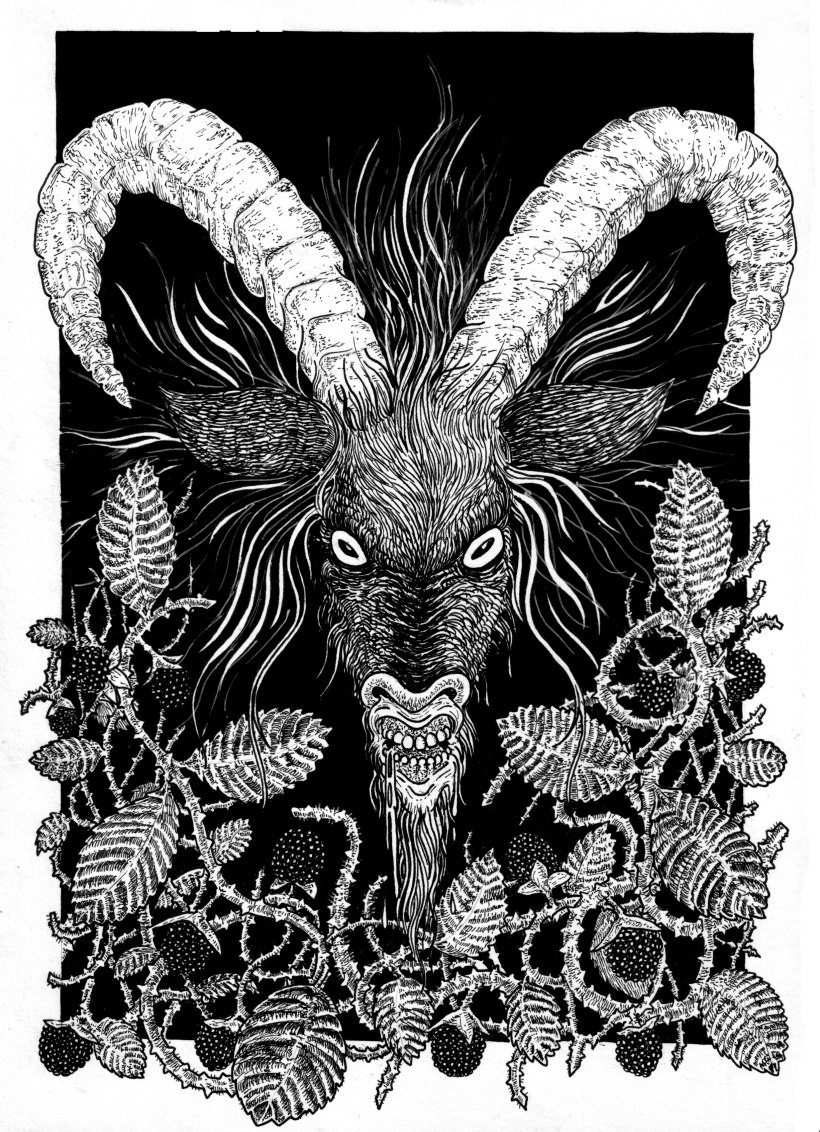
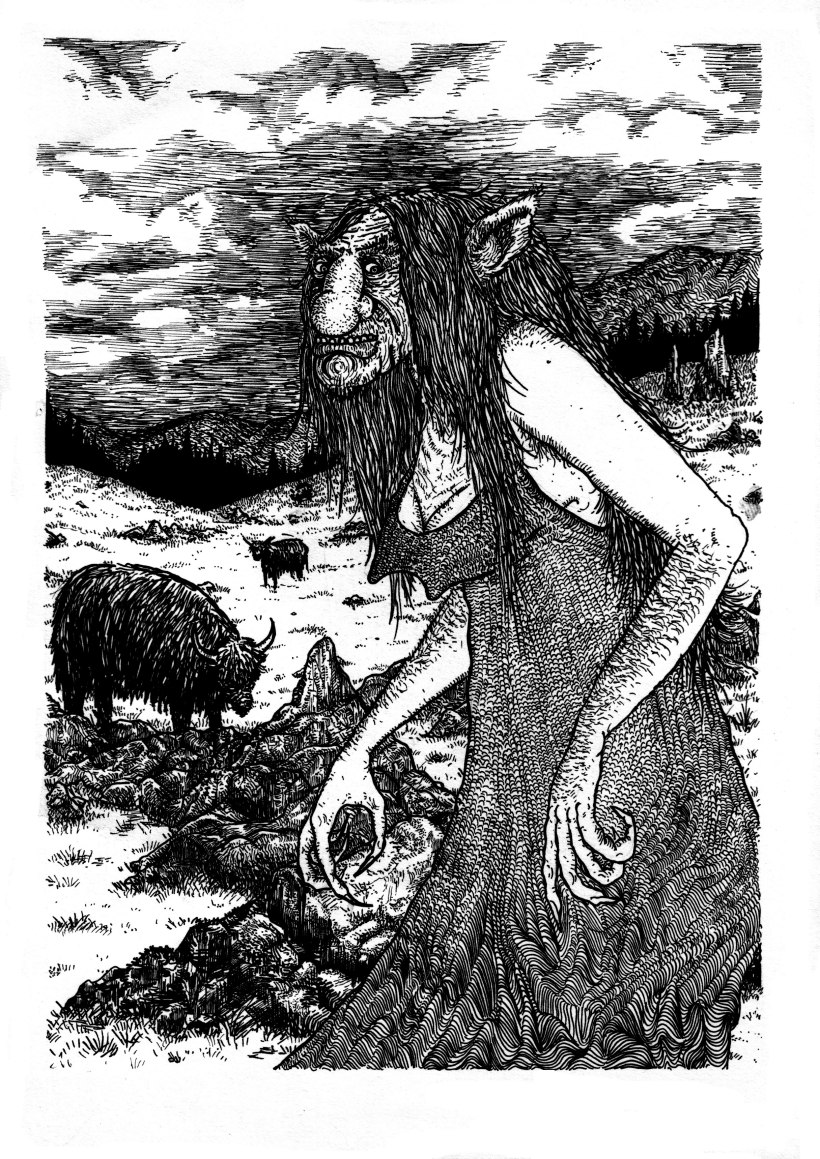
Strange Lands is a deeply researched and richly illustrated information guide to the entities and beasts of Celtic myth & legend and to the many strange beings that have entered the lore of the land through the influence of other cultures and technological evolution.
At nearly 400 pages and featuring over 170 original illustrations, Strange Lands is an essential accompaniment for both the novice and seasoned walkers between worlds. Includes a foreword by Dr. Karl Shuker
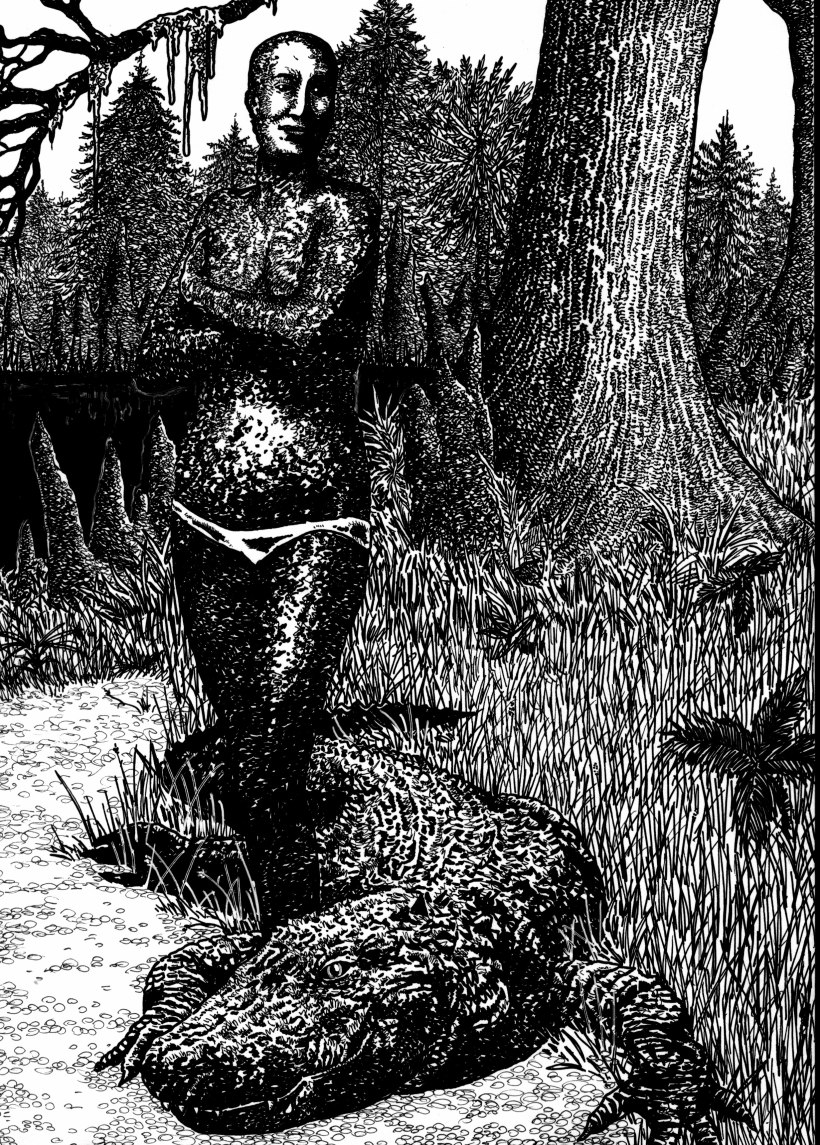
Containing over 100 original pen & ink portraits alongside biographic text, The Human Chimaera is an indispensable guide to the greatest stars of the circus sideshows and dime museums.
Includes a foreword by John Robinson of Sideshow World.
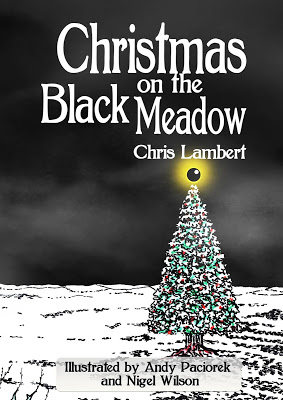
A perfect Christmas gift to satisfy all of your Folk Horror Christmas cravings…
Do you see shadows in the mist? Are you stalked by meadow hags? Do you long to play with black stars? Do you crave a darker yule? Then this book could be for you!
It is Christmas on the North York Moors.
The snow sits upon the heather and bramble. The fences around RAF Fylingdales are silent and still. A dense mist grows in the distance. If you listen closely you can hear strange Yuletide chants, the hum of a land sphere and the cackle of a meadow hag.
This collection of Christmas tales from the Black Meadow contains three new Yuletide stories. Experience a beautiful inversion of The Nativity in A Black Meadow Christmas, warm your toes in a tale of matriarchal terror in The Meadow Tree and marvel at the delightful wonders of The Black Star. You will also find details of ideal gifts you could give and games that you can play when visiting the Black Meadow.
With beautiful illustrations by Andy Paciorek and Nigel Wilson, this is a festive treat that will bring joy and fear in equal measure to your Christmas celebrations.
Strange Lands: A Field Guide to the Celtic Otherworld by Andy Paciorek~
Strange Lands is a deeply researched and richly illustrated information guide to the entities and beasts of Celtic myth & legend and to the many strange beings that have entered the lore of the land through the influence of other cultures and technological evolution.
At nearly 400 pages and featuring over 170 original illustrations, Strange Lands is an essential accompaniment for both the novice and seasoned walkers between worlds.
About Strange Lands:
“Right from a child, I have always been fascinated by mythology and folklore, especially the rich corpus originating in the British Isles, and I have read very extensively on the subject. However, I can say in all honesty that Strange Lands is one of the most comprehensive single volumes on British mythological entities that I have ever encountered. Even Dr Katharine M. Briggs’s essential tome, A Dictionary of Fairies, universally acclaimed as the standard work on such beings, now has a rival in terms of the sheer diversity of examples documented.
And where Strange Lands effortlessly outpoints even that classic work is of course in its illustrations, which are truly breathtaking in their beauty, intricacy, and vibrancy” from the foreword by Dr Karl Shuker
On the Autumn Equinox (September 22) we will again donate 100% of sales profits from our books to the Wildlife Trusts. Please choose the project below you would like to vote for (write name in comments box below or vote via the pinned post on our Facebook Group.)
100% of profits from FHR / Wyrd Harvest Press books sold are charitably donated at intervals to different environmental, wildlife and community projects undertaken by the Wildlife Trusts.
Titles currently available (more in planning production )-
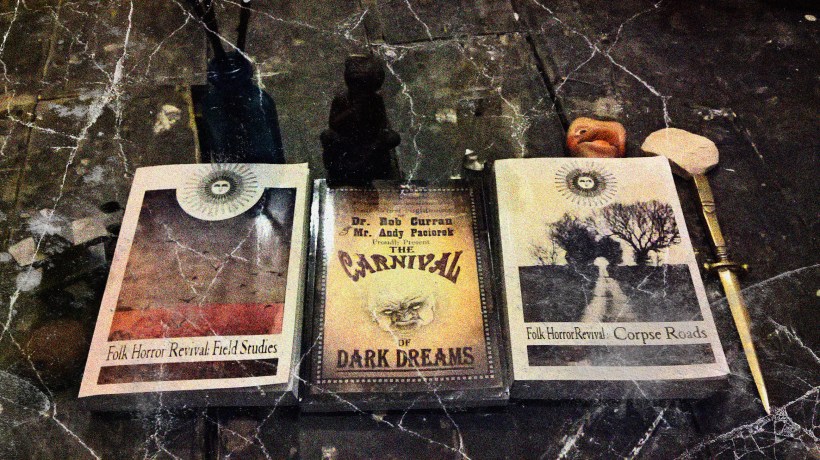
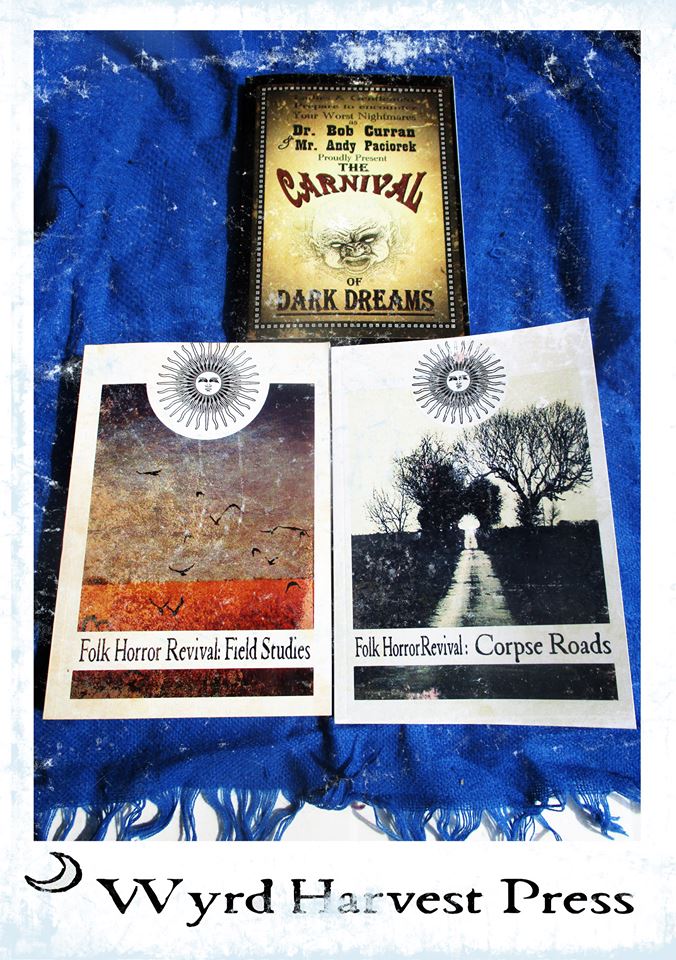
Folk Horror Revival: Field Studies – Featuring essays and interviews by many great cinematic, musical, artistic and literary talents, Folk Horror Revival: Field Studies is the most comprehensive and engaging exploration to date of the sub genre of Folk Horror and associated fields in cinema, television, music, art, culture and folklore. Includes contributions by Kim Newman, Robin Hardy, Thomas Ligotti, Philip Pullman, Gary Lachman and many many more. 100% of all profits from sales of the book will be charitably donated to environmental, wildlife and community projects undertaken by The Wildlife Trusts.
Folk Horror Revival: Corpse Roads – An epic collection of spellbinding poetry, focusing on folk horror, life, death and the eeriness of the landscape by many creative talents both living and departed. Accompanied throughout with atmospheric imagery by an impressive collection of contemporary photographers. 100% of sales profits from this book are charitably donated to The Wildlife Trusts
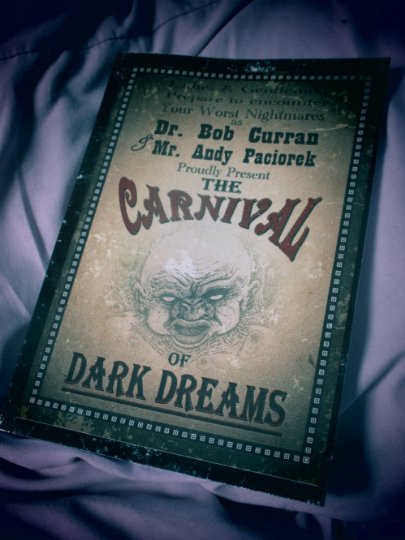
The Carnival of Dark Dreams by Dr Bob Curran & Andy Paciorek – Welcome to The Carnival of Dark Dreams. A visual daytrip into the depths of the jungle, the sands of the desert, to many haunted habitats and worse still into the darkness of the human imagination. But fear not, for captured, caged and presented for your curiosity by Dr. Bob Curran and Mr. Andy Paciorek are some of the most deadly, grotesque, fearsome entities of world folklore. Roll up Roll up for the fright of your lives. Dare you visit The Carnival of Dark Dreams???
Note: Enter code THEBIG30 at checkout and receive 30% off the cover price. Coupon expires Sep 19th. Coupon codes are CASE-SENSITIVE. Click “Apply” after entering the coupon code. (Before committing to buy, ensure your country is selected at the top of the Lulu.com site, to ensure domestic shipping.)
To Buy our books and help environmental projects go to –
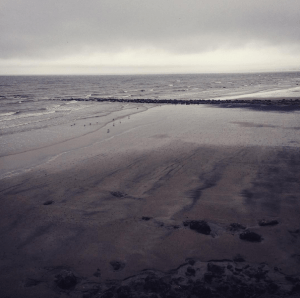
It smiles at me with frothy lips
Inviting me to stay;
To watch it as it leaps and drips with sand and stones at play.
The gulls fly screaming overhead
As if their prey to wake;
They dive into the watery mass,
At liberty to take.
Its icy waves they touch my skin
And play around my feet.
Seaweed stops and lingers there, the hazard it will meet.
Who knows what secrets it contains,
On its dark and secret bottom;
With rusting wreckage, and silver bones
Of heroes long forgotten.
What mythical beings are dwelling there?
Mermaids, Monsters, Lorelei;
The tales we heard so long ago, in us will never die.
It’s enticing me to join it
In its never ending quest;
To swallow up the living earth
And leave mortal souls at rest.
The sea goes on forever
As it has since time began;
Guided by a silver moon, never touched by wars or man.
I shiver in its coldness
Wanting not to go,
And leave this green and pleasant land
I have come to know.
I can no longer stay here
A captive on the beach
Two steps back, and they will take me
Forever out of reach.
Daniel Pietersen is an author of weird fiction and horror philosophy who has spent the past few years poring over the vast and only-recently unearthed archival material from the so-called Constant University. This vast selection of prose fragments, poetry, anthropological material and photographic media of various types and qualities outlines the lives and customs of the inhabitants of the city of Benedictine, a curiously formless conurbation consisting of five Quarters and surrounded on all sides by the dangerous wildlands of The Fen.
As these scraps are analysed and put into some kind of order, a world as rich and complex as our own comes into being.
Further information on the archive can be found at its aetherycal repository. Daniel Pietersen has an online presence here.
The foundations of the city are riddled with holes. Basements, sewers, sub-basements, forgotten wells and more upon more. Even the eerily still worlds of natural cave systems stretch down for untold fathoms beneath the daylight world. Very few people venture down into these dark, fungus-haunted spaces. Fewer still return.
And, in the centre, the great campanile rises high above the clouds of salesman’s patter as if unconcerned by the price of silken gloves or sesame. An ersatz gnomon – although built long after the square was named for a now-forgotten bureaucrat, giving it a perhaps not entirely subconscious homophone – whose even-paced shadow strolls from dawn to dusk, a dark-suited overseer marking out ungraded time against lamp-post and flagpole.
There lies, far East, a nameless fen/didst Man last tread I know not when/but beasts there are/and worse by far/things that yearn for foreign stars/things as shy from mortal ken/but dance and howl on the nameless fen…
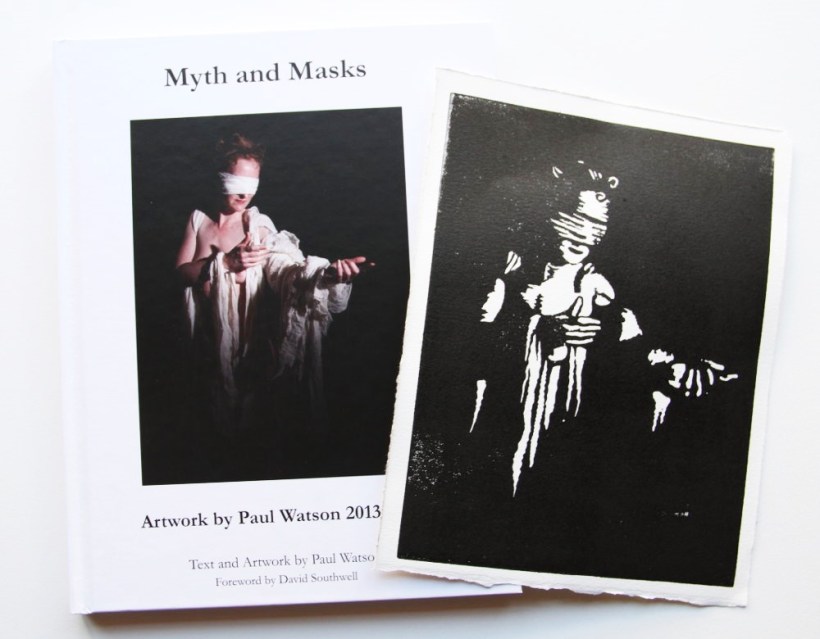
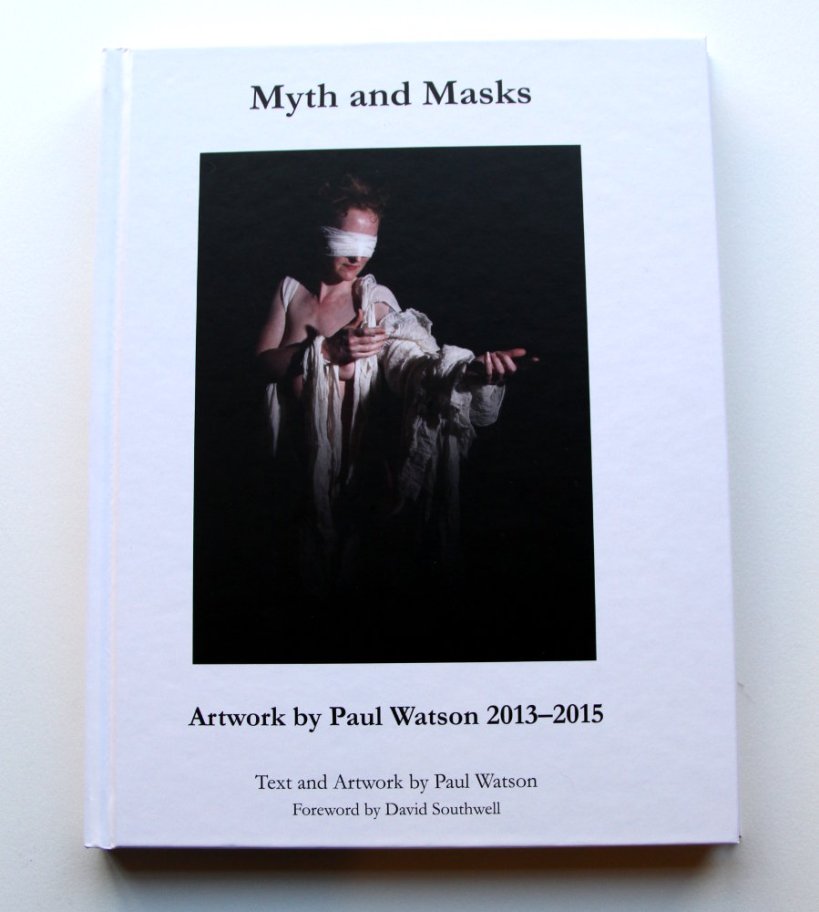
Myth and Masks by Paul Watson is an evocative work; described as ‘Shamanic’ in the foreword by David Southwell – a word he does not use lightly but it is a word that accurately describes this book. Myth and Masks is a transformative journey, a gateway into an Otherworld.
Within its pages are mainly photographs but also included are drawings and prints as well as writings by the artist about the inspiration, history and creative process of his work and subject matter. Intriguingly Watson questions whether the masks he creates, which feature so prominently in his work, are part of the art. He states seeing them more perhaps as preperation or costumes for his photography. For me looking inward at his work, the masks are both elements and subject matter of a larger work but I consider them also beautifully strange artworks in themselves.
In creating the masks, Watson was inspired to investigate the role, history and nature of masks more deeply. Gazing upon his masks, his photos and graphics, they tantalise the viewers’ eyes and impregnate their mind with questions – what do these masks represent? What do they reveal and what do they conceal?
They are not mere costume – they are ritual, mythical, mystical. There is a theatrical narrative suggested in the still images. Stories dying to be told.
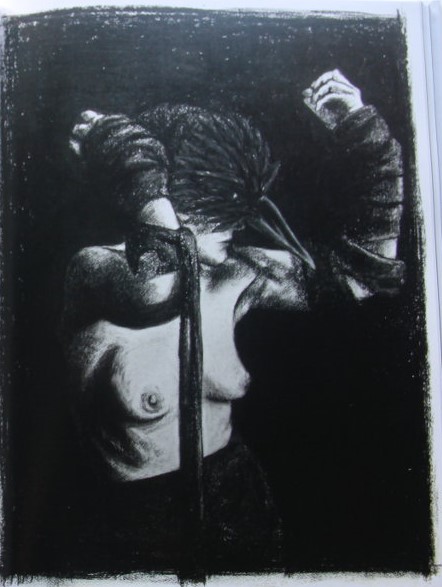
Dying … an apt word, for within these book pages we find the Badb Catha, the Death Mask and the Crow. The imagery of the crow goddess as rendered by Watson is reminiscent of the Plague Doctor masks of medieval times; but it is not confined to an isolated historical pestilence but is an eternal archetype. The Crow – devourer of carrion, a memento mori ~ a reflection of death in life.
By placing the masks upon models, Watson puts life into death; the empty sockets of the mask are given a glint of life in some images but in others they eyes remain hidden, hinting at greater mysteries.
Life and death are intertwined as revealed in the Ivy Mask. Ivy is an evergreen plant, a reminder that life continues through the greatest adversities but it also reminds us of its presence in tumbledown graveyards or clinging to the crumbling ruins of abandoned weather-beaten buildings. It speaks of life beyond death.
There is perhaps an element of sex that buds beneath the surface in some images also. The nudity is not overtly erotic in the imagery. It is not the bodies perhaps here that draws the carnal aspect of the mind in but the masks. There can be something enthralling, oddly sinister but alluring, something fetishistic too about masks. Sex and Death frequently go hand in hand. In the realm of folk horror, death has been portrayed several times as an act of fertility and therefore rebirth or new or transformed life.
We look at the masks and they gaze back at us with whispers of life, death, rebirth and of change. The element of change is of course integral to masks; they change the appearance of the wearer and as such change our perceptions of them. Another chapter in Watson’s book deals with that archetypal mythic character – the Shapeshifter.
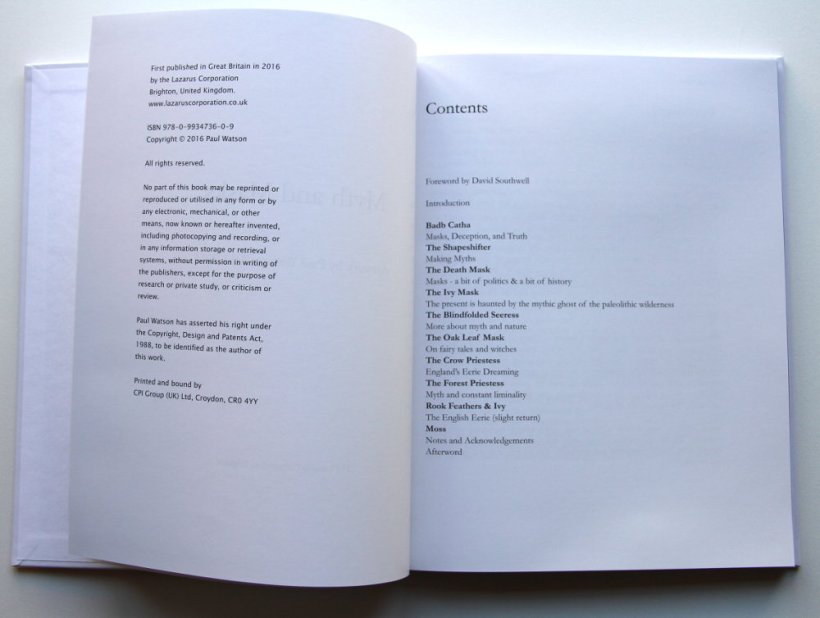
Within his writings that accompany the imagery, Watson seamlessly draws in considerations of sources such as ancient myth, fairy tales, witchcraft, folk customs, hauntology and the ‘English Eerie’. Literary luminaries such as Robert Macfarlane, Marina Warner, Warren Ellis, Martin Shaw, Robert Holdstock and others take their place.
Visually and textually, Myth and Masks is an intriguing, evocative work and one that I recommend a place on the bookshelves of Folk Horror Revivalists.
Each copy of this initial print-run of Myth and Masks comes with a free, hand-printed linoprint by Paul Watson of the Blindfolded Seeress, exclusive to this book.
Myth and Masks: Artwork by Paul Watson 2013–2015is a volume of Paul Watson’s artwork from 2013 to 2015, focusing mainly on photography but also including drawing and printmaking. The stark and dramatic images are complemented by an edited selection of his writings on myths, masks, and the “English Eerie”, previously published on his Artist’s Notebook blog during the course of creating these pieces of artwork.
These selected pieces of Paul Watson’s artwork show his development of an intertwined host of primal characters, drawn from his imagination, but strongly influenced by the English landscape and the myths and legends that are embedded deeply within that landscape.
The accompanying written pieces show the artist’s exploration of, and research into, the wider subject matter of what has become known as “the English Eerie” that runs in parallel with the creative process.
What others have said:
“The book takes the reader on a journey through the last two years of his work, touching on subjects as eclectic as the English eerie, folk-horror and psychogeography, with every stop in between. In addition to the beautiful colour plates of Paul’s work, the book includes several essays focusing on the inspiration behind his work along with ideas of myth and folklore, creating together an engrossing volume that will lead you to another world.”




 Daniel Pietersen is an author of weird fiction and horror philosophy who has spent the past few years poring over the vast and only-recently unearthed archival material from the so-called





 Folk Horror Revival & Urban Wyrd Project ⨘