Season’s Greetings to All ~ To mark the Winter Solstice, Wyrd Harvest Press & Folk Horror Revival are again making a charity donation of our book sales profits to a Wildlife Trusts’ environmental and conservation project – This year we have donated £300 to Yorkshire Wildlife Trust’s Species Recovery Appeal.
Protect and restore Yorkshire’s rarest wildlife
From the windswept uplands of the Dales to the rolling chalk hills of the Wolds, the lowland moors on the Humberhead levels and the shining chalk cliffs of Yorkshire’s 100-mile coastline – wildlife should flock to this vast and varied county.
And yet, the data is telling us that many woodlands, wetlands and waves are slowly falling silent and still.
If we don’t act now, we will lose the species that make Yorkshire so special!
We wish you all a very peaceful and pleasant Yuletide and 2026. Special Thanks to everybody who has supported both nature and varied artists and writers by buying our books.
❄️Season’s Greetings to All ~ To mark the Winter Solstice, Wyrd Harvest Press & Folk Horror Revival are again making a charity donation of our book sales profits to a Wildlife Trusts’ environmental and conservation project – This year we have donated £500 to Gloucestershire Wildlife Trust’s ‘Corridor of Life’ project.
From ancient woodlands teeming with life and history, to buzzing hedgerows and towering oaks, trees play an essential role in our landscapes and lives.
They provide homes for a diverse range of species, act as natural flood management systems, purify our air and provide sanctuaries of solace. Yet our trees are under threat like never before.
Over-development and climate change have left the UK with some of the lowest amounts of tree cover in Europe… This hugely ambitious project aims to create, enhance and protect hedgerows, orchards, wood pasture and more to establish a 60-mile corridor of tree cover. Linking two of the UK’s biggest ancient woodlands, the Forest of Dean and the Wyre Forest, this corridor of life will give vulnerable species secure habitats that are critical to their expansion and future survival.
We wish you all a very peaceful and pleasant Yuletide and 2025. Special Thanks to everybody who has supported both nature and varied artists and writers by buying our books. ❄️
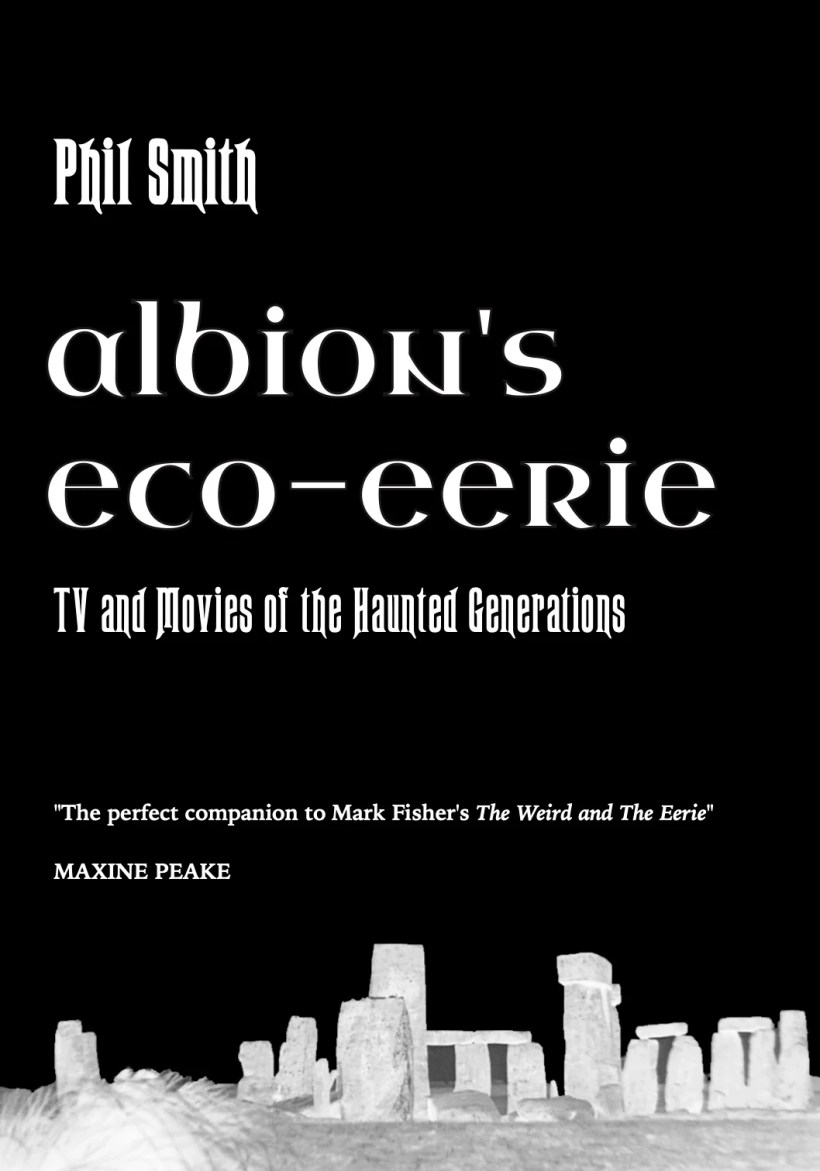
In Albion’s Eco-Eerie, author and professor, Phil Smith seeks an alternative readingof TV and Movies of the Haunted Generations suggesting looking at the media in terms of ‘unhuman characters, the materials and the edgeland spaces’. He suggests the term ‘hobgoblinology’ as a name for his contemplation of the subject matter, but I question whether that is necessary as the ‘Eco-eerie’ term he uses in the book title does a much better job of specifically conveying the centre of attention. If the use of a term helps the writer unlock what they want to say in the book, then it’s a useful tool, but going forward I don’t know if there is a need for any further terminology within the gamut of topics. I enjoyed reading Smith just talk about his selected subjects more than about the terminology and application of it, which I felt disrupted the flow a little. I have personally discovered with labels that they have a limited purpose – they only need to point in a direction rather than map a territory down to the millimetre. Sometimes too much definition risks stifling and suffocating further creativity in the crib, whilst a net cast too widely can serve no real purpose. Further labelling may be best served to supermarket shelves and the toes of mortuary corpses. I fully understand that as wider interest in the sub-genres/modes have grown that the terms ‘Folk Horror’ and ‘Hauntology’ may carry some baggage or alternatively are limiting but I don’t feel like the remedy for that is more terminology. That said, for the purpose of this book the term ‘Eco-eerie’ alone is ideal.
Smith’s lens upon the estrangement between humankind and nature when looking at specific examples is an intriguing vantage point to take. Smith adds an s to the end of Bob Fischer’s term ‘Haunted Generation’ to take us back before Generation X’s particularly spectre-ridden childhoods (a demographic that also seems particularly attuned to Burns’ predilection for a nostalgia that is part warm and fuzzy and part traumatised by monsters).
Smith’s book, as the name suggests, mainly concentrates its attention on British examples (some creations from other countries are discussed at times in comparison) and again there’s a nice range of choices including The Company of Wolves, Oh Lucky Man!, Whistle and I’ll Come to You and the work of the late Nigel Kneale (whom is currently enjoying a long renaissance of interest) is covered well particularly regarding one of his lesser-discussed creations The Quatermass Xperiment. One of the strongest sections in the book for me talks about the strange 1975 children’s television series The Changes. This curious show is possibly the epitome of Albion’s Eco-eerie, though I must admit that whilst I enjoyed watching that programme I was never as much a fan of its conclusion and its explanation as I was of what came before in earlier episodes.
Albion’s Eco-eerie is a slim book but there is a lot packed within its covers and I would recommend it as a book for those with an existing interest in the fields who want to look at the subject matter from a different and intriguing vantage point, and as a reference book for students and film-TV critics/writers rather than a first-stop introduction to the subjects covered.
Films and TV shows discussed:
Night of the Demon The Maze The Company of Wolves The Quatermass Xperiment Quatermass 2 The Strange World of Planet X Fireball XL5: ‘Plant Man from Space’ Quatermass and the Pit O Lucky Man! The Changes Children of the Stones Whistle and I’ll Come to You A Warning to the Curious The Lovecraft Investigations (podcast) Hellraiser and Hellbound: Hellraiser II The Girl with All the Gifts
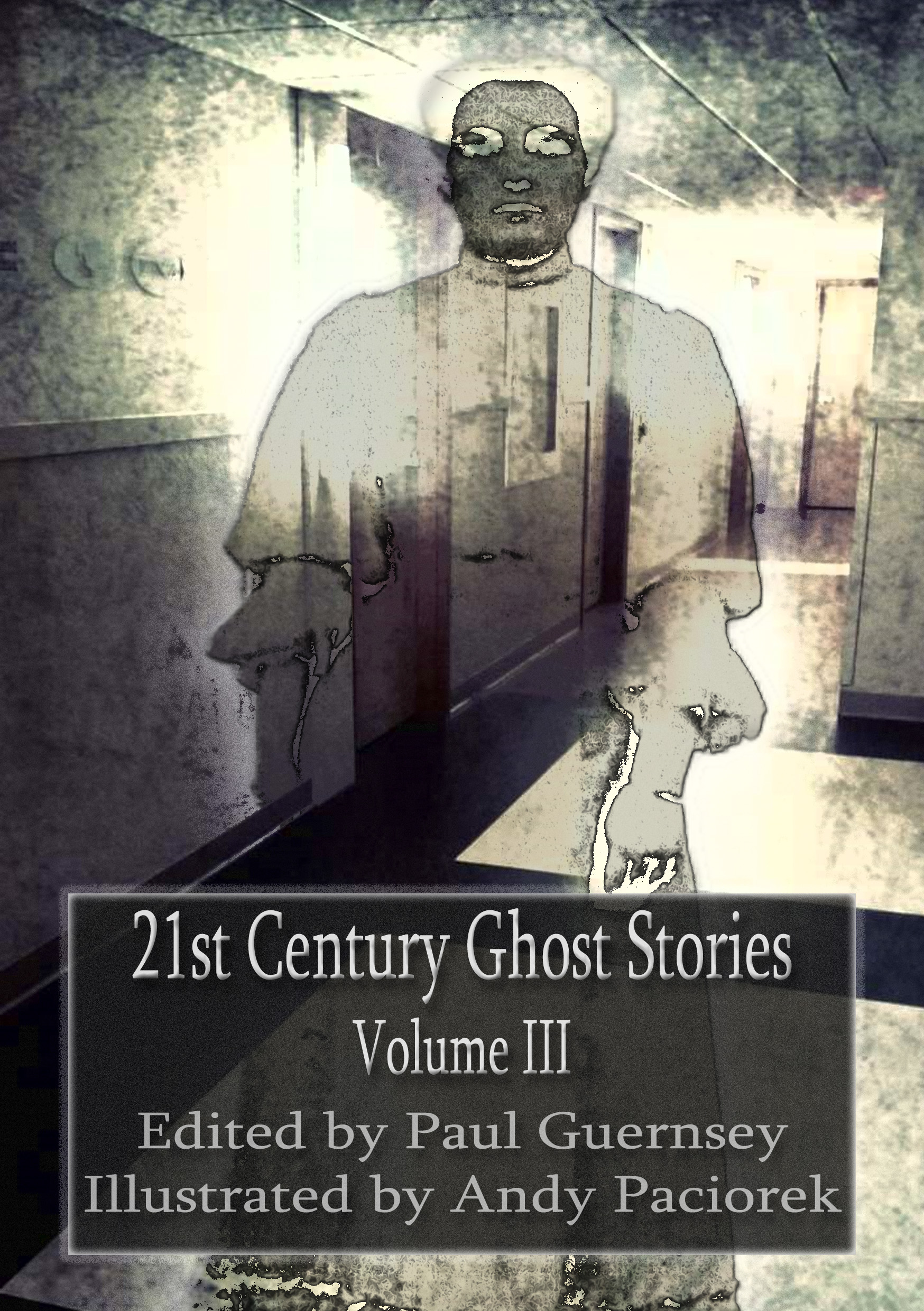
Wyrd Harvest Press are thrilled to present 21st Century Ghost Stories: Volume III the latest in our spooky anthology series. Featuring a host of new stories by a wealth of talented writers, edited by Paul Guernsey, illustrated by Andy Paciorek and created with great thanks to Richard Hing and Grey Malkin; sales profits from this book will be charitably donated to The Wildlife Trusts ‘ nature conservation projects.
This third volume in our 21st Century Ghost Stories anthology series features 39 astonishing short-fiction contributions from writers the world over, each with a surprising and contemporary twist on some aspect of the uncanny. The collection includes unsettling stories of supernatural seduction, episodes of AI gone terrifyingly awry, accounts of workplace witchcraft, and tales of ghostly and/or demonic forces that infest places and ensnare people. We invite you to open this book and feel the chill!
featuring …
Introduction – Paul Guernsey
The Carny — Ann O’Mara Heyward
Gina Of Golden Gardens — Shala Erlich
The Pickup — Kathryn Pratt Russell
Door To Door — Ruth Schemmel
Ghost Story — Isobel Oliphant
He Loved His Mamma And His Mayonnaise — Gerard J Waggett
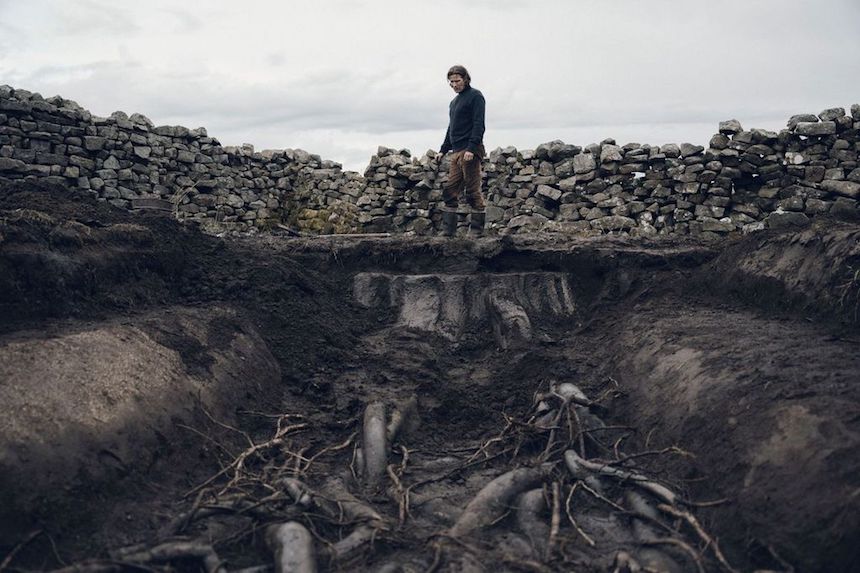
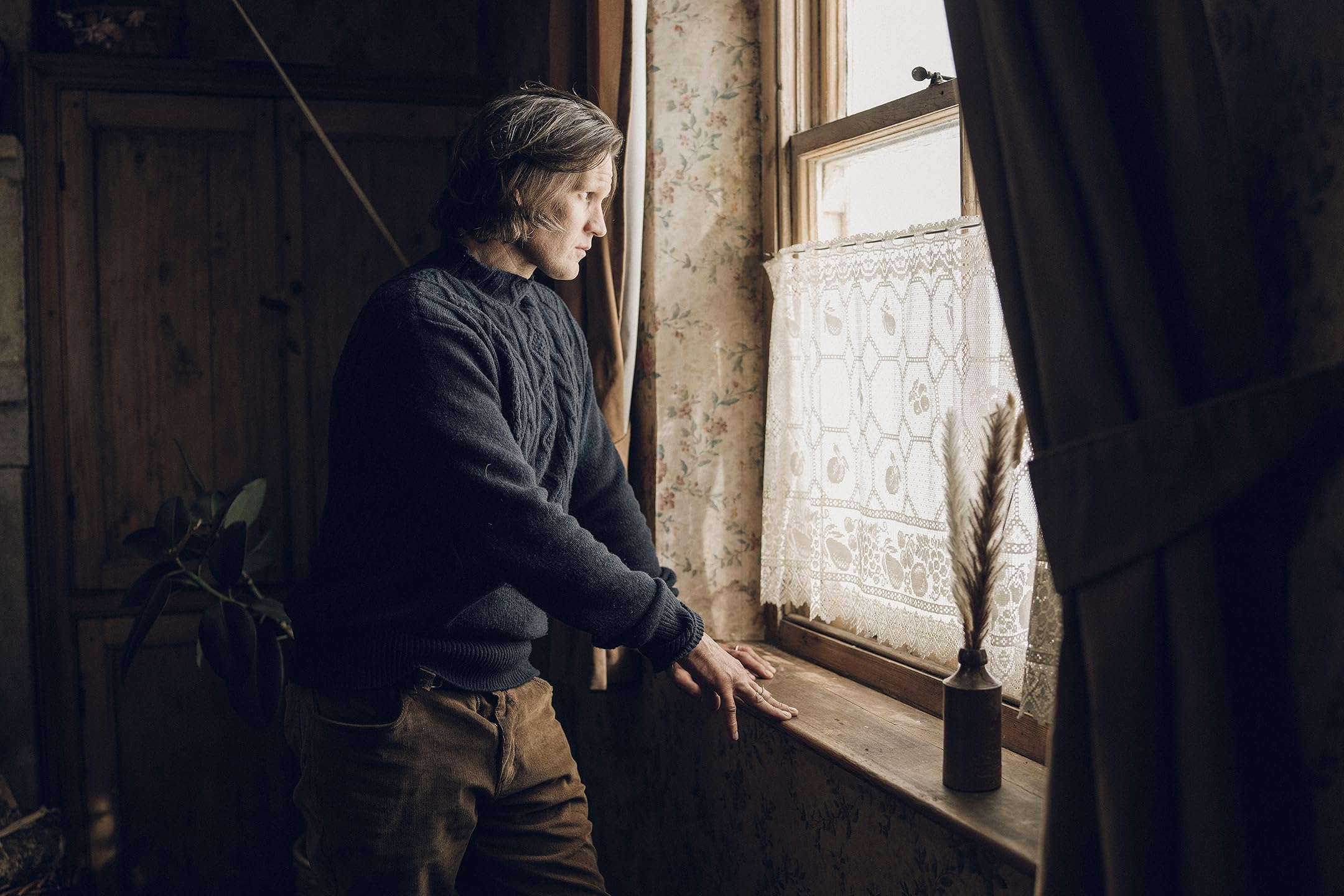
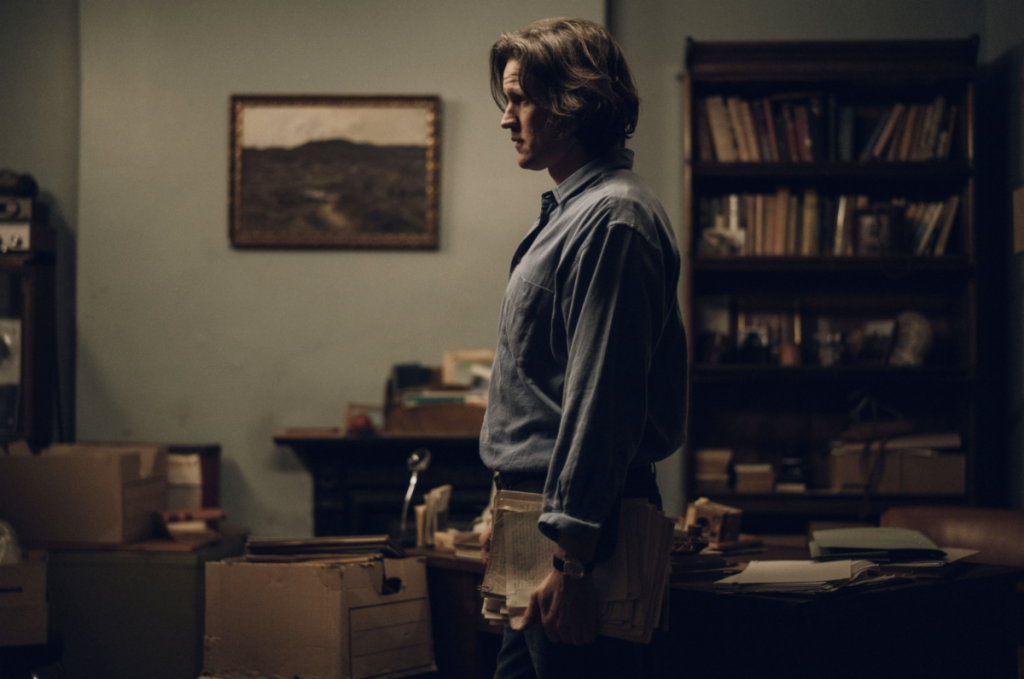
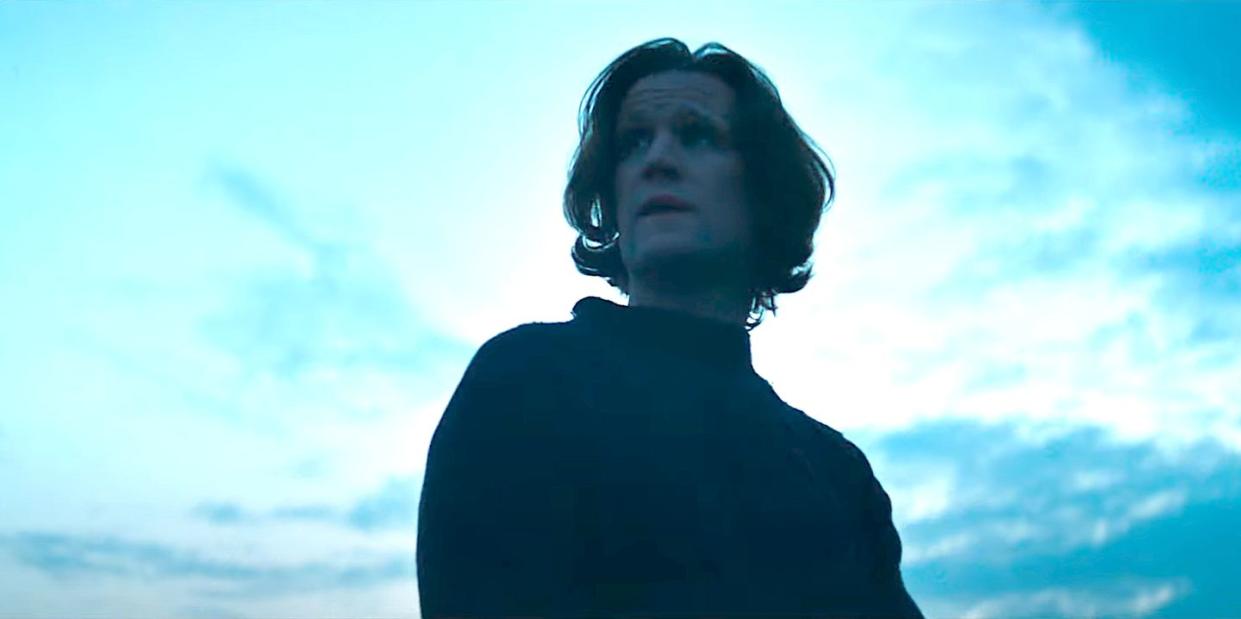
One thing that the new wave of British Folk Horror / Hauntological/ Occult cinema sometimes excels at is ‘bleakness’. Think Possum, Kill List, Under The Skin, Saint Maude, A Dark Song … and now add Daniel Kokotajlo’s ‘ Starve Acre’ to the list. Even its name ‘Starve Acre’, which relates to an isolated rural homestead, suggests a dark foreboding. Based upon the novel of the same name by ‘The Loney’ writer Andrew Michael Hurley; the premise of the film revolves around a couple, Richard and Juliet, (played by former ‘Doctor Who’ Matt Smith and ‘Saint Maud’s’ Morfydd Clark in well-cast roles) who are dealing with the loss of their child and in Richard’s case the ghosts of his own early life. Within that scope we can see and feel elements of other films/books such as ‘Don’t Look Now’, ‘Pet Sematary’, and ‘Wake Wood’. The spectre of childhood abuse and its manifestation in the present are suggestive of ‘Possum’ and the uncovering in the soil of a biological relic (in this case the skeleton of a hare) that takes on a life of its own is reminiscent of ‘Blood on Satan’s Claw’. But whilst this film does cover tropes seen before and emulates a 1970’s setting and aesthetic it does craft its own identity. The folk elements are amplified by the lingering presence of a mysterious entity known as Jack Grey or Dandelion Jack, who seems to be a genii loci of the moorlands, if not indeed Starve Acre itself. This eldritch figure is ritually invoked in the abuse that Richard suffered as a child and is apparently not done with him yet.
A star of the film is its location. The moors of Northern England really speak to me but their beauty is shrouded in bleakness. In watching the film you can almost feel the damp seep under your skin and wrap itself around your bones. The heavy soil sticking to your boots like the loss and sorrow that hangs onto the central characters. The pace also sometimes feels like trudging through mud, but I have no problem with slow-burn cinema. It is a ‘miserable’ film perhaps but like ‘Father Ted’s’ Mrs Doyle’s reflections on the drudgery of tea-making ‘ some of us like the misery’. Its dark weight may likely be a turn-off to those who like their folk horror all summery and colourful like ‘Midsommar’. The colours of Starve Acre are those of the 1970’s and of the moors – greys, browns and subdued hues. Starve Acre may not be for all, it’s certainly not a feel-good movie and it’s not perfect by any means but although Dandelion Jack may not feel somehow quite genuine enough, within its premise there is no “But is it Folk Horror?” debate. It clearly is. It may not be destined to be remembered as a classic but I liked it, for me there is something about it that’s not quite there but the casting, acting, setting and mood hit the mark.
Our great friends at Buried Treasure (they of the magnificent Delaware Road) are releasing 100 limited edition LPs of "Children of the Stones" this Friday. It will come with incredible art and goodies in a folk horrortastic bundle. Don’t miss out! Check out their incredible output here: https://buriedtreasure.bandcamp.com/
In this engaging and timely update to The Art of Wandering we are in the convivial company of Merlin Coverley, an author who has written on a variety of topics which will naturally intrigue many Folk Horror Revivalists, including hauntology, psychogeography and occult London.
Merlin Coverley
In the preface to the new edition Coverley reflects on the increasing popularity of walking, not least as an antidote to the stresses of modern life. Many of us will have experienced the positive impact which walking can have in relation to our general sense of wellbeing and in helping us to make sense of our lives. In this book Coverley guides us through the historical legacy of the ‘writer-as-walker’ and surveys the work of contemporary authors, all of whom illustrate how walking, sensemaking and writing are intimately connected.
We learn how from the ancient world to the modern day, the role of the walker has continued to evolve, ‘from philosopher and pilgrim, vagrant and visionary, to experimentalist and radical’. The deceptively simple act of placing one foot in front of another is explored in the context of a rich literary tradition which encompasses writers such as Rousseau, De Quincy, Coleridge, Wordsworth, Clare, Thoreau, Edgar Allan Poe, Machen and Virginia Woolf. We learn too of the work and lives of those involved in twentieth century movements such as Dada, Surrealism and Situationism. Other perspectives are shared such as that of the anthropologist Tim Ingold who reflects on how walking and writing are closely coupled in movement, for ‘to walk is to journey in the mind as much as on the land: it is a deeply meditative practice’.
As well as the philosophical reflections on the relationship between walking and writing, I very much enjoyed the colourful anecdotes which are peppered throughout the book. Coverley explains how Charles Dickens had an extraordinary capacity for walking, on one occasion choosing to get out of bed at two in the morning and walk for thirty miles into the country for breakfast. Another account relays how Dickens often expected his dinner guests to join him for a walk of many miles across the city at night before eating.
As might be expected given the author’s related work, some time is taken to explore the foundations and contrasting traditions of psychogeography, the space where psychology and geography intersect. Throughout the book an illuminating approach is taken to the use of literary extracts. One such example is that taken from ‘Introduction to a Critique of Urban Geography’ by Guy Debord for whom the psychogeographer, ‘like the skilled chemist, is able both to identify and distil the varied ambiences of his environment’, not least through walking in the form the aimless drift or dérive which enables the practitioner to determine the emotional characteristics of particular zones in the city in a way which would not otherwise be possible.
Several writers highlighted in The Art of Wandering will be of particular interest to those with an interest in horror. One such writer is Arthur Machen, author of The Great God Pan, who Coverley considers to be of equal significance as a literary walker to William Blake, De Quincey (Confessions of an English Opium-Eater) and Dickens.
Portrait of Arthur Machen by John Coulthart
Machen spent many years walking through the streets of London, frequently around Gray’s Inn Road but also further afield and often without direction, overwhelmed by a sense of awe bordering on sheer terror at the city’s dark undercurrents and occult associations. Coverley explains how much of Machen’s work can be seen as a strategy to combat this sense of dread and gain mastery over London’s streets by walking them, and through this knowledge overcoming their menace. Here Coverley draws a vivid picture of Machen as ‘the solitary walker seeking an escape from the labyrinth, yet fated to spend a lifetime in doing so’.
One contemporary author who appears to have been similarly fated, though not necessarily in such a solitary way, is Iain Sinclair. For more than fifty years Sinclair has pursued what he refers to has his ‘London Project’, a series of poems, novels, diaries and other non-fiction accounts of London’s neglected spaces.
Iain Sinclair in conversation with John Pilgrim at FHR’s ‘Otherworldly’ event
Early works such as Lud Heat took inspiration from work of Alfred Watkins’ thesis that much of the country’s landscape is connected by hidden ‘lines of force’:
A triangle is formed between Christ Church, St George-in-the-East and St Anne, Limehouse. These are centres of power for those territories; sentinel, sphinx-form, slack dynamos abandoned as the culture supported goes into retreat. The power remains latent, the frustration mounts on a current of animal magnetism, and victims are still claimed.
For Sinclair the city is to be re-discovered through a process of walking and imagination which has the potential to reveal the hidden relationship between the capital’s financial, political and religious institutions.
In more recent years Sinclair has extended the scope of his London project, one journey of note being his extraordinary walk around the M25 in the company of his wife Anna, the artist Brian Catling and the fantasy writer and magician Alan Moore. Participants in the Folk Horror Revival ‘Otherworldly’ event held at the British Museum may also recall Sinclair’s account of the pilgrimage which he and others undertook in memory of Edith Swan Neck, who may have been the first wife of King Harold II. This involved walking over one hundred miles from Waltham Abbey in Essex to St Leonards via Battle Abbey. In instances such as this walking and the act of writing are complementary tools by which hidden narratives and forgotten lives may be resurrected.
Lengthy and arduous walks such as those of Sinclair and Will Self (who once walked across London to New York in a day) are by no means the sole focus of Coverley’s exploration of writer-as-walker. One literary example which Coverley highlights is ‘Street-Haunting’ by Virginia Woolf. Subtitled ‘A London Adventure’, Woolf’s essay is essentially a light-hearted account of one woman’s walk across London in search of a pencil.
Virginia Woolf
The deliciously named practice of ‘street-haunting’ was a lifelong habit which Woolf first began when she moved to Gordon Square in 1904 and enabled much of the author’s creative thinking, planning and ‘scene-making’ to flourish. In this essay, Woolf leaves the solitude of her room to explore her fleeting impressions of London’s inherent strangeness and ‘that vast anonymous army of anonymous trampers’. The transitory nature of Woolf’s walking experience is reflected in her writing which reveals a sense of self which is fragile and free floating.
Importantly, Coverley notes the historical importance of Street-Haunting in relation to the female experience of writer-as-walker, a critical dimension which has traditionally been overlooked. In the preface to this new edition of the book Coverley rightly acknowledges the dominance of this ‘somewhat dispiriting demographic of ageing masculinity’ and welcomes the counter-narrative that has emerged in recent years, with Lauren Elkin’s Flâneuse providing a critical turning point in bringing the female writer-as-walker to the fore. I would have welcomed a deeper exploration of this aspect, for example, through a more detailed appraisal of Rebecca Solnit’s work (Wanderlust: A History of Walking, and A Field Guide to Getting Lost).
The updated edition of The Art of Wandering is an invigorating read, impressive both in its scholarly breadth and in the vivid way in which the relationship between walking and writing is communicated. It also offers the reader something more: a welcome stimulus to re-connect with our cities and landscapes in deeper, more meaningful ways. It is a tonic for our times.
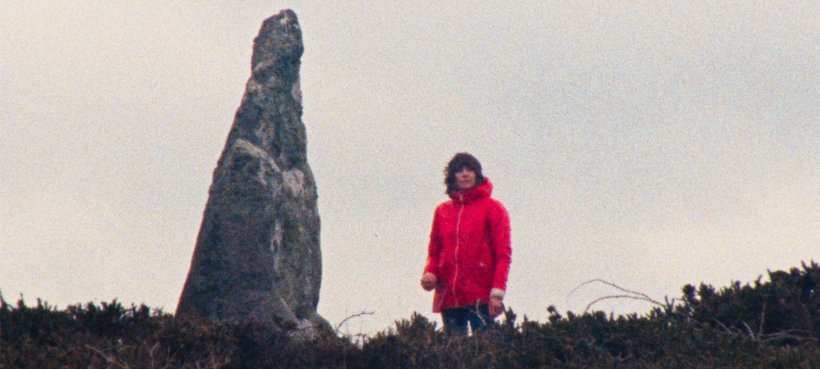
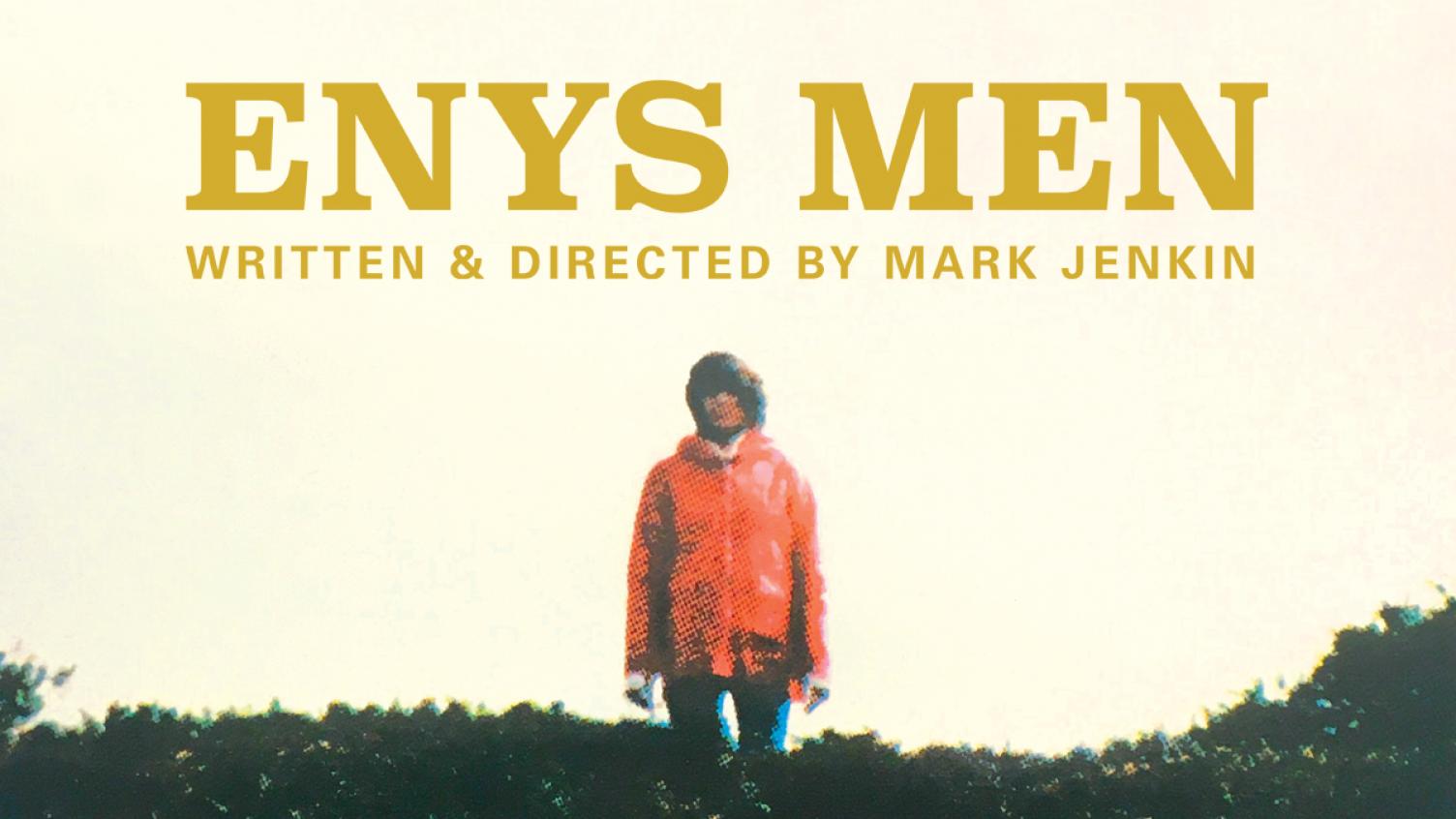
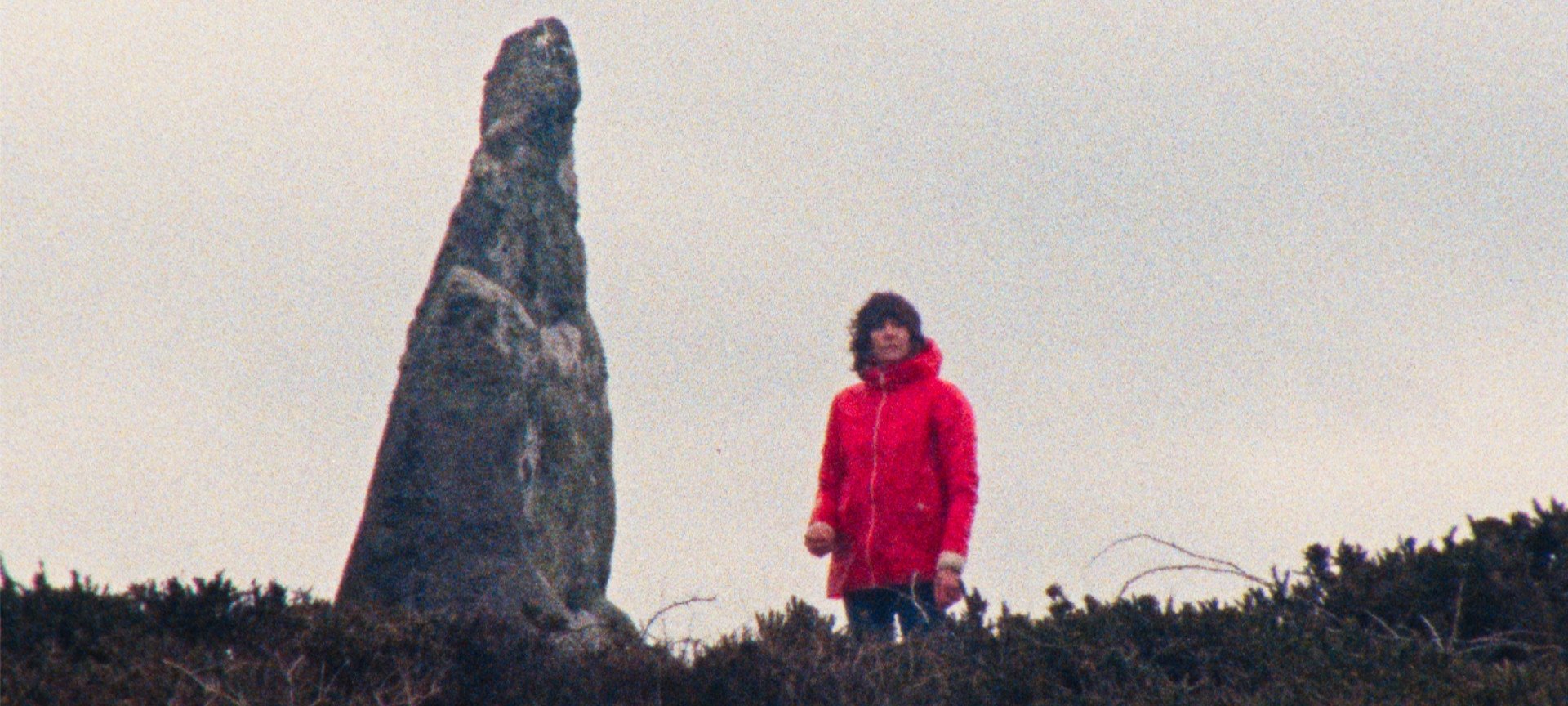
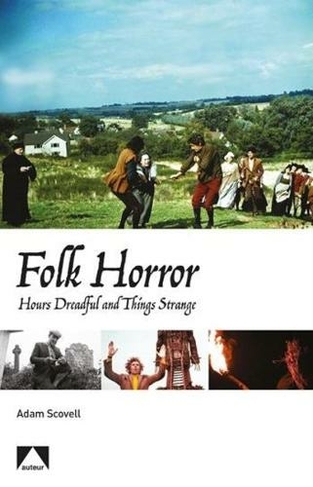
Off the back of Mark Jenkin’s new film Enys Men (2022) being premiered in official competition at the London Film Festival (LFF), the Southbank Centre hosted a panel discussion entitled What the Folk! on Saturday 15th of October. The event was advertised as an introduction to the Folk Horror subgenre; a discussion of “the dark innovative projects that test the boundaries of art and media, and [a] journey through the forests, fields and furrows to explore all the seamy, dreadful and macabre elements of the folk phenomenon” (bfi.org.uk). It was hosted by Michael Blyth (LFF programmer) and was in conversation with Mike Muncer (the creator and host of the Evolution of Horror podcast) and Adam Scovell (author of Folk Horror: Hours Dreadful and Things Strange (2017)). Anna Bogustskaya (host of The Final Girls podcast) was advertised to attend but couldn’t make it due to illness.
From the jumping-off question of ‘What’s your favourite folk horror property?’ the panel praised 70s British television like Children of the Stones (1976) and Sapphire and Steel (1979) – citing the creative and economic freedom of ITV and the BBC in this period as being an irreplicable space to introduce avant-garde film to a wide audience; “imagine something like Penda’s Fen being aired today, right after the Ten O’clock News”.
Scovell and Muncer also praised contemporary novels like Francine Toon’s Pine (2020), Andrew Michael Hurley’s The Loney (2014), and writers like Benjamin Myers, Elizabeth Gilbert, and Daisy Johnson.
These examples were then drawn together to create something towards a taxonomy of folk horror – what is it that connects these disparate works across time, form, and aesthetics? Is there then an example that neatly contains everything that the subgenre has to offer – a starting point for potential folk horror fans? Scovell repeatedly praised the quality of Czech folk horror but suggested James Mactaggart’s Robin Redbreast (1970), as a good starting point for British folk horror viewing.
Muncer moved a little further afield, speaking on the overlooked influence of Ingmar Bergman’s The Seventh Seal (1957)and The Virgin Spring (1960) on the themes and aesthetics of folk horror. He then discussed examples of films that he felt played with the typical folk horror formula in interesting ways. Films like Pumpkinhead (1988), Onibaba (1964), and Straw Dogs (1971)– those titles that have something folk horror about them but seem too difficult to define as ‘purely’ folk horror in the way that The Wicker Man (1973) or The Blood on Satan’s Claw (1971)are.
This diverse range of examples provided by both panellists drove the conversation down the difficult path of defining folk horror. After some back and forth, the conclusion ultimately ended up being that they couldn’t really define the subgenre in any concrete way. Scovell admitted that, upon rereading his seminal text Folk Horror: Hours Dreadful and Things Strange, he hadn’t managed to define the subgenre very well in that book either.
This was one major highpoint of the discussion, the panellists’ aversion to gatekeeping the discourse around folk horror. When Blyth asked if there were any films that either panellist would say definitively isn’t folk horror (despite the wider world suggesting that it is), they were reluctant to suggest anything – pointing to the ambiguity of the subgenre, a lack of concrete definition, and the importance of keeping the discussion open. To this quality, Muncer described how discussion and interaction with fans and their theories are some of the most productive parts of the Evolution of Horror podcast. In fact, the closest thing to negativity that either panellist said was that some modern folk horror chooses to reproduce the aesthetics of the 70s films but does so without any of their innovation or excitement; becoming, as Scovell said, ‘content’.
The panellists’ reluctance towards providing a solid definition of folk horror and the awareness that a firm definition will run the risk of diluting the ineffable folk horror-ness of the subgenre, is a breath of fresh air within folk horror discourse. It is a fantastic answer to the parade of ‘What is Folk Horror’ articles marching across the internet. Scovell and Muncer argued that there are a hundred different ways to define folk horror depending on form, country of origin, or time that the piece was created in. We must keep these definitions in discussion with one another, while at the same time knowing that they are all equally correct and incorrect.
As Scovell, Muncer, and Blyth agreed – now is an incredible time to be a folk horror fan. Films and television programmes that would have been expensive or impossible to track down only a few decades ago are being lovingly restored by institutions like the BFI and Arrow Films and released to a wide audience. Artists like Mark Jenkin are endeavouring to recapture the ‘English Eerie’ on screen while simultaneously creating something entirely new. And, perhaps most importantly, it has never been easier to find other fans and open these dialogues with them, attempting and failing to define or taxonomize a shared interest.
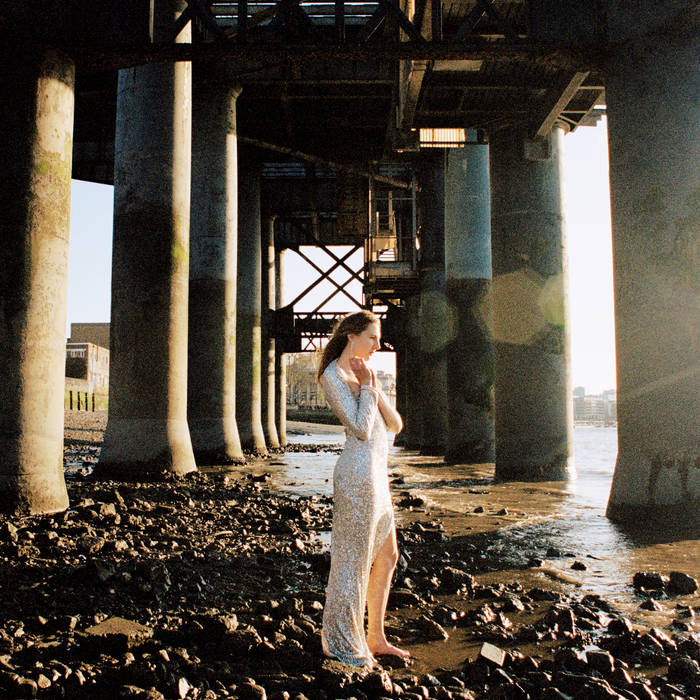
Lizzy Laurance’s debut album, Rocketman was released April 30th of this year. I would like to start by apologising to Lizzy for the delay in posting this review, however, a series of health issues and time constraints have held things up, which I hope are gradually coming to an end. Anyway, now that’s out of the way lets get down to Lizzy and her suitably impressive debut release.
Lizzy is a London based electronic musician who create “grainy pop-collages inspired by spatial locations; inner, outer and cyber”. In creating her music, she uses found sounds, ambient electronics, library samples, and electronic beats; stitching them together to create atmospheric aural soundscapes. Lizzy explores “the mythology of pop music and the icons who inhabit it”, through stories of “female identity, image-making and toxic masculinity”. Her inspirations are varied and thought-provoking, Lizzy cites David Lynch, Lana Del Ray and Godspeed You! Black Emperor as key influences on the sound of her album, and whilst this may sound like a disparate selection of artists, you can hear a little bit of each in the music, as well as a whole lot of herself. This is by no means an exercise in simply showing adulation for her heroes, she simply uses them to inspire and inform her own original sounding material.
The concept for the album came together while Laurance was artist in residence at Illutron, an arts and technology institute situated on an 800ft dredging boat in Copenhagen. She lived alone on the boat and made a number of field recordings that would form the basis of the songs featured on the album, not just from a musical perspective but from a storytelling perspective too. Lizzy says that she always felt there was “something rotten about the place” before she eventually uncovered that she was living at the site of the infamous Copenhagen Submarine murder of 2018. Founder of Copenhagen’s rocket building scene, Peter Madsen murdered a journalist (Kim Wall) who had come to interview him on board his home-made submarine. Laurance tries to reconcile the visionary ideals and technological innovations Madsen made with the destruction that was “left in its wake.”
After a short intro track (Promenade) that merely hints at what is to follow we are into our first song proper. “Baby Loves”, is a hauntingly atmospheric piece of Avant Garde audio that is eloquent and beautiful, yet possesses hints of a much colder, darker, industrial soundscape. “Come Down” almost sounds like drum and bass at times, yet Lizzy’s haunted vocals and the jazz trumpet samples give it a wholly warmer feel. “Gasoline Blue Jeans” reminds me a little of Portishead at their most experimental. There is also a starkness throughout the album that draws me back to Lynch’s solo albums Blue Bob and Crazy Clown Time. I also feel this particular track would have fitted nicely on the soundtrack to Lynch’s third series of Twin Peaks. “Too Hard to Die” is an off kilter, glitchy industrial nightmare that leaves the listener feeling drained, while “White Nights” is the sound of some sort of clanking mechanical hell, manifesting as music, with Lizzy’s ethereal vocals rising out of the clanking sounds of heavy machinery. “Shine” is a largely ambient track that allows Lizzy’s voice to take centre stage while strange otherworldly sounds move around it. I really like this track for the way in which it manages to create something that sounds like it belongs on the soundtrack to a 1970s Avant Garde science fiction movie. “Famous” starts off with what sounds like corrupted seabird samples before settling into slightly off kilter ethereal pop territory. The lyrics are written from the perspective of a man who stalked Lizzy during her time in Copenhagen, but it’s got a much deeper meaning about toxic masculinity and why women continue to fall for bad men. “Rocketman” is a collision of metallic sounds, screeching metal guitar punctuates ambient industrial drones amid the roar of mighty engines. This is a throbbing and pulsing masterpiece of wyrd electronica. The album closes with the incredibly sad, “Song for Kim Wall” a short, melancholy tour de force that reminds you of the horrific events surrounding her disappearance and subsequent discovery before coming to what feels like quite an abrupt end.
Overall, I found Rocketman to be a masterpiece of dark industrial electronica that sounds like nothing else out there. There are hints of other things from time to time, David Lynch’s albums really come to mind at certain points, but it retains a special quality all of its own. Lizzy’s ethereal vocals are somewhat reminiscent of the sadly missed Julee Cruise, but that may be a lazy observation on my part.
Thank You to everybody who voted in our Solstice charity donation poll. The poll is now closed and we are pleased to say that Yorkshire Wildlife Trust will receive £500 from our book sales profits towards their grassland appeal.
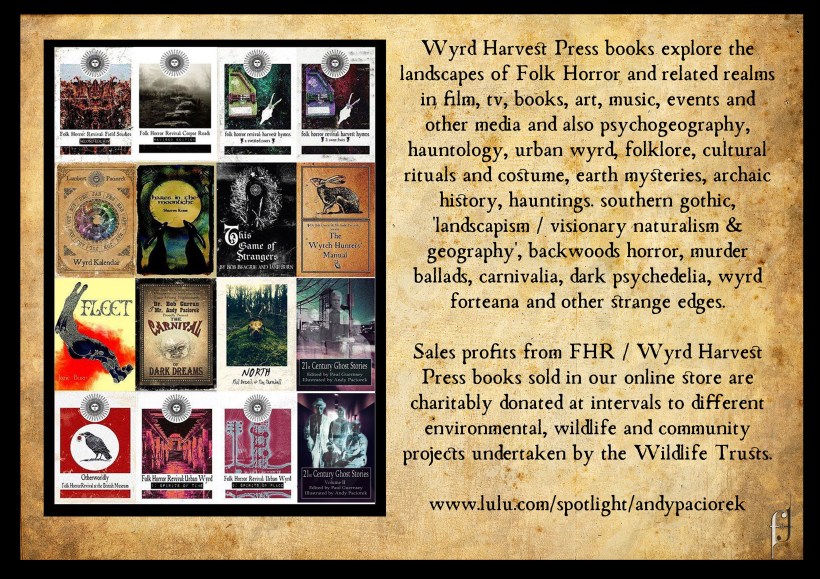
You can support more Wildlife Trusts projects by buying our folk horror and urban wyrd books at –


















 Happy Solstice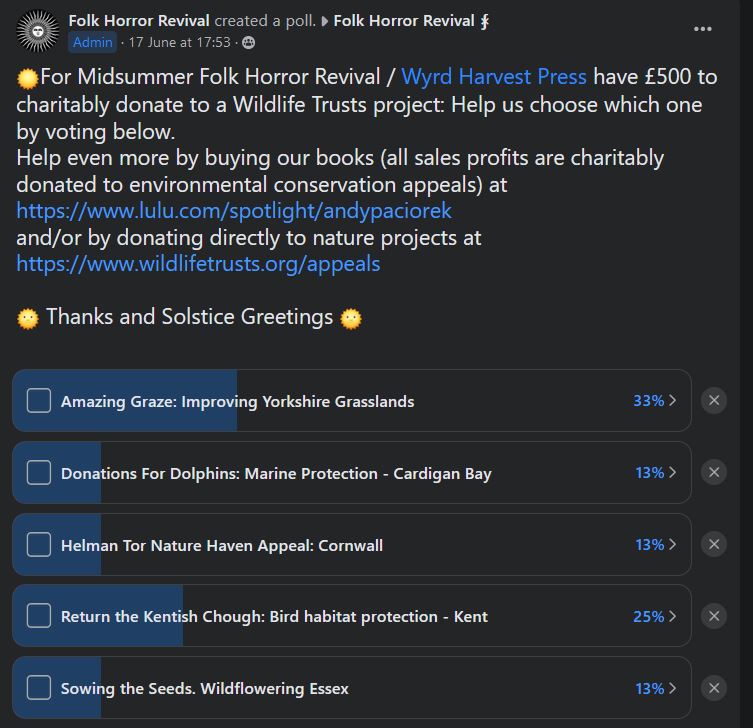
 Folk Horror Revival & Urban Wyrd Project ⨘