Folk Horror Revival: British Museum Otherworldly (Second Reveal)

BM banner2.jpg

The first Folk Horror Revival event will be taking place at the British Museum, London on  October 16th 2016, featuring talks, lectures, short films, poetry readings, museum tours and other wyrd and intriguing happenings.

Cult television programmes and films of the 1960s and 70s are inspiring a new generation of poets, writers, artists and musicians with their atmospheric themes of contemporary individuals interacting with a uniquely British world of ancient mythology and magic, often uncanny and unsettling.

This special event will feature lectures, film screenings, performances and gallery tours of featured objects in the Museum’s collection to explore themes of cultural rituals, earth mysteries, psychogeography and folklore. Come along and prepare to be scared!

Ticket details to be announced very shortly.
6fd99fc9a8a066e6987acb11c18e1b9e

We are proud to reveal other additions to the line up – see also

Folk Horror Revival: British Museum Otherworldly (First Reveal)

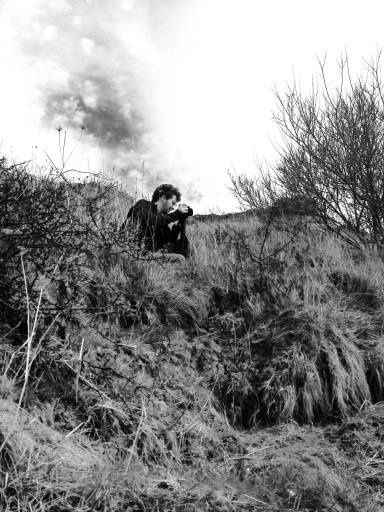
Eamon Byers completed his PhD at Queen’s University Belfast in 2014. His thesis explored the interaction between medievalism and folk music in English culture from the eighteenth century to the present day. Also in 2014, he co-organised ‘A Fiend in the Furrows: Perspectives on ‘Folk Horror’ in Literature, Film & Music’, the first conference dedicated to the academic study of folk horror.
He currently teaches English at Marymount International School London and continues to research and publish on the interactions between folk culture and medievalism in music, literature and politics.

The title of Eamon’s talk is: ‘The Ghost of Song: Folkmusic in the 21st Century’ where he will be looking at the influence of folk horror on contemporary folk, breaking down some hauntological examples and discussing sampling and the theoretical aspects of tradition and ancestry that goes along with modern folk.

Follow him on Twitter at – https://twitter.com/folkoff
 

13466034_10154332274095530_1944516659989939499_n

In addition to speakers and other live performers we will also be screening some short films by talnted film makers. The first of the filmmakers to be revealed is Adam Scovell.

Adam is a writer and filmmaker currently based between Liverpool and London He has produced film and art criticism for over twenty publications including The Times and The Guardian, runs the Celluloid Wicker Man website and has had work screened at FACT, The Everyman Playhouse, Hackney Picturehouse and Manchester Art Gallery.
Adam is the creator of the intriguing and impressive blog Celluloid Wicker Man

The title of Adam’s talk is Analogue Hauntings – The Ghost In The Grain
Why do ghosts manifest so effectively through analogue technology? Whether through tapes made of stone, through signal mechanisms on old Dickensian railway stations or through alchemically enhanced binoculars, ghosts have a tendency to achieve corporeality most powerfully in fictional media through pre-digital technologies. In this mixture of presentation and screenings, this phenomena will be examined within the contexts of hauntology, Nigel Kneale, M.R. James and filmic practice on super-8 celluloid.

Screenings :
• Salthouse Marshes (2015) (7:16) – Super-8 ghost stories inspired by Algernon Blackwood’s The Willows.

• No Diggin’ Here (2016) (3:07) – Super-8 essay film looking at Aldeburgh in the context of M.R. James’ A Warning To The Curious with a specially composed score by Laura Cannell. (Preview screening)


More speakers and ticket details to be revealed soon. Follow us on Facebook
2

Folk Horror Revival: British Museum Otherworldly (First Reveal)

00

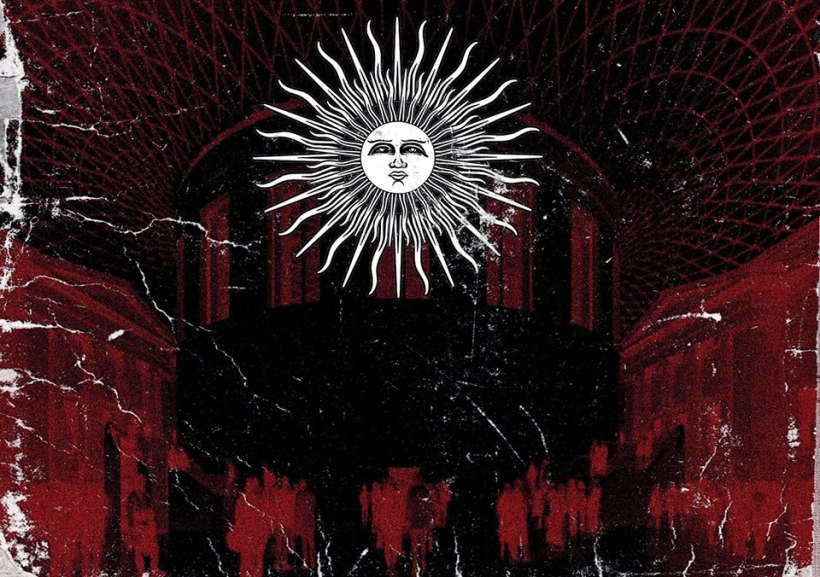
The first Folk Horror Revival event will be taking place at the British Museum, London on  October 16th 2016, featuring talks, lectures, short films, poetry readings, museum tours and other wyrd and intriguing happenings.

Cult television programmes and films of the 1960s and 70s are inspiring a new generation of poets, writers, artists and musicians with their atmospheric themes of contemporary individuals interacting with a uniquely British world of ancient mythology and magic, often uncanny and unsettling.

This special event will feature lectures, film screenings, performances and gallery tours of featured objects in the Museum’s collection to explore themes of cultural rituals, earth mysteries, psychogeography and folklore. Come along and prepare to be scared!

Ticket details to be announced very shortly.

We can proudly announce that one of the guest speakers will be Gary Lachman.

Gary is an American writer and musician. he is best known to readers of mysticism and the occult from the numerous articles and books he has published – Turn Off Your Mind: The Mystic Sixties and The Dark Side Of The Age of Aquarius (2002), The Dedalus Book of the Occult: A Dark Muse (2004), The Quest For Hermes Trismegistus From Ancient Egypt to the Modern World (2011), Revolutionaries of the Soul: Reflections on Magicians, Philosophers, and Occultists (2014) – He is additionally known to music fans as Gary Valentine one of the founders, and bassist of alternative rock/new wave band Blondie.

Gary will be presenting on Colin Wilson and the Angry Young Outsiders.

Before bursting on the London literary scene with the overnight success of his first book The Outsider in 1956, Colin Wilson spent some months sleeping rough on Hampstead Heath while writing his first no0gvel, Ritual in the Dark by day in the old Reading Room of the British Museum. Wilson was caught up in the media craze around the Angry Young Men, and he suffered from it, when the critics turned on the Angries and Wilson in particular. With a few exceptions, like his 1971 ‘comeback’ book The Occult, for most of his long career, Wilson remained an Outsider, ignored by the cultural establishment, while writing book after book. He died in 2013 at the age of 82. Gary’s talk will be based on his biography of Wilson, Beyond the Robot: The Life and Work of Colin Wilson, which, like a new edition of The Outsider to which he has contributed a new foreword, is published to commemorate the sixtieth anniversary of The Outsider’s first publication.

A tribute to Colin Wilson and An Interview with Gary Lachman features in the book        Folk Horror Revival: Field Studies


Also appearing will be Michael Somerset and his new ensemble The Consumptives. Michael is a former member of Clock DVA, has collaborated with Was (Not Was) and I Monster.

He is currently a freelance writer published by BMG and has written a series of short stories and poems accompanied by music and read by Reece Shearsmith, Bat For Lashes, Barry Adamson and numerous other impressive souls.

0m

FHR are proud to announce that The Consumptives (Michael Somerset’s new Gothic Orchestra) will be gracing us with their presence on the 16th. Performing macabre tales set to music (suitable for children and adults), Sylwia D Kittyfly,  Jules Lawrence,  Ozlem Simsek and Michael Somerset will guide us through a labyrinth of supernatural tales accompanied by singing and classic horror soundtrack instruments including theremin and saw.

A selection of Michael’s poetry features in the book Folk Horror Revival: Corpse Roads

More speakers and ticket details to be revealed soon. Follow us on Facebook
12705724_10156474613515484_1299533609324065036_n

Tales of the Damned

000

Edited by and featuring the work of cryptozoologist and folklore author Richard Freeman, Tales of the Damned : An Anthology of Fortean Horror is a chilling compendium of short stories by numerous luminary writers including Andy Roberts, Karl Shuker, Lars Thomas and numerous other talented souls – including and forgive us for blowing our own trumpets  😉
no less than three administrators of Folk Horror Revival the authors Andrew McGuigan (Cumbrian Cthulhu), Chris Lambert (Tales from the Black Meadow) and Andy Paciorek (Strange Lands: A Field Guide to the Celtic Otherworld)

“Here we have a book unique in the annals of horror literature. This is a book where the stories are penned, mostly, by fortean researchers. For those who are unfamiliar with the term, ‘fortean’ refers to the works of Charles Hoy Fort (August 6, 1874 – May 3, 1932). Fort was an American writer and researcher into strange phenomena. Fort collected newspaper reports of sightings of strange creatures, weird light phenomena, falls of fish and other creatures, and poltergeist outbreaks to name but a few. Fort realized that mainstream science was acting somewhat like a fundamentalist religion and that any anomalous data that did not fit into the current scientific paradigm was simply swept under the carpet. Fort called this ‘damned data’. He published his findings in four books: The Book of the Damned (1919), New Lands (1923), Lo! (1932) and Wild Talents (1932), all of which are still in print today. Fort has influenced modern research with magazines like Fortean Times, which has been recording weird happenings since 1973, and the Centre for Fortean Zoology, the world’s only full time mystery animal investigation organization. The publishing wing of the latter is responsible for this book.”

00000


Lucifer Sam

ExGw4vv
Photography Unidentified – Let us know and we will credit!

Lucifer Sam


Lucifer Sam, siam cat.
Always sitting by your side
Always by your side.
That cat’s something I can’t explain.
Ginger, ginger, Jennifer Gentle you’re a witch.
You’re the left side
He’s the right side.
Oh, no!
That cat’s something I can’t explain.
Lucifer go to sea.
Be a hip cat, be a ship’s cat.
Somewhere, anywhere.
That cat’s something I can’t explain.
At night prowling sifting sand.
Hiding around on the ground.
He’ll be found when you’re around.
That cat’s something I can’t explain.

Gawain and the Green Knight: Clive Hicks-Jenkins and the Penfold Press

The finished print
The finished print

The Green Knight’s Head Lives. Screenprint. Edition of 75

Gawain and the Green Knight: Clive Hicks-Jenkins and the Penfold Press

The Martin Tinney Gallery, Cardiff

Thursday 8th Sept – Saturday 1st Oct, 2016

In collaboration with Dan Bugg of Penfold Press, Clive Hicks-Jenkins is devising a series of fourteen prints based on the medieval verse drama, Sir Gawain and the Green Knight – a classic vividly translated for the 21st century by Simon Armitage. The exhibition will present the first seven prints, marking the half-way stage in this major project, together with paintings and drawings on the theme.

Art commentator James Russell writes of the series:

“The story is the kind you might find in The Mabinogion. Sir Gawain is more human than your average legendary hero. Having taken up the challenge offered at the Camelot Christmas feast by the terrifying Green Knight, he embarks on a quest to find this ogre, only to be tested – and found wanting – in unexpected ways. Sir Gawain is both a glittering knight and a fallible young man, and it is this flawed human character that intrigues Clive. Each print is inspired by the text and rooted stylistically in its world, but beyond that Clive and Dan have allowed their imagination free rein.”
unnamed
Crown of Leaves. Gouache and pencil on gessoed board.

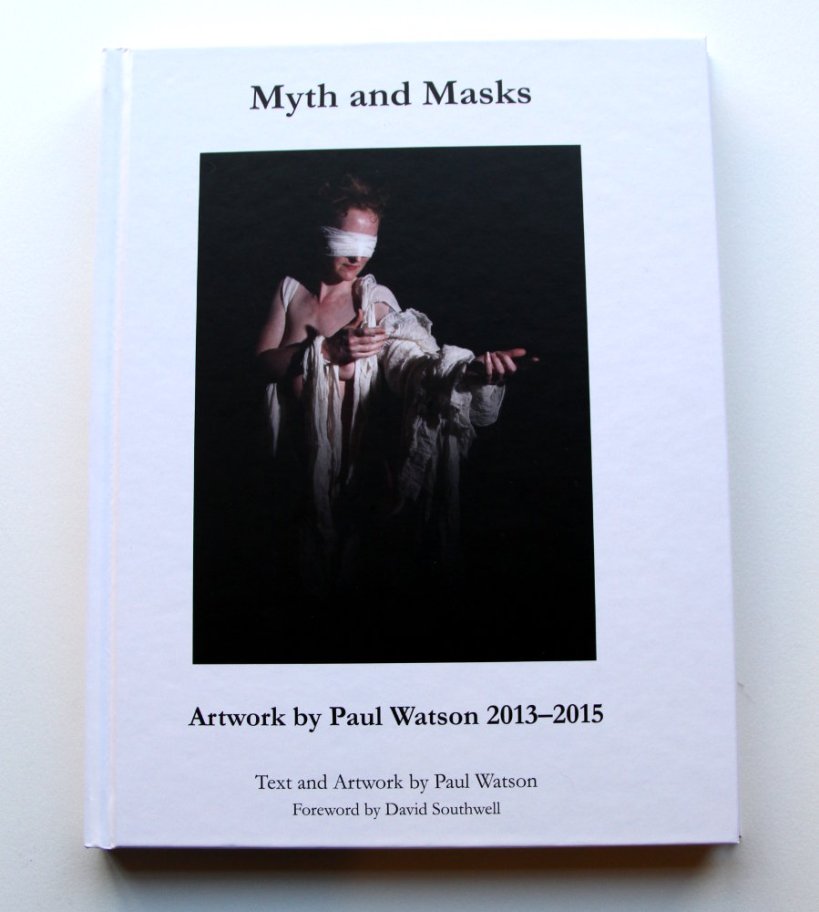
Book Review ~ Myth and Masks: Artwork by Paul Watson 2013 -2015

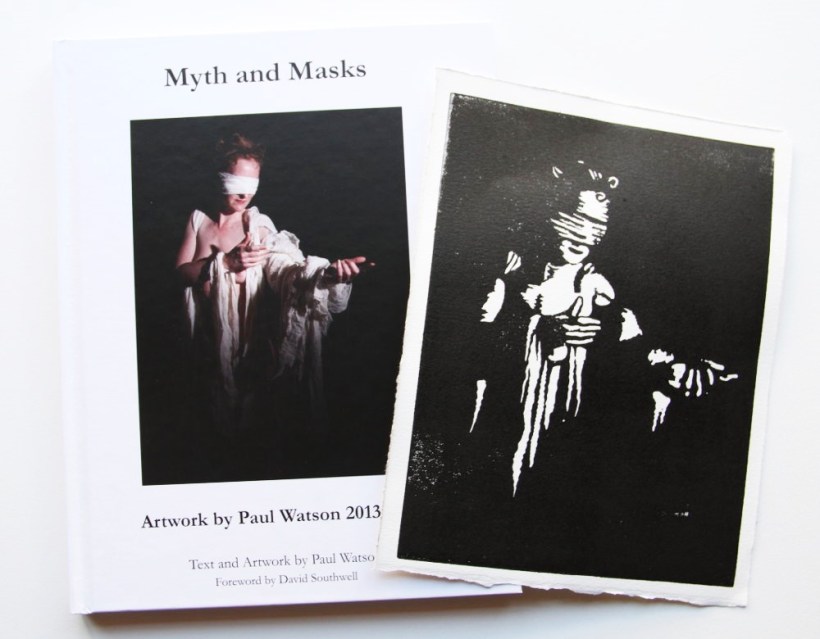
Myth and Masks: Artwork by Paul Watson 2013 -2015book06a

Myth and Masks: Artwork by Paul Watson 2013 -2015

book01

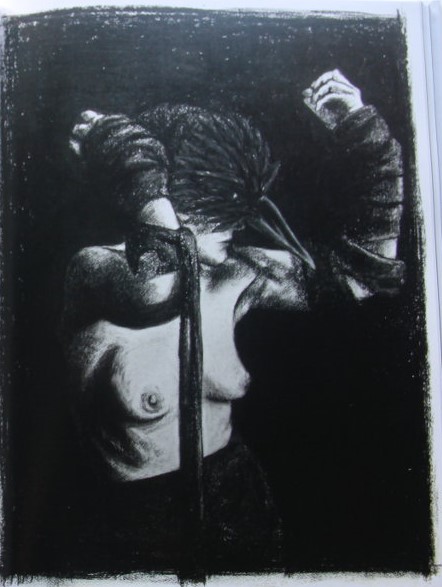
Myth and Masks by Paul Watson is an evocative work; described as ‘Shamanic’ in the foreword by David Southwell – a word he does not use lightly but it is a word that accurately describes this book. Myth and Masks is a transformative journey, a gateway into an Otherworld.
Within its pages are mainly photographs but also included are drawings and prints as well as writings by the artist about the inspiration, history and creative process of his work and subject matter. Intriguingly Watson questions whether the masks he creates, which feature so prominently in his work, are part of the art. He states seeing them more perhaps as preperation or costumes for his photography. For me looking inward at his work, the masks are both elements and subject matter of a larger work but I consider them also beautifully strange artworks in themselves.

In creating the masks, Watson was inspired to investigate the role, history and nature of masks more deeply. Gazing upon his masks, his photos and graphics, they tantalise the viewers’ eyes and impregnate their mind with questions – what do these masks represent? What do they reveal and what do they conceal?
book03
They are not mere costume – they are ritual, mythical, mystical. There is a theatrical narrative suggested in the still images. Stories dying to be told.
Dying … an apt word, for within these book pages we find the Badb Catha, the Death Mask and the Crow. The imagery of the crow goddess as rendered by Watson is reminiscent of the Plague Doctor masks of medieval times; but it is not confined to an isolated historical pestilence but is an eternal archetype. The Crow – devourer of carrion, a memento mori ~ a reflection of death in life.
book04

By placing the masks upon models, Watson puts life into death; the empty sockets of the mask are given a glint of life in some images but in others they eyes remain hidden, hinting at greater mysteries.

book10

Life and death are intertwined as revealed in the Ivy Mask. Ivy is an evergreen plant, a reminder that life continues through the greatest adversities but it also reminds us of its presence in tumbledown graveyards or clinging to the crumbling ruins of abandoned weather-beaten buildings. It speaks of life beyond death.
There is perhaps an element of sex that buds beneath the surface in some images also. The nudity is not overtly erotic in the imagery. It is not the bodies perhaps here that draws the carnal aspect of the mind in but the masks. There can be something enthralling, oddly sinister but alluring, something fetishistic too about masks. Sex and Death frequently go hand in hand. In the realm of folk horror, death has been portrayed several times as an act of fertility and therefore rebirth or new or transformed life.
book08

We look at the masks and they gaze back at us with whispers of life, death, rebirth and of change. The element of change is of course integral to masks; they change the appearance of the wearer and as such change our perceptions of them. Another chapter in Watson’s book deals with that archetypal mythic character – the Shapeshifter.
book05

Within his writings that accompany the imagery, Watson seamlessly draws in considerations of sources such as ancient myth, fairy tales, witchcraft, folk customs, hauntology and the ‘English Eerie’. Literary luminaries such as Robert Macfarlane, Marina Warner, Warren Ellis, Martin Shaw, Robert Holdstock and others take their place.

Visually and textually, Myth and Masks is an intriguing, evocative work and one that I recommend a place on the bookshelves of Folk Horror Revivalists.

book12


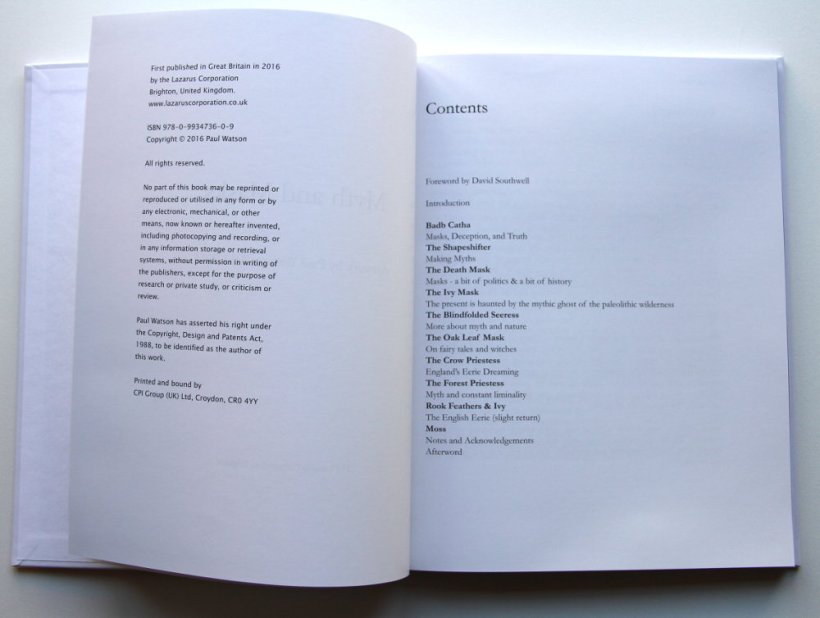
  • ISBN : 978-0-9934736-0-9
  • Pages: 128
  • Format: Hardback, high-quality litho-printed, sewn binding
  • Price: £24.99 exc. shipping – ONLY AVAILABLE FROM http://www.lazaruscorporation.co.uk/shop/38
  • Size: 252mm × 196mm (approx. 9.9ʺ × 7.7ʺ)
  • 28 colour plates, 3 b&w plates
  • Foreword by David Southwell (of Hookland Guide)
  • Each copy of this initial print-run of Myth and Masks comes with a free, hand-printed linoprint by Paul Watson of the Blindfolded Seeress, exclusive to this book.

    Myth and Masks: Artwork by Paul Watson 2013–2015 is a volume of Paul Watson’s artwork from 2013 to 2015, focusing mainly on photography but also including drawing and printmaking. The stark and dramatic images are complemented by an edited selection of his writings on myths, masks, and the “English Eerie”, previously published on his Artist’s Notebook blog during the course of creating these pieces of artwork.

    These selected pieces of Paul Watson’s artwork show his development of an intertwined host of primal characters, drawn from his imagination, but strongly influenced by the English landscape and the myths and legends that are embedded deeply within that landscape.

    The accompanying written pieces show the artist’s exploration of, and research into, the wider subject matter of what has become known as “the English Eerie” that runs in parallel with the creative process.

    What others have said:

    “The book takes the reader on a journey through the last two years of his work, touching on subjects as eclectic as the English eerie, folk-horror and psychogeography, with every stop in between. In addition to the beautiful colour plates of Paul’s work, the book includes several essays focusing on the inspiration behind his work along with ideas of myth and folklore, creating together an engrossing volume that will lead you to another world.”

    – Willow Winsham, FolkloreThursday website, 2016.

    “Highly recommended: a treat for the eyes and the imagination!”

    – Jane Talbot, author of The Faerie Thorn & Other Stories


The Hallowed Halls of Learning: Folk Horror at Cambridge University


13495198_10157081038425484_7753546394648192294_n

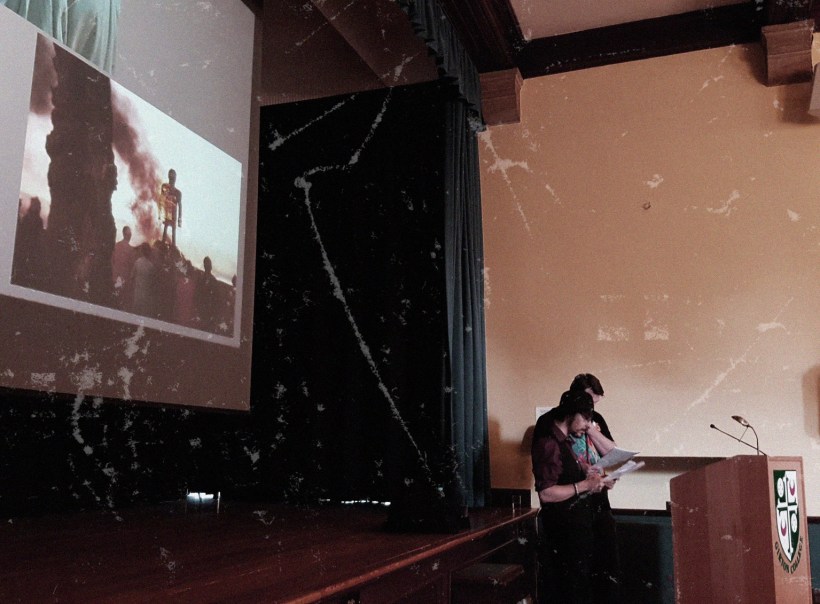
On the 7th July 2016, by happenchance the anniversary of Cambridge’s son Syd Barrett, Folk Horror Revivalists Adam Scovell, Andy Sharp, Gary Parsons, Darren Charles and Andy Paciorek were all invited to speak alongside several other interesting chroniclers of the wyrd at the Alchemical Landscapes II symposium at Girton College,  University of Cambridge – the same seat of learning at which  Deliah Derbyshire studied.

13620032_10157102294425484_1208021429080038546_n

The talks given that day were ~

Jo Melvin (Chelsea College of Arts)

Double Exposure: ’pataphysics and the Rural in Barry Flanagan’s Sculptural Practice

Lewis Wynn (University of Cambridge)

The Visual Occulture of Left Fields: Reclaiming the Radical History of Fields in Contemporary English Film

Adam Scovell (Goldsmiths / Celluloid Wicker Man)

Rurality in the Films of David Gladwell

Liberty Rowley (Four Feet Films)

Microgeography and an Exploration of the Magic that can be Found at the Bottom of the Garden

Harry Baker, (London Film School)

Folk Horror and the Mythic Cycle

Gary Parsons (University of East London)

British Witchcraft Documentaries of the 1970s and their Relation to Landscape and Culture

Christopher Josiffe (Independent Researcher)

The Dalby Spook in his Landscape: Gef the Talking Mongoose

(Un) remembered

Andy Paciorek (Wyrd Harvest Press)

Darren Charles (Unearthing Forgotten Horrors)

The Folk Horror Revival

Andy Sharp (English Heretic)
Video Anxieties

Marc Atkins and Rod Mengham (Sounding Pole Films)

The Fields of England

Folk Horror Revival would like to thank Yvonne Salmon and James Riley for their interest and enthusiasm in our various work and the kind hospitality they showed.
We thoroughly enjoyed the day and all the talks and look forward to more symposiums to come.

Keep watching the horizon …

13738090_10157126165470484_8216095507930361395_o

Photos: Andy Paciorek. Except third image by Yvonne Salmon